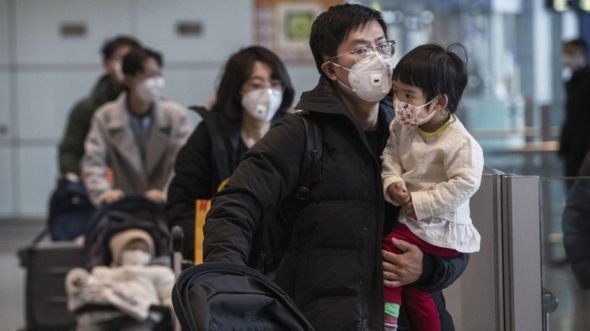
Officials in protective suits check on an elderly man wearing a facemask who collapsed and died on a street near a hospital in Wuhan on Thursday [Hector Retamal/AFP]
At least nine million people in Wuhan were put under quarantine on January 23rd after the authorities decided to seal off the entire city. The order was later expanded to the entire Hubei province, affecting at least 56 million people. Now a week has passed. What does Wuhan look like under quarantine? How has the city's population been handling it?
I have been in touch with a few local residents since the beginning of this outbreak, and here is one of the stories of all those people living in the epicentre of this epidemic. The storyteller is a teacher. He has requested to remain anonymous.
Story as told to Shawn Yuan on Thursday, January 30
My city has been ill for over a month now, and it has been sealed off for a week. Millions of us have been put under quarantine for seven days now, and all of this still feels surreal.
Advertisement
These days, I have been doing the same things over and over again: eat, sleep, eat, and the cycle continues.
All entertainment shows have also been cancelled by the government, and that leaves only the news about the virus playing on a loop on TV. Every aspect of my life is constantly reminding me of a single fact - the virus outbreak is still very real.
Coronavirus: Walking around Ground Zero
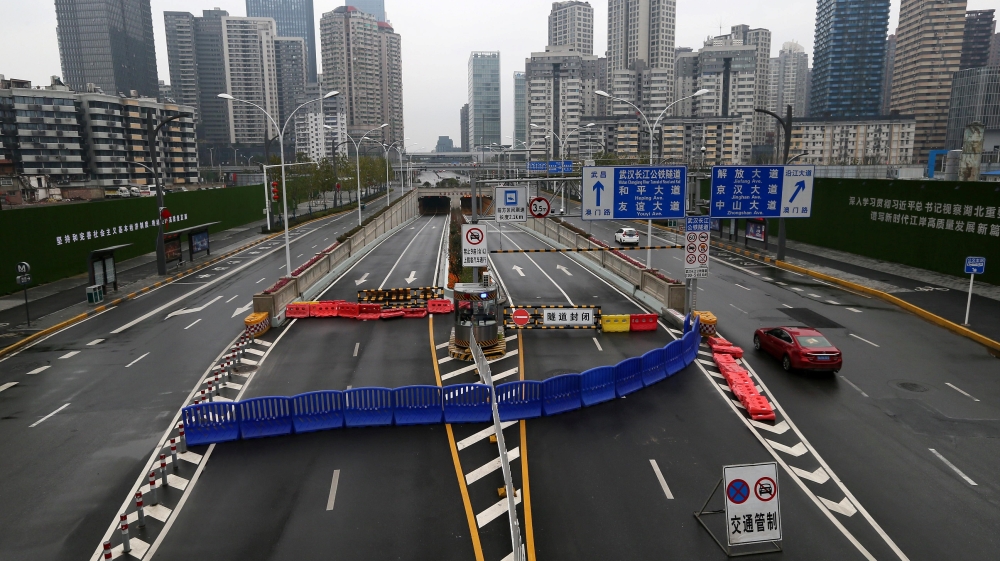
Last night, I looked outside of the window of my apartment - absolutely empty streets, eerily quiet neighbourhood, some flickering streetlights, and one giant LED screen playing the public service announcement, advising people to stay indoors. All of this almost feels like a scene out of a zombie movie.
I try to distract myself and keep my mind fresh: I read books, I make podcasts, I watch films, trying my best to make sure this whole mess doesn't get me. But sometimes, in this repetitive daily routine, we start to forget what we used to and aspire to be. This epidemic has taken a toll on all of us.
The memory of waking up to a city completely sealed off remains fresh. "Dumbstruck" is probably the best word to describe how I felt. This had never happened - not in my life, not in my parents'.
Fear and anxiety
Having seen what the SARS outbreak did, this still is the first time we all became nervous. That's also when I realised the situation had gone way beyond what the official facade looked like. In the first days following the lockdown, I was overwhelmed, but more afraid, I guess.
The morning of the lockdown, many private cars were trying to get out of Wuhan. But all my family is in Wuhan and it made no sense for me to leave. Instead, I rushed out to get more masks, but at that time, the supply for masks had already dwindled significantly - many pharmacies had run out of them. That's when I first started to freak out - what if I couldn't get them? What if I or someone in my family got infected?
Luckily, I managed to get some after a few tries in different pharmacies. And that was the last day I was out of my house for more than one hour during a day. Almost hourly anxiety took over me during these past seven days.
What's the economic impact of China's coronavirus outbreak?
I went out yesterday to go to a supermarket. Food was running out at home, but also because I really needed to get out. I was going crazy - it's ironic that when I was working, I always wanted to stay at home and rest, but now that I am spending almost my entire time at home, it feels like torture.
Luckily, food is still readily available, and the price wasn't ridiculous, either. There were a lot more people than I expected at the supermarkets. Waiting outside of the market to get temperature checked and using hand sanitiser before going in have become the requirement for all the markets.
'Eerily empty neighbourhood'
Yesterday I saw the video of people singing national anthem and shouting from their homes to each other to keep the morale high.
"Add oil! You can do this!" It really made me smile and want to cry at the same time. It's a tough time but I have always thought Wuhan is a place full of potential and energy.
Today is the fifth day of the Chinese New Year, so according to traditions, we are supposed to go to temples and pay tribute to the God of Wealth today. Most of the businesses should be open today, too. But I took a walk around my neighbourhood this morning - just like the past seven days, it's empty - eerily empty. But at least the weather is getting better.
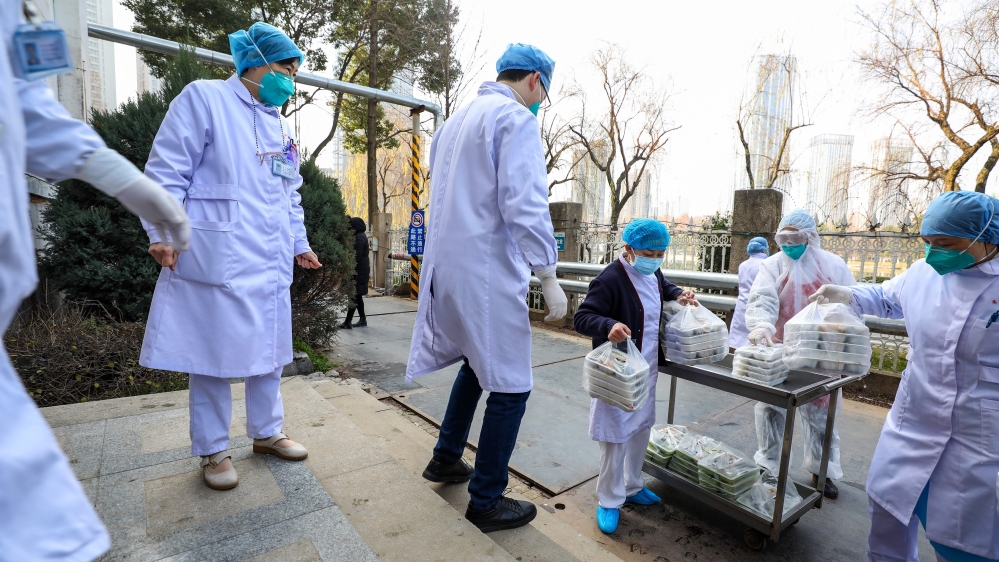
Medical staff at a hospital in the city of Wuhan carry meals for patients and other hospital workers on Friday [Yuan Zhang/EPA]
I took a photo of my dad today standing on the pavement of a park. His quarantine life, like so many others, has been eating and sleeping and eating again. No friends to talk to, no relatives to visit, and no TV programmes that he loved to watch nowadays. The only little "entertainment" for him is to take a look at this empty road and do nothing.
Whenever I get bored and start thinking, which happens quite often these days, the feeling of anger started to boil inside of me - why did this local government keep hiding the truth and even arresting the eight people who initially shared the information?
I had already known the situation wasn't as rosy as pictured by the government at that time, but I never for a second thought the scale of the crisis had reached a level to warrant a city-wide lockdown.
'An incredibly difficult time'
The Lunar New Year couldn't have come at a worse time, either. My family had already planned some trips during the week, and we're supposed to go to my grandmother's. Of course, all of this has been cancelled, but the thought of what this could have been is making what this ended up being even more unbearable.
On New Year's Eve, my dad went to sleep early because the Lunar New Year has been ruined - no visiting family, no drinking with them, no entertainment, but more important, a constant fear looming the entire family and the city.
Al Jazeera attempts to visit China's coronavirus epicentre
I saw him turning off the light before 10 pm - this is the first time I saw him turning off lights on New Year's Eve. He always told me that we should leave one light on for New Year's Eve. I guess a new year like this has made him forget about all the rituals.
The gala hosted by China's state television angered me even more. The entire country was struggling to cope with the virus outbreak and thousands of people were getting infected in Wuhan alone. But there was almost no mention of Wuhan during the gala except for a poetry recitation.
"Wang Qiang defeated Serena Williams during the Australia Open, so that means we can defeat anything, " one host said.
Wuhan Yangtze River Tunnel is blocked with a barrier following an outbreak of the new coronavirus and the city’s lockdown, in Wuhan on Saturday, January 25 [File: China Daily via Reuters]
That only made me angrier - their response to how we are going to defeat the outbreak is this completely unrelated analogy? I guess after this crisis, people's trust towards the "Big Brother" will be more fragile.
It's an incredibly difficult time for this city, but I'm so very proud of my city: everyone is trying their best to make sure the city continues to operate as normal - something we desperately need right now.
But still, Wuhan will be forever changed, and now we are just anxiously waiting for the epidemic to end so we can start getting used to whatever the shape new life will take.
Years or even decades from now, how are we supposed to tell this story to our next generation? Can we really realise what it means to be a "citizen" of the society?
The only thing I hope now is that our generation doesn't fail the next. At least I know I will keep this memory fresh.
The Day I Realized I Would Never Find Weapons of Mass Destruction in Iraq
J.D. Maddox in Baghdad in 2003.Credit...via J.D. Maddox
By J.D. Maddox Jan. 29, 2020
I rolled west from Baghdad in a convoy of soft-side Humvees. It was a morning in late June 2003, and I had traded a bottle of whiskey for the use of an American military police detachment as protection for a daylong mission to Abu Ghraib prison. As an intelligence officer for the Department of Energy assigned to the Iraq Survey Group — the American-led team searching for weapons of mass destruction in Iraq — I was scheduled to interview an Iraqi prisoner who had been captured weeks before, on suspicion of transporting stolen nuclear material. I couldn’t know it that morning, but the interview would entirely change my perspective on America’s involvement in Iraq, and set me on a decades-long course of struggling with the false narratives used to persuade us to march into that conflict and other ones.
I gripped my pistol tightly as we moved along in the doorless vehicles, occasionally pointing it in the direction of anything that came near the convoy. I had borrowed the weapon — no more than a party favor in that bacchanal of R.P.G.s and gold-plated Kalashnikovs — from a fellow intelligence officer, who asked me to return it with all of its bullets.
As we approached the outskirts of the prison, the road narrowed, and we drove through a frenetic marketplace. During Saddam Hussein’s long rule, families of Abu Ghraib prisoners had made the area their home, and many stayed there after Hussein had released his prisoners in the lead-up to the war. As our oversize vehicles stalled traffic and disrupted local business, men cursed us and spat on the ground. A butcher stared me in the eyes and hacked deeply into a hanging goat carcass. Children came within an arm’s length, demanding handouts and laughing mockingly.
Finding the entryway to the prison was a relief — until an American service member explained that a convoy had been struck just outside the facility by a roadside bomb the day before, severing one soldier’s spine. A young guard manning an M60 machine gun waved us in while keeping his weapon aimed in our direction. I hardly felt safer than I did outside — the place was under a constant threat of attack.
There was a sense of anxiety in every facility I visited in Iraq, but the American soldiers at Abu Ghraib had an unusual look of dread and contempt in their eyes. The place felt completely detached from the headquarters I’d been dealing with in Baghdad, and I could tell their isolation was affecting them. At the time I knew nothing about the horrific human-rights abuses that took place behind those prison walls and would be revealed to the world 10 months later, but I could sense that everyone I encountered was on edge.
This was my first deployment to a “shooting war.” I had previously served in the Army, but by the time of the Sept. 11, 2001, attacks, I had left the military to go into nuclear-counterterrorism operations for the Department of Energy. I had privately questioned the motive for going into Iraq, suspicious of the way the administration had shifted its justification over time, but I still chose to go. Secretary of State Colin Powell’s now-notorious United Nations speech on Feb. 5, 2003 — when he argued that Saddam Hussein’s regime had developed weapons of mass destruction and posed an imminent threat — assuaged any reservations I might have had. “Every statement I make today is backed up by sources, solid sources,” he said. “These are not assertions. What we’re giving you are facts and conclusions based on solid intelligence.” There was no more trustworthy spokesman, I thought at the time.
A few months later, I deployed to Qatar and then to Iraq. The Iraq Survey Group would scour the countryside, excavating purported W.M.D. sites and interrogating dumbfounded Iraqi military officers. There was a core group of true believers who led the effort and controlled every meeting. The rest of us followed their lead, unsure what to expect. After just a short time with the group, I had little belief that we would find any nuclear weapons. During late-night rants, my fellow intelligence officers debunked the stories that the Iraqi government had access to African uranium, had developed special centrifuges or was driving biological-warfare trailers around the country. But nobody said anything during work hours. That argument had already been made and lost in Washington.
Instead, I eventually focused my work on counterterrorism questions. I felt that I could best carry out my duty and contribute something useful by following up on more realistic threats. A terrorist named Abu Musab Al-Zarqawi, then presumed to be affiliated with Al Qaeda, was reportedly active in the region and had supposedly shown interest in nuclear weapons. I wanted to know everything I could about his operations, and I thought the man arrested for transporting illicit nuclear material could potentially provide a link to al-Zarqawi’s network.
At Abu Ghraib, I interviewed my subject in an outdoor holding pen under a tent in a large courtyard. A double line of concertina wire separated me from what seemed like hundreds of prisoners. A few of them threw rocks that landed at my feet as I made my way to the tent. The intense heat of the sun soaked right through the canvas roof, my desert camouflage uniform and my body armor, and it felt like it was boiling my blood. A guard brought my subject. I offered him a cold bottle of water. He cried.
My line of questioning was simple: Tell me about the nuclear material you were transporting. His answers also were simple: I wasn’t transporting nuclear material; I didn’t do it. For a while I assumed his tears were a ploy. I applied greater pressure: Stop lying to me; tell me where you got it; we know everything. His crying intensified.
In the famous deck of cards that depicted Hussein’s henchmen, my subject wouldn’t even rank as a two of clubs. The truth is that this old man — caught with car parts patched together to look like a small radioactive-material container — was no more than a con artist. He probably just wanted to make some cash by selling the fake material to a sucker. Almost certainly he was crying in front of me out of genuine despair.
But my questions were unrelenting. I was determined to eke out any details that could offer clues about Al-Zarqawi. A colleague in the tent gave me a confused look, and later commented that my face was indecipherable during the interrogation. My subject protested his innocence and even tried to take my hands in his, pleading for his family’s security. In the end, I turned to the interpreter and whispered, “He doesn’t belong here.” He promised to tell the commanding officer. My comment was as much about the absurdity of the whole situation as it was about the prisoner’s innocence. I had risked the lives of a dozen soldiers to be there — only to find a small-scale confirmation of the ludicrous false premises under which we had invaded and occupied Iraq. The Iraqi weapons of mass destruction were no more than a bit of improvised sham, a con man’s counterfeit goods. In the process I had stumbled into one of the darkest places in wartime Iraq and into the most revealing truth of the conflict: Nobody belonged there.
When I returned to Washington, some weeks later, it was clear to me that people who hadn’t served in Iraq knew little of what was really going on. A friend asked me how the search for weapons of mass destruction was going. I responded wryly, “Well, I’m back, aren’t I?” I avoided explaining the enormity of it. I relied on funny stories of swimming in Uday’s pool or peeing in Hussein’s golden toilets to escape the conversation.
When the Iraq Survey Group’s interim progress report was released, in October 2003, the truth became unavoidable. It offered a thinly veiled admission of failure to find any convincing evidence of recent W.M.D. activity. I had often justified my participation as my duty, but that claim began to sound more and more like an excuse for blind adventurism. It became impossible to square my American sense of free will — our image of ourselves as empowered citizens participating in informed choices — with the reality of the way that we were hoodwinked into going along with the invasion of Iraq. I had been taught throughout my childhood and my military training that America conducts wars based on just cause, but the reality emerging from Iraq was that we had been compelled by deception.
A few months later, in April 2004, CBS News broke the story of torture at Abu Ghraib prison, revealing that American guards, maybe even some of the people whom I had seen at the prison, had beaten and abused prisoners. I was horrified. There had been little to stop me from harming my interviewee there, but doing so would have required moral bankruptcy. The actions of the guards at Abu Ghraib invalidated the American idea of liberation that I believed in. To me, the cruelty and abuse of power represented a perversion of American values.
In that moment, it became clear to me that the administration’s public narrative of the war was exactly what drove us to that dark place. The time-tested tropes of war for freedom and war of liberation had been used masterfully, and had been enabled by false claims of the Hussein regime’s involvement with Al Qaeda. We were fighting in a fantasy and our leaders knew it, even while we were there, yet we persisted.
I was repulsed by the idea that we could have been so easily manipulated. For a time I considered ending my government career. But I also felt that walking away would make me powerless to do anything to push back against the administration’s dishonesty. Instead, I refocused my intelligence career on understanding the underlying causes of war. Later, as an adjunct professor, I spent time developing an assessment of historical false justifications, and taught on the subject. To this day, I’m chastened by the memory of my experience at Abu Ghraib, and I’m haunted by the unknown fate of my interviewee. Like many veterans, I carry a deep desire to prevent another conflict like the invasion of Iraq, fueled by my understanding of the war’s absurdities. But I’m struck by the power of our national momentum toward going to war — especially unnecessary ones — and alarmed that this momentum seems nearly impossible to halt.
How Nairobi CBD is controlled by the Kikuyu, Luo, Kamba communities & the arrival of the new kid in the block the Somali who have taken Nairobi by storm?
By Dan Okwiri
Penning 🖊 my Journal Memoirs, must forewarn you this one is a long one, I want to write a little about the city that made me, I was actually born in Kiambu past Riruta around Kikuyu Town in the mid 60s’. Dad was a policeman and he did move across the country. He knew the city like the back of his hand and everyone who made it pulse. If you are in Nairobi Policeman you have to while in Nairobi’s downtown, that’s where everything beats. I schooled right in the city, Catholic Parochial Primary School deep in the CBD, and walked the streets during lunchtime and evenings.
Cause I was born Kikuyu town the Kiambu area particularly the Kingeero, Kangemi, Ruaka, Wangige, Uthiru, Kabete, Kikuyu area has always held lots of fascination for me. It is perhaps the reason I bought land in the Kabete area, which I still hold dear, it reminds of my roots.
It is said that the most dangerous women in Kenya come from this belt. Trust me they are no joke. If you live with one you must understand one rule, “A Kiambu woman must go out and look for money, dont stop her as that is ingrained in her DNA, the end justifies the means. Eventually she will religiously come back, ask her no questions, expect lies as it’s futile to persist”
Almost Kiambu women have property that their husbands are not aware, often they put it in the names of there daughters. Indeed there a Luo colleague, a Mr. Onyango I worked with in Kenya Airways who married a Kabete woman, they were literary living from hand to mouth. Unfortunately she passed on after 25 years of marriage, a man who identified himself as Kamau a rental collector knocked on his door & said gave him Kes 350k as monthly rental collection since his Mama Wambui had passed away.. He fainted in joy and couldn’t believe his luck, the family didn’t have any property he was aware of? He hurried took the cash and told me “Dan Okwiri Wuod Baba you have been a great boss but am quitting my job. Have struck a jackpot and I no longer need to work” I immediately consented to his resignation, a hard worker though frustrated over the years due to stagnancy. Today he has a cash flow of 350k every month. He has since moved to Kisumu and has two young wives, beat that my friend. Thank Nyar Kiambu!
The other thing I have never understood is their passion for Luo men. They say they give them the good life. The Kiambu men refer to Luo men as “kihii” but interestingly the Kiambu ladies don’t mind the “kihii”, a puzzle that I never quite understood? Every Kiambu girl desires to get married to a man from the North Rift, this they say is a sure ticket to land and wealth.
For reasons beyond my understanding I intermingle with Kiambu women very malleably, once you understand their vibe you get to understand & mitigate the risk. Prepare for anything with a Kabete (Kiambu) woman. Its is through a Kiambu that I got a full scholarship to do my Masters Degree, I still appreciate the Kiambu contribution and will never forget. A deal is a deal amongst Kiambu folk and one must keep his or her side of the bargain. If you dont you must know that you will end up in the dead.
The Kiambu people practice “Omerta” which is a code of honor that places importance on silence in the face of questioning by authorities or outsiders; non-cooperation with authorities, the government, or outsiders. Willfully ignoring it will land you in a morgue.
There parts of Nairobi you will not find landlords but only land ladies. All landlords are all dead. If you think am lying trying and search for house in Kawangware, Kangemi, Kikuyu, Kingeero, Wangige etc and tell me who you find? There’s nothing as short-lived as being a Kiambu man. Take this from me, a son of soil by birth though not by blood, some Kabete woman tell that am one by thinking, nowhere in this country does land have value the way it does in this belt.
If a Kiambu man inherits one acre of land around Ruaka he is already has Kes 100 million to his name, and even if he is not enterprising. The ladies are aware of this, that’s why no Kiambu land owner will get rest. His wife does not “need’ him, nether do his children. They badly need his assets.
Most Kiambu men hardly go to school and its not cause of lack of school fees. Nairobi city is next door and its allures many. The Kiambu girls too are drawn by the city lights, Kiambu women are usually short light skin, and attractive. They were first in the twilight business, today the rest of Kenya has caught up and our Nyanza girls are giving them more than a run at the world’s oldest trade.
The Kiambu progeny as a source of income usually build rentals, some keep cows or rear chicken. The men have it easy than the rest in the city as they born with land so housing is not an issue. Everywhere someone is trying to supply you eggs or sell you milk. Kiambu youth from this belt end up life being taxi drivers usually in Westlands and City Center.
Others do brokerage in Nyamakima and the hardened are deep into crime. Many of the Kiambu people have an entrepreneurial streak that is amazing & a tremendous work ethic. The only other people that surpass them are Muranga folk (a write for another day, have interacted with Muranga Kiriaini people greatly).
Every morning I board the Route 118/119 matatus at early dawn 5:30 to 6 am destined for Nairobi CBD, I never fail to observe that all the early rise commuters are ladies. They are dress in power suits, strut handbags, high heels usually in the corporate greys & navy blues. The matatus dock town in the Tom Mboya Street, this street is the Nairobi divide between Uptown and Downtown (the seedy bit of Nairobi.
All these kabete ladies on alighting walk to the uptown part of CBD, and often branch into a Java for a coffee before disappearing into one of the business offices. They are often work in the financial sector, real estate, lawyers or accountants.
The next wave of commuters into Nairobi CBD are the Kiambu/ Kabete men. They dock town from 0900 to 1000 hrs. The matatus charge less fare at that time cause its off peak. Often these men look weary with blood shot eyes. Their dress is often jeans, scruffy, khaki informal trousers, Tshirts & a few sport dreadlocks.
On alighting in Tom Mboya Street they walk downtown towards the seedier River Road, Luthuli often passing a butchery for a breakfast consisting of bone soup broth, and goat head laced with bile and pepper. I presume this is a remedy for their perennial headaches caused by their incessant daily top up of spirits/ beer.
The next group of commuters into town are the Luo urban boys. They grandfathers were born in Eastlands in Ofafa Jericho, Maringo, Kariolor, Ziwani. These guys are total urbanites and they have the most advanced Swahili Sheng slang (frankly I personally can’t understand half of it, call me the “consummate Luopean” ), sheng is dynamic and probably changes completely every 6 months. The Luo urban boys are sleek and clothed in the latest “mitumba” (used clothes) gear. These guys are more conversant with the Italian and French designer labels than the Europeans, the designer labels are segregated from the rest of the mitumba and are referred to as “camera” hence sold at a premium. The urban Luo group clad “camera” French/ Italian suits, used clothings, even used briefs crowned booted with fancy shoes.
The urban Luo group have 4 meeting points where they congregate in Nairobi City. There’s the City Hall group. They hangout opposite opposite City Hall. The next group is the Mama Ngina Street 20th Century one. The other group hangout between Green Corner and Kenya Cinema. There’s the latter group at Ambassedeur Hotel along Tom Mboya Street side..
Each of these 4 groups of the Luo urban guys make a hustle in a different way. The City Hall group make their hustle through City Hall. They know literary everything that happens in city “live” as it happens, call it in real time.. They can get anything done in City Hall even the Nairobi Governor is unable to do what these guys can do, yet his the office holder. They are the city fixers, the ultimate hustlers, suave, political astute and they come in all ages. They are multi lingual and speak Kikuyu, Kamba and go course Luo n equal measure. The restaurant owners around City Hall have now altered their cuisine to accommodate them. You will find that the brown Luo porridge “nyuka bel kaal gi marieba” is served in the Somali/ Kikuyu owned eateries around City Hall. These restaurants have also introduced “mauno soup” bone soup for the weary over indulged Luo urban hustlers. Tea isn’t a favorite for the Luo City Hall group. As a restaurant owner you have one thing to contend, these guys will sit in your restaurant all day often ordering nothing but taking up space, removing them isnt easy my friend unless you are prepared for the backlash, they are vicious.
The Mama Ngina Street 20 th Century group are the political arm of the Luo community. They earn a retainer from every politician in Nairobi. Refuse to retain them at your own risk. They normally rent one copy of each newspaper daily for 10 shillings. These guys will study, analyze, hypothesize, postulate, theorize everything Jakom has said. Jakom is their world. They know what time Jakom woke up that morning, what he had for tea, his exact location and who is not in his good books, and if you are not woe to you.
Never Never Never talk ill of Jakom here in any circumstance. These guys are extremely politically savvy, can create political events and even forecast political events. The members of this group are drawn from Kibera, Eastlands and Nairobi West. When I am the city if I want to listen to real news I call on the group.
The other group is Green Corner Kenya Cinema group. These are the Jericho, Maringo, Ziwani guys. They are traders in everything. If you want the latest mitumba accessories call on them. They are also fixers, if you want the most beautiful woman in town they will do it. In the evening they can found in Garden Square opposite City Hall. Garden Square which belts out the latest Luo/ Lingala Benga. It is also the place where all Luo funerals are planned, even for these young urbanized Luo, Garden Square is the final meeting place for every Luo’s eternal send off.
There is also the Ambassedeur Luo group. These are generally the senior Luo citizens in Nairobi. They are the most intellectual of the Luo community in the city. In these group you will find Phd Holders, engineers, lawyers and the sages of the community other than Luo businessmen. Call them the Luo dons. wazee. Jo ker. They retreat in the evenings downtown Luthuli, to Nyanza Bar to have a drink and reminisce the good old times.
In this Ambassedeur group are many retired Luo Civil Servants who have refused to go home after retirement. Many in this group suffer many economic difficulties maintaining themselves in the city but will never leave the city. They believe that they will die if they do so. Most of this group are from either JoGem, JoUgenya. JoAlego and JoKarachuonyo. Some of them have no where to sleep or fixed aboard. They will sleep in the buses in Machakos Bus Stop, the conductors charge them kes 50 for a night sleep in the bus. They help the bus owners by pretending to be passengers so possible commuters who are journeying to Nyanza may board thinking it is full not knowing these guys are pawns to fool commuters. They are there to pretend that the buses are full so the commuters can quickly board. This group benefits from this b that they also get cheap accommodation for the night. There are facilities around Machakos Stage where you can bath for Kes 50. By 6am the Ambassedeur group are spanking fresh. When see these guys cladded in smart “camera” Italian designer wear, please note they have gone through a lot, so please appreciate there style if anything else. After no Nairobian will ever tell his or her real place of residence, you would be shocked.
Every time I arrive Nairobi from Migori, Wuod Baba is what they call me, its is my routine I pay a courtesy call on each of these groups, I have know many of them intimately over the years. The welcome I get is overwhelming, the Nairobi City Hall Group always feted me at the best joints in town. They have the cash.
Whilst meeting the 20th Century group they expect a brief of political landscape in Migori County, nowhere is politics hotter in Kenya than Migori who also happen to host the “man in black” brigade. The 20th Century group have a tremendous fascination, call it awe from anyone from Migori.
Nairobi town is partitioned by the hustlers, each street has its owner, the street commander is the de facto street head. Under each street there are his brigade. The street commanders control everything that happens on the street. Even the Nairobi County Askaris have to work with them to collect parking revenue. The Bible says give to Caesar what is his and to God what is his too, trust me if you want car to be safe follow this law. Pay the Nairobi County its parking fees and pay the Street Commander his dues for allowing you to park & security. If you ignore the street you do it on your own peril, I once paid dearly and ended up losing both my headlights, car jack, spare tyre, tyres were deflated and imagine even the askaris guarding a bulldog in Kimathi Street “conveniently”didn’t all see this happening all in broad daylight. Since that sad day, before I park in Nairobi CBD I must first salute & pay my homage to the Street Commanders. Interestingly when am broke they do understand and give me credit.
Kenyatta Avenue the main thoroughfare has 2 street commanders.
The upper part around 680 Hotel ran by the Kikuyu urban group and the lower part towards the Stanley Hotel side ran by the Luo/ Kamba urban group. These 3 communities basically control all the activities in Nairobi city. They too have an omertà and never cross into each other’s territory.
I usually park in the upper part of Kenyatta Avenue controlled by the Kikuyu urban youth. Have known the boys for years. I usually hand over my car to the group on the street whilst in traffic and the car running. They will find a parking as all the parking slots have been pre blocked by the group anyway. Should try to find a parking on your own you will circle town for hours without respite.
My trust is 100%, the commander & his brigade will never steal, tamper or disappear with your car. Several times I have left my car for an overnight or two days running and will find everything completely intact. These guys are great, they are delivering a great service for a fee, I thank them everyday and have watched the boys grow to men.
The Somali community is a relatively new entrant in the Nairobi CBD fraternity and believe me this community has literary taken Nairobi CBD by storm. They stream into town from around 11am. Many of them wake up late cause of their night long sojourn miraa sessions. They congregate around Jamiya Mosque.
There are in 2 groups in the Somali circles, firstly the Kenyan Somalis and the secondly the Somalian Somali. The Somalian Somali are more business astute. If they are business machines in Kenya, I tell you it is the Somalian Somalis, I have lots of respect for the business acumen of this community. They work under an omertà brotherhood system, and invest in groups. The Somalian Somalis have taken over the restaurant business in Nairobi by storm in every street in Nairobi. Somali biryani and meat dishes are now common part of the Nairobi cuisine, you get arosto, hilibari, otka, Canjeero, lahoh everywhere in Nairobi something unheard of uptown 2010.
They also love coffee and have introduced lattes, cappuccinos, macchiato to the Nairobi unsuave, the Kikuyu and Luo Urban groups today relish it, the coffee froth isnt cheap. A cup can set you back kes 300.
The Somalian Somalis stand out from the Kenyan Somalis as they love to clad in suits. They have also introduced a new business known as online shopping. Today I buy all my gear on FB online from the Somalian Somalis and it’s delivered the next morning to Migori. Everyone in Migori laments “Wuod Baba” others call me “Masai” is astonishingly smart. If you think I am, please thank the Somalian Somalis for this!! The Somalian Somalis restaurants work 24 hours, people literally eat on shifts and they have a brought a new 24 hour life to Nairobi city. The Somalian Somalis being business people literary discuss, dream, think or sing business. They think of nothing else.
In the evening at around 5 to 6 pm the Kingeero, Kabete, Uthiru, Wangige, Kikuyu corporate ladies board the matatus and retreat back home after their coffee dates at Java. It’s on Fridays that they will extend their coffee dates till 8 pm. Nairobians have a term for Fridays, they call it ladies night. Everyone in Nairobi usually dresses down apart from the Nairobi urban City Hall group.
The Kabete Kiambu boys will still remain downtown till midnight++. They rave late till the night or is it dawn. This is what makes Nairobi vibrant. These Kingeero, Kabete, Uthiru, Wangige, Kikuyu urban boys cut and broke many deals often till the night, Marijuana flows in from Nyanza and they ran the distribution networks in the city, more and more youth especially young ladies have taken to smoking marijuana, its the new rave and demand for it is at an all time, how it passes over 20 road blocks from Nyanza to be delivered fresh every morning to the city is bewildering, the logistical chain is amazing and its now in every suburb both up and down town.
The newspaper sellers, handicapped in wheel chairs are all part of the logistical chain, they too need to make a decent living for Nairobi is one of the most expensive cities in the world. One cant make a living just by selling papers anyway.
The Meru community hang downtown in area known as Tea Room along Accra Road. They supply the succulent twig known as miraa to the Somalian Somalis who then distribute in the Somali neighborhoods. Today Somalis are dominant in Eastleigh, Pangani, Fedha Estate past Donholm, South B and South C areas. Neighbor migration is normal in cities and communities have changed,
Most of the residents in these areas were retired citizens in the old neighborhoods, they have cashed in their properties as Somalian Somalis pay a hefty premium as they love living as a community and with the proceeds the former residents have moved in the far flung outskirts in Rift Valley Kajiado, Kamulu towards Kagundo,
The Nairobi tyre industry was inherently controlled by the Kamba community. Kambas are natural experts in carving. Some of them took advantage of this God given talent and cut grooves in bald tyres with razor blades, and then sold them as new, this con made many clients lose faith..
The Somalian Somalis noted the customer dissatisfaction and today import tyres in bulk from China and have now taken over the tyre industry by storm.
The Luo urban groups also stay in town late into the night. Nairobi is literary a 24 hour city, fast food joints operate throughout the night. The matatus ply throughout the night and people revel everywhere.
Many of the buildings in Nairobi were formerly owned by the Muranga businessmen, they bought these buildings in groups on the departure of the colonials.
Today these buildings are being sold off and snapped by Somalian Somalis. They are totally revolutionizing the city’s landscape plus the demographics.
The Somali Hass petroleum group is currently constructing the tallest building in Nairobi known as the Pinnacle Towers. When completed, the skyscraper is expected to become the tallest building in Africa and the third tallest building in the Southern Hemisphere, at 70 stories and over 300m in height. This investment reflects the arrival of the Somalis on shaping Nairobi future and Kenya’s economy.
Nairobi is an amazing place, and no city in Africa other than Lagos can match its vibrance. It is the multicultural melting pot that makes the people of this great African city so special.
Coronavirus declared global health emergency by WHO
Image copyrightGETTY IMAGESBy BBC
The new coronavirus has been declared a global emergency by the World Health Organization, as the outbreak continues to spread outside China.
"The main reason for this declaration is not what is happening in China but what is happening in other countries," said WHO chief Tedros Adhanom Ghebreyesus.
The concern is that it could spread to countries with weaker health systems.
The death toll now stands at 170 people in China.
The WHO said there had been 98 cases in 18 counties outside of China, but no deaths.
Most cases have emerged in people who have travelled from the Chinese city of Wuhan, where the outbreak began.
However, there have been eight cases of human-to-human infection - in Germany, Japan, Vietnam and the United States.
Dr Tedros, speaking at the press conference in Geneva, described the virus as an "unprecedented outbreak" that has been met with an "unprecedented response".
He praised China's "extraordinary measures", taken to prevent it from spreading.
When has this happened in the past?
The WHO declares a Public Health Emergency of International Concern when there is "an extraordinary event which is determined … to constitute a public health risk to other states through the international spread of disease".
It has previously declared five global public health emergencies:
Swine flu, 2009 - The H1N1 virus spread across the world in 2009, killing more than 200,000 people, and a public health emergency was called to ensure the international community was monitoring its spread more carefully.
Polio, 2014 - Although closer than ever to eradication in 2012, polio numbers rose in 2013. An emergency was declared due to fears the global fight against its eradication could face a major setback.
Zika, 2016 - The WHO declared Zika a public health emergency in 2016 after the disease spread rapidly through the Americas. Although for many Zika symptoms are mild, it can be dangerous for pregnant women and the emergency was called to spur urgent research.
Ebola, 2014 and 2019 - The deadly disease has twice been declared a public health emergency. The first one lasted from August 2014 to March 2016 as almost 30,000 people were infected and more than 11,000 died in West Africa. Reasons given by the WHO were down to "the virulence of the virus, the intensive community and health facility transmission patterns, and the weak health systems" in affected countries. A second emergency was declared last year as the disease spread in the DR Congo.
Media captionInside the US laboratory developing a coronavirus vaccine
Photo Illustration by Ricky Ferrer / Foreign Affairs
Just after 10:30 AM on August 7, 1998, two truck bombs exploded within minutes of each other outside the U.S. embassies in Kenya and Tanzania, killing 224 people—12 of them Americans—and wounding more than 5,000 others. In the days that followed, the FBI and the CIA briefed U.S. President Bill Clinton on those they believed were responsible. “This one is a slam dunk, Mr. President,” said the CIA’s basketball-loving director, George Tenet. “There is no doubt that this was an al Qaeda operation.”
The remains of the U.S. embassy in Nairobi, August 1998Franco Pagetti / VII / Redux
The CIA had been tracking Osama bin Laden, the fanatical son of a Saudi construction magnate, since 1996. His global organization, al Qaeda, was not yet synonymous with mass carnage, but the CIA knew that it was plotting operations against U.S. interests around the world. Now, the CIA director didn’t just have proof that bin Laden was behind the East African embassy bombings—he had intelligence that would allow the president to target the terrorist mastermind. Bin Laden planned to attend a meeting near the southern Afghan town of Khost on August 20, the agency had learned. Soon after the meeting with Tenet, Clinton told his national security adviser, Samuel Berger, to begin preparations for a military strike.
But as Berger and other aides drew up a target list for the planned attack, a very different kind of intelligence altered Clinton’s presidency forever. On August 16, the president learned that semen found on the dress of former White House intern Monica Lewinsky contained DNA that matched his own. For the last seven months, Clinton had denied an affair with Lewinsky, including in a sworn deposition related to a separate sexual harassment suit brought by former Arkansas state employee Paula Jones. But he had agreed to appear voluntarily before the grand jury of Independent Counsel Kenneth Starr, and the date for his testimony had been set for August 17. Now, with the evidence from the dress, the president would have to admit what modern science could prove.
Clinton constantly worried about blurring the lines between domestic politics and foreign policy.
The implications of the scandal enveloping the White House weren’t lost on Clinton’s national security team as it assembled a plan to assassinate bin Laden by cruise missile. Daniel Benjamin and Steven Simon, both staffers on the National Security Council, recalled Secretary of Defense William Cohen saying to members of the NSC in the Situation Room that the president would face criticism for “trying to change the subject.” After the Pentagon shared the final plan for the strike with Clinton, another aide cautioned the president about the political optics of military action. “If I have to take more criticism for this, I will,” Clinton replied.
And take criticism he did. On August 17, Clinton appeared before the grand jury and then went on national television to admit an inappropriate relationship with Lewinsky. Three days later, U.S. warships fired dozens of Tomahawk missiles at al Qaeda training camps in Afghanistan and at a suspected chemical weapons factory in Sudan. Bin Laden escaped unharmed, and the Sudanese factory turned out to make pharmaceuticals. But even before the error in Sudan was confirmed, some lawmakers reacted to the missile strikes with incredulity. Although Republican leaders supported the president’s decision, the grumbling on Capitol Hill was so widespread that members of the president’s own party felt the need to respond. “I know some are suggesting this was a decision made for other reasons, because of the Monica Lewinsky investigation,” Senator Christopher J. Dodd, of Connecticut, said. “To those people I have one thing to say: Either put up or shut up.”
But the narrative didn’t go away. At a Pentagon press briefing on August 20, a journalist even asked Secretary of Defense William Cohen if he had seen the Hollywood movie “Wag the Dog,” in which the U.S. president stages a fake war in Albania in the midst of a sex scandal. Although wholly unsubstantiated, the “Wag the Dog” parallel caught on in popular culture—and it hit a nerve with the president. And as the scandal devolved into the second impeachment crisis of the superpower era, Clinton constantly worried about being perceived as blurring the lines between domestic politics and foreign policy. The pressures of impeachment would continually test that sacred barrier and occasionally breach it—just as they had in the Nixon era.
NEW WORLD, NEW THREATS
Clinton handled impeachment in a fundamentally different way than Nixon did a quarter century earlier, but his vulnerability invited similar challenges from revisionist powers bent on disrupting the international system. Unlike Nixon, who delegated day-to-day responsibility for foreign policy to Henry Kissinger, Clinton remained the most important decision-maker throughout his impeachment saga. A decade younger than Nixon was during Watergate, Clinton was also not as psychologically traumatized by his personal political crisis. His resilience enabled him to devote more energy and focus to foreign policy. Even so, during a meeting in the Middle East in December 1998, when the House’s impeachment hearings were at their height, aides watched the president scrawl on a notepad, “focus on your job, focus on your job, focus on your job.” Clinton seems to have followed his own advice for the most part, and he never shifted overall supervision of foreign affairs to his lieutenants.
Clinton also faced a very different international system than Nixon did. The end of the Cold War had weakened the ability of the superpowers—never great to begin with—to temper or blunt regional power plays. At the same time, it unleashed new and deadly transnational ambitions among non-state actors that seemed more characteristic of the Middle Ages than of the modern era. Compared to Nixon and Kissinger, Clinton and his national security staff faced a more formidable cast of villains eager to exploit the administration’s domestic difficulties. As Clinton confided in his closest ally, British Prime Minister Tony Blair, a few days before the bin Laden strike, “We’re going to increasingly have to deal with terrorists with no ties to any nation-state …[I]n the case of a lot of Middle East and African countries, we could be dealing with these people, like in those old James Bond movies with SPECTRE and Dr. No. We’re going to have a twenty-first-century version of those.”
Clinton and Blair in Washington, D.C., April 1999Larry Downing / Reuters
The nature of such adversaries made the late 1990s a very different testing ground for a weakened U.S. presidency than the early 1970s. Clinton faced multiple foes with less to gain from shoring up the international system than from disrupting it. Among these, in addition to bin Laden, were Serbian leader Slobodan Milosevic and Iraqi leader Saddam Hussein, both of whom sensed opportunity in the wounded American presidency. Each sought to defy the United States in a moment of domestic political confusion, often adjusting the boldness of their provocations to match their perceptions of Clinton’s weakness.
TROUBLE IN KOSOVO
Trouble came first from Milosevic, less than a month after early rumors of Clinton’s affair with Lewinsky appeared on the Drudge Report in January 1998. The Serbian leader, then the self-styled president of the Federal Republic of Yugoslavia, had begun flooding troops into the rebellious province of Kosovo. Milosevic feared that the province’s Albanian majority would follow the lead of the Croats, Slovenes, and Bosnians in seeking independence from the rump Yugoslav state, and so he prepared to crush any such aspirations.
While the situation in Kosovo deteriorated, so did the U.S. president’s domestic political position.
The United States had played a leading role in forcing Serbia to accept the loss of most of Bosnia in 1995. As a result, Milosevic saw any weakening of the American presidency as helpful in holding on to the territories that remained under his control. In July, Milosevic’s forces began “busting” Kosovar towns, driving out Albanian-speaking civilians with the stated goal of rooting out members of the separatist Kosovo Liberation Army. The Pentagon worried that full-scale ethnic cleansing was not far behind, and so it submitted plans for an air campaign to NATO, which had already undertaken an unsuccessful flyover exercise in order to deter the Serbian leader.
While the situation in Kosovo deteriorated, so did the U.S. president’s domestic political position. On September 9, Starr issued his salacious report to Congress, recommending articles of impeachment against Clinton for lying under oath and then seeking to cover up his affair with Lewinsky. Almost immediately, the Republican majority in the House began preparing for an impeachment inquiry, which the House Judiciary Committee formally commenced on October 5.
By October 2, Clinton had decided to prepare Congress and the public for air strikes against Milosevic. But the president didn’t want or expect that the United States would ultimately have to use force. Clinton sent his chief Balkans negotiator, Ambassador Richard Holbrooke, to Belgrade to broker a diplomatic settlement with Milosevic. On October 12, Holbrooke struck what he thought was a deal to get the Serbian leader to withdraw his forces from Kosovo. But the White House and the U.S. team at NATO couldn’t be sure the agreement would hold, so preparations for an air strike continued. The North Atlantic Council, NATO’s political arm, approved an air campaign that would begin as early as October 16, and NATO began assembling strike aircraft in Italy to put Milosevic on notice. Clinton continued to believe that even though his presidency was under strain in Washington, the threat of force was credible and would be enough to convince the Serbian leader to back down. “I’m convinced we can avoid military action, if it [military action] is always hanging there,” he told Blair on October 14.
A Royal Air Force jet during the NATO campaign in Kosovo, October 1998Handout / Reuters
The president was right about the Serbian dictator, at least for the time being. The next day, October 15, Milosevic caved, pledging to withdraw the forces he had deployed to Kosovo over the last seven months. General Wesley Clark, the NATO military commander, met with Milosevic that day to nail down the details of the withdrawal, and NATO agreed to put a ten-day hold on the planned air strikes to ensure Milosevic’s compliance. For the moment, Clinton’s high-stakes brinkmanship appeared to have paid off. His impeachment troubles, moreover, didn’t seem to have diminished his ability to cow a dictator like Milosevic into submission.
TROUBLE IN BAGHDAD
But the embattled U.S. president didn’t have to face down just one revisionist autocrat that October. And while one can debate the extent to which domestic U.S. politics shaped Milosevic’s choice of tactics in Kosovo, there can be little doubt that Iraqi dictator Saddam Hussein sought to take advantage of the impeachment scandal to escape a UN containment regime imposed on him by Clinton’s predecessor, President George H. W. Bush.
Clinton was confident he would get bipartisan support to go through with the strikes in Iraq.
At the end of the Gulf War in 1991, the UN Security Council had passed Resolution 687, which required Iraq to identify and destroy all of its weapons of mass destruction and ballistic missiles with a range greater than 150 kilometers. Although Iraq had formally accepted the resolution in April 1991, seven years later the United States believed that Saddam was cheating. “I’ve reached the conclusion after eliminating all possible alternatives that Saddam still has the makings of a chemical and biological program he doesn’t want to give up,” Clinton had told Blair back in February. As he had been with Milosevic, Clinton was prepared to threaten force, but bombing was not his preferred means of dealing with the dictator. In the same conversation with Blair, he had revealed that he had sent a signal to Saddam through King Hassan of Morocco: “I told him to go to Saddam, call him, and tell him that I have no interest in killing him or hunting him down. I’m not fooling with him. I just don’t want his chemical and biological program going forward.”
In the summer of 1998, the U.S. president’s deteriorating political fortunes seem to have emboldened the Iraqi dictator. On August 5, Saddam expelled UN inspectors sent to catalogue Iraq’s compliance with the WMD portion of Resolution 687. Clinton sought to pressure Saddam through additional UN sanctions, but, unlike Milosevic, the Iraqi dictator dug in. On October 31, Iraq announced that it was ending all cooperation with the UN inspection regime, known as UNSCOM. Unless the UN lifted sanctions and purged certain UNSCOM officials that the Iraqis didn’t like, weapons inspectors wouldn’t be allowed back into the country.
Clinton seemed to grasp that the Iraqi leader was testing him. On November 3, the day of the midterm elections in the United States, he called Blair again. “We have to take decisive action this time to respond to Saddam’s challenge,” he said. “It is clear to me that Saddam really wants to force the [Security] Council to lift sanctions without giving up his weapons of mass destruction and missile program.”
Gingrich in Marietta, Georgia, December 1998Tami Chappell / Reuters
Later that day, the U.S. president received an unexpected boost as a result of the midterms, one that would cause the threat of impeachment to temporarily recede and likely strengthened his hand with Saddam. Historically, second-term presidents have seen their parties lose seats in their sixth year in office. But in the 1998 midterms, the Democrats, not the Republicans, gained seats (five in total), signaling that impeachment was a political loser. Republican Speaker Newt Gingrich, who had made impeachment the rallying cry of the midterm campaign, was forced to resign his speakership on November 7, pending the selection of his replacement.
Clinton and his aides assumed that the Republican drive for impeachment would end as a result, but they pressed ahead with their preparations to strike Saddam’s military headquarters as well as his suspected WMD depots. On November 11, Clinton told his friend and historian Taylor Branch, with whom he was taping a presidential diary, that he assumed the impeachment crisis had subsided. He also told his diarist that he had approved “orders to dispatch more bombers and reposition ships” for the planned operation in Iraq. He hoped Saddam would get the message and back down as Milosevic had done. If the Iraqi leader didn’t, Clinton was confident he would get support from Republicans as well as Democrats to go through with the strikes.
Clinton’s signaling worked once again, and on November 14, the Iraqis sent two letters to the UN, the second less equivocal than the first, promising to allow UNSCOM back in. Berger rejected the first as “Swiss cheese,” or full of holes, and because there was a great deal of uncertainty about whether the second was acceptable, the military preparations continued.
The next day, with U.S. and British bombers in the air, Clinton finally decided to place a hold on the strikes. He did so over the objections of Secretary of State Madeline Albright, Secretary of Defense Cohen, and Chairman of the Joint Chiefs of Staff General Hugh Shelton, all of whom thought that Saddam couldn’t be trusted to keep his word. But the president felt that he couldn’t launch a strike that would inevitably kill Iraqis if Saddam had formally backed down. In calling off the attack, Clinton made it clear that this was Saddam’s last chance: if he interfered with UNSCOM’s disarmament mission again, the United States would respond with military force.
THE PRIZE OF MIDEAST PEACE
Clinton’s successful brinkmanship with Saddam and Milosevic in the fall of 1998 came at a moment when his presidency was imperiled, although not yet in mortal danger. But neither threat of force was a “Wag the Dog” story. Had the embattled president wanted to distract the public from his personal foibles, he would have actually struck these deserving targets. Instead, he got them to back down without resorting to violence.
Netanyahu, Clinton, and Arafat in Washington, D.C., October 1998Stephen Crowley / The New York Times / Redux
But not all areas of U.S. foreign policy remained insulated from domestic political pressures in the early days of Clinton’s impeachment crisis. Like Nixon before him, Clinton energetically sought a major foreign policy achievement to prove his indispensability. And also like Nixon, he sought that achievement in the Middle East. But Clinton’s chief Middle East negotiator, Ambassador Dennis Ross, found steering a peace process in the middle of an impeachment crisis much harder than Kissinger did.
“I could hardly insulate my efforts from the drama being played out in Washington,” recalled Ross, who served as a Middle East negotiator for both George H. W. Bush and Clinton. “President Clinton’s ability to survive in office was in doubt, with ill effect for the peace process.” Israeli Prime Minister Benjamin Netanyahu in particular was skeptical that the president could remain in office. Yasir Arafat, leader of the Palestinian Liberation Organization (PLO), had his own concerns, but he accepted Ross’s optimistic prognosis that the president would fend off this constitutional challenge.
Nonetheless, Clinton set his sights on the ultimate prize of Middle East peace. Back in 1994, the Gaza-Jericho Agreement between Israel and the PLO had started a five-year clock to complete a final agreement on Palestinian statehood and Israeli withdrawal from the Gaza Strip and the West Bank. A year later, an interim agreement laid out some guideposts for redrawing the map in the areas Israel had occupied since 1967, transforming these areas into three zones of varying Israeli and Palestinian control. But the final map and the timetable for Israeli withdrawal remained unresolved in the fall of 1998. With less than a year remaining before the end of the five-year period, after which the PLO threatened to declare independence, there was already pressure on the parties to reach an agreement. Clinton’s impending impeachment added a touch of political desperation to the mix.
During his famous “shuttle diplomacy” in 1974, Kissinger had effectively held three posts: chief Middle East negotiator, secretary of state, and national security adviser. Twenty years later, three people held those positions—and impeachment tested the triad. In early September, Clinton ratcheted up the pressure on Berger and Albright, who, in turn, pressured Ross to wrap up the agreement between Netanyahu and Arafat.
Berger and Albright in Washington, D.C., August 1998Gary Cameron / Reuters
Clinton pushed his Middle East team even harder after Starr’s damaging report was released to the public on September 11 and the gears of impeachment began to turn in Congress. Ross later recalled that he was being pressed “under the pressure of the Starr Report … to show that the President was doing his job, was not distracted, and was visibly dealing with highly sensitive, serious issues.” Ross added: “I would say that’s the one time—and I would also say that’s a unique circumstance where he literally thinks that his Presidency may be at stake and the only way to save his Presidency is to show that he’s being Presidential. I mean, it didn’t have to be this issue, it could have been something else, but this was the one that was there and it was probably most prominent and could capture attention.”
When Ross reported back that Arafat and Netanyahu were still far from a deal, Clinton apparently pounded the table, demanding that Albright and Berger get the results that he needed. Clinton wanted Arafat and the Israeli prime minister to come to the United States to conclude an agreement so he could have a very public diplomatic victory. For Nixon, the standard had been a repeat of his China trip. For Clinton, the standard was President Jimmy Carter’s historic 1978 Camp David accords, a peace deal between Egypt and Israel that enabled Israel’s withdrawal from the Sinai.
In the end, Netanyahu offered Clinton a quid pro quo.
But Ross wasn’t Kissinger. He didn’t have the chits to play, and neither Albright nor Berger controlled a foreign policy regency. All U.S. foreign policy power flowed directly from Clinton, and he his stature overseas had diminished as a result of the scandal. Ross didn’t sugarcoat the situation for his bosses: “The President doesn’t have the authority or clout with them [Arafat and Netanyahu] that he had previously—and they won’t make concessions just because he needs them to do a deal.”
Another problem was the president’s schedule, since the president wanted to be personally involved in closing the agreement. Clinton’s approval rating remained high throughout the fall, despite the revelations of his affair and the opening of an impeachment inquiry. As a result, Democratic congressional candidates were eager for him to stump for them in their districts, a task the president viewed as a welcome distraction. Unlike Nixon, Clinton loved campaigning. But the midterms placed an artificial deadline on the Middle East negotiations, since Clinton political team hoped he would be available by October 24 or so for the last week of the campaign.
Clinton and Netanyahu at the Wye River Plantation, October 1998Handout / Reuters
That deadline—and the U.S. president’s need for a win—gave Netanyahu an edge. The Israeli leader agreed to come to the Wye Plantation in Maryland on October 15 for negotiations with Arafat, but he wasn’t prepared to make additional concessions. Although the peace process was very popular with most Israelis, it was not popular with the base of supporters that propped up his fragile Likud government. As a result, for Netanyahu the advantage lay in appearing to be for peace without really doing anything to achieve it.
In the end, Netanyahu offered Clinton a quid pro quo. U.S. negotiators thought they were on the verge of brokering an agreement between Netanyahu and Arafat, but at the last minute, the Israeli prime minister insisted that he could not give his final assent without a side agreement with Clinton: the United States would have to pledge to release Jonathan Pollard, a U.S. citizen who had been convicted of spying for Israel. In his memoirs, Clinton admitted that he told Netanyahu that he was "inclined" to release Pollard if that was what it would take for Netanyahu to accept the deal with Arafat.
Anne Pollard announces a hunger strike to protest her husband's sentencing in Jerusalem, October 1998Rula Halawani / Reuters
Clinton floated this idea on his own, and when he told his negotiating team that he had done so, many members objected. Albright thought that Netanyahu was engaging in blackmail. Tenet, whose CIA was essential for brokering the complex security arrangements that would be needed to govern the future West Bank, threatened to resign on the spot if the Pollard deal happened. The U.S. intelligence community had experienced Pollard’s espionage as not just a personal betrayal but as a betrayal of Israel’s special intelligence relationship with the United States. With hours left before the Clinton administration’s self-imposed deadline of October 23, the Israelis leaked that the deal wasn’t happening because Clinton had reneged on his promise to Netanyahu.
Neither Clinton nor Netanyahu could afford to let the negotiations fail. Both leaders needed a win for their own domestic reasons. So instead of giving ground to one another, they decided to take something away from Arafat. The agreement on the table had promised to release from Israeli jails some 750 Palestinians, some of whom had injured or killed people. Now Clinton secretly promised Netanyahu that Israel could release more common criminals and fewer people whom Arafat viewed as political prisoners. Clinton vaguely revealed to his team that he had agreed to let Netanyahu alter the “mix” of prisoners to be released, so that they could get Arafat’s reluctant approval. But the U.S. president withheld the key detail that he had assured Netanyahu that he could refuse to release anyone with “blood on their hands.”
On October 23, Arafat and Netanyahu joined Clinton in Washington, D.C. for the signing of the Wye River memorandum. The agreement was to give the Palestinian Authority control over 40 percent of the West Bank and the Gaza Strip, a major improvement over the 27 percent agreed on in 1995. For their part, the Israelis were to receive security guarantees, monitored by the United States, from the Palestine Liberation Army, the military wing of the PLO. The Clinton-Netanyahu understanding on Palestinian prisoners, once it became known, angered the Palestinians, but it didn’t scuttle the deal—or the diplomatic win that it conferred on Clinton.
DESERT FOX
Reading the news about impeachment in Miami, Florida, December 1998Colin Braley / Reuters
The president’s domestic political problems didn’t disappear with the midterms. Even without Speaker Gingrich, the Republicans continued to pursue impeachment, to Clinton’s surprise. On December 11, the House Judiciary Committee sent three articles of impeachment to the House floor. The next day the Committee added a fourth, setting the stage for a debate and then a vote by the entire House. For the first time since October, Clinton’s presidency seemed in jeopardy, and once again, U.S. adversaries took note.
In early December, Saddam resumed his obstruction of UNSCOM’s inspection efforts and refused its representatives entry to an installation controlled by the ruling Baath Party. The move was a violation of Clinton’s November ultimatum and of the Iraqi leader’s commitment to the United Nations. On December 11, the same day that the Judiciary Committee sent its articles of impeachment to the floor, Clinton called Blair and told him that there would have to be a military response. Operation Desert Fox began five days later and included 650 bomber or missile sorties by U.S. and British air forces. It lasted four days and targeted Iraqi command and control sites as well as installations associated with WMD delivery systems. In addition, the Clinton administration changed its official Iraqi policy from “containment” to “containment plus” and made “regime change” its explicit goal.
A U.S. jump jet on high alert after operation Desert Fox, December 1998Pool / Reuters
Predictably, the operation reignited earlier partisan claims that the president was trying to distract the American public from his domestic political woes. Clinton had called off the planned attack against Baghdad in November, when the threat of impeachment was dissipating. In doing so, he had disappointed many on his national security team. Now, the president was forging ahead with the strikes at a time when the country was once again riveted by the impeachment drama. As a result, he was again vulnerable to charges, however unfair, of creating a “Wag the Dog” diversion.
But it was the Pentagon, not the president, that recommended the air strikes and their timing. “I would never have been a party to anything—neither Cohen nor I—that was not based on sound military logic and something that needed to be done militarily,” Shelton, the chairman of the Joint Chiefs of Staff, later recalled. “The timing of that particular one had been made by Cohen and me, primarily based on my recommendation because of the light conditions, the attack conditions, the weather conditions that were forecast, and Ramadan that fell in that particular area.”
HOLD YOUR FIRE
On December 19, 1998, the House approved two of the four articles of impeachment, necessitating the first Senate trial of a president since 1868. (Nixon resigned before the House approved any articles of impeachment.) Under the U.S. constitution, the bar is very high to remove a president, requiring the vote of two-thirds of the senators. But the Senate had a Republican majority, and despite Clinton’s enduring public support, even some senators from his own party wanted to find a way to punish him for his dishonesty and his Oval Office indiscretions.
The opportunity to get Bin Laden came just when Clinton’s impeachment crisis reached a crescendo.
The trial, which started on January 7, 1999, coincided with yet another sensitive military decision involving an opportunistic U.S. adversary. Ever since the failed attempt to kill bin Laden in August 1998, Clinton’s national security team had remained on the lookout for another opportunity to permanently disrupt al Qaeda’s leadership. Following the U.S. and British air campaign in Iraq, the terrorist mastermind had issued a threat that prompted the United States to close 38 embassies and three consulates in Africa for two full days. Not long after, Clinton’s national security team received intelligence that put bin Laden back in their sights. The opportunity to get him, it turned out, came just when Clinton’s impeachment crisis reached a crescendo.
Back in mid-December, U.S. intelligence officials had received information that the terrorist leader was spending a lot of time in Kandahar. At the beginning of February, the intelligence became more precise: bin Laden was at or near a desert hunting camp called Sheik Ali, and, according to later revelations in the 9/11 Commission Report, CIA informants believed he would be there until midmorning on February 11. On or about February 8, the White House ordered the Pentagon to begin preparing for another missile strike.
Camera crews wait outside the Senate chamber for news of the impeachment trial in Washington, D.C., February 1999Stephen Crowley / The New York Times / Redux
The timing could not have been worse for Clinton. February 8 was the day that the House impeachment managers, arguing for prosecution, and the president’s lawyers made their closing arguments in his Senate trial. The window of opportunity for the bin Laden strike—between then and February 11—coincided with the closed-door deliberations of the senators who would be deciding whether to convict or acquit Clinton.
Some in the administration counseled against carrying out the strike. Prominent figures from the United Arab Emirates were also known to be at the Sheik Ali camp. Clinton worried about what would happen if the Emiratis were killed and bin Laden survived or turned out not to have been there. But the tide in the administration seemed to be turning toward taking that risk—as well as the risk of an impeachment-related political uproar. Later, the 9/11 Commission found reason to believe that House Speaker Dennis Hastert, who had replaced Gingrich in January, was notified of an impending attack. The U.S. military was ready to strike on the morning of February 11.
A demonstrator outside the U.S. Capitol in Washington, D.C., February 1999Kevin Lamarque / Reuters
But the attack didn’t happen, and there is reason to believe that the Senate trial influenced Clinton’s decision to hold back. Top officials in his administration have sought to dispel that notion. “Before a decision could be made as to whether to launch a strike,” Tenet later wrote, “we got word [bin Laden] had moved on.” But that information came on February 12, a day after the U.S. military was ready to strike. And although no NSC staffers—in discussions with the 9/11 Commission—blamed the Senate trial for the president’s decision, they were divided over whether the intelligence had been good enough to run the risk of killing the Emiratis. In his memoirs, Tenet noted that he “never saw any evidence that Clinton’s personal problems distracted him from focusing on his official duties.” Nevertheless, he allowed that “[p]erhaps they circumscribed the range of actions he could take.” On February 12, the day that the military stood down the planned strike in Afghanistan, the Senate acquitted Clinton on both of the impeachment counts.
A HOBBESIAN WORLD
Compared to Nixon’s impeachment crisis in 1973-74, Clinton’s impeachment crisis coincided with a more turbulent period in U.S. foreign relations. Nixon and Kissinger’s unusual relationship, and the unusual respect it was accorded overseas, explains part the difference, but there is a more important reason that Clinton faced so many tests in his moment of greatest vulnerability. Fewer powers had an interest in propping up a weakened chief executive in 1998-99 than in 1973-74, and more had an interest in challenging him when he seemed vulnerable. While the United States was indisputably the world’s sole superpower during Clinton’s presidency, its relative power was beginning to ebb. More important, a greater number of countries and dangerous nonstate actors were eager to reshape the global system that had emerged after the Cold War.
The weakening of Trump’s authority will invite ever greater challenges to U.S. interests.
What was true at the end of the 1990s is even truer today. In 2016, Americans elected a leader who rejected the very notion of an international system that relies on the United States to maintain equipoise. U.S. President Donald Trump understands international affairs through threats and counterthreats, bluffs, and exploitation, and these are the means by which he expects other countries to behave. The success of Trump’s approach depends on the illusion of U.S. invincibility, and by extension his own. A weakening of his authority, in this more Hobbesian world, will invite ever greater challenges to U.S. interests.
Historians have much to learn about the tit for tat between Iran and the United States in the final months of 2019, but, at the very least, Quds Force commander Qasem Soleimani and the Iranian leadership underestimated what Trump would do if tested during his impeachment crisis. There can be no doubt, however, that another U.S. adversary, North Korea’s Kim Jong Un, has taken advantage of the current impeachment crisis to resume his nuclear program. On December 31, 2019, Kim announced a “new path,” promising more nuclear tests and a backing away from diplomatic efforts to denuclearize. In January, reports emerged of preparations for more missile tests.
Moreover, the Trumpian worldview ensures that American foreign relations will be distorted to serve the end of personal political survival. The Nixon and Clinton cases show that while those presidents occasionally breached the barrier between domestic politics and foreign policy, they knew that they shouldn’t. Trump has no such compunction, as the very basis for the impeachment trial makes clear. The use of executive action to distract, which Nixon and Clinton were at least wary of when it came to foreign affairs, was a beloved tool of this president before impeachment was even on the horizon. Having sold himself as a dealmaker, moreover, Trump is even more likely than his predecessors to want to produce agreements with foreign states. The details of the recently signed U.S.-Chinese trade deal have yet to be made public. But it is unlikely this time that Beijing acted as it did in 1973-74, helping a wounded president maintain a stable international system. Rather, like Netanyahu in 1998, it likely exploited the U.S. president’s need for a deal that he can hold up as a win. Even after being impeached for subordinating the national interest to his own, Trump appears to see foreign policy only as a means to personal ends. “Get over it,” as his acting chief of staff Mick Mulvaney advises us all.

![Officials in protective suits check on an elderly man wearing a facemask who collapsed and died on a street near a hospital in Wuhan on Thursday [Hector Retamal/AFP]](https://www.aljazeera.com/mritems/imagecache/mbdxxlarge/mritems/Images/2020/1/31/245610d802324d5e8a2749e476fe0d04_18.jpg "Diary of a Wuhan native: A week under coronavirus quarantine")