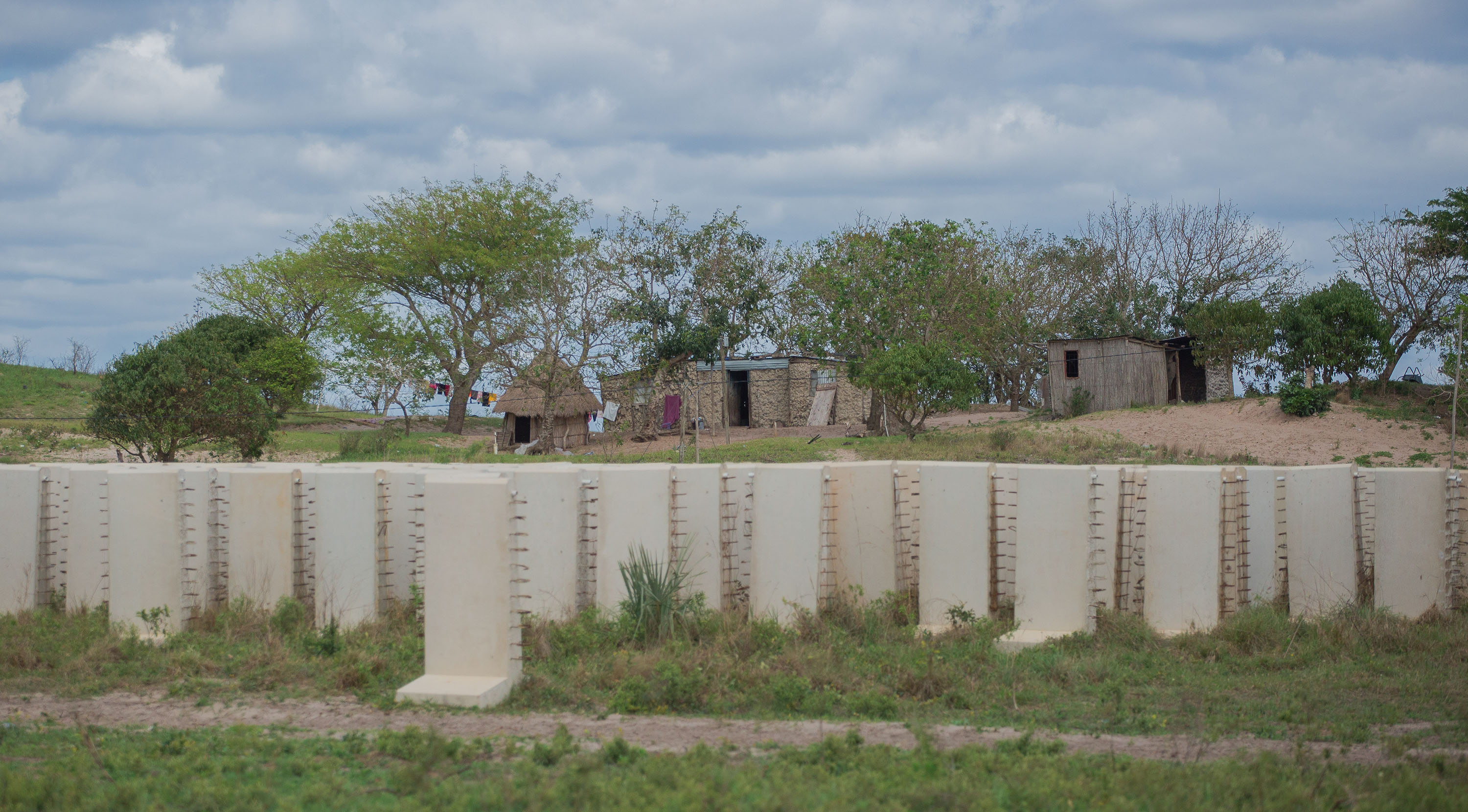
Concrete barriers that are not yet operational but are intended to separate Manguzi and Mozambique as an anti-crime barrier. By 2020, only 166m of the wall had been constructed, even though R48-million was paid to the contractor. The amount should have covered the cost of installing 3km of border wall. The SIU is investigating. (Photo: Supplied)
The border community of Manguzi feels under siege from armed syndicates, yet one of the solutions to bring stability to the area – Jersey barriers – has been mired in controversy, and is currently on hold.
The installation of concrete Jersey barriers – also known as border walls – along the porous fence that separates South Africa and Mozambique in the far north of KwaZulu-Natal was hailed as the solution that would bring an end to vehicle smuggling in the area.
But the R85.7-million tender that was awarded for the construction of an 8km border wall has been mired in controversy. It was awarded to ISF Construction and Shula Construction.
The project has now been halted and is facing a number of disputes. The so-called construction mafia, Amadelangokubona, have invaded the site, saying they want a piece of the project.
The project is the subject of investigation by the Special Investigating Unit (SIU), which is probing allegations of corruption and maladministration at the KwaZulu-Natal Department of Transport when awarding this tender.
SIU spokesperson Kaizer Kganyago told Daily Maverick they started the probe after “we received allegations from an unnamed whistle-blower, claiming that the transport department has executed the project of constructing a concrete barrier, despite the legal mandate of such project resting with the Department of Public Works and Infrastructure.
“The investigation is ongoing as we are still collecting further documents after our initial document analysis and witness interviews. We are expected to conclude the investigation in May 2022 in line with the project plan. However, the completion date depends on SIU getting the required information timeously.
“At this stage we are looking into the procurement process and delivery ‘value for money’. We are probing allegations of the contravention of KZN Department of Transport procurement processes as well as noncompliance with PFMA [Public Finance Management Act].”
The KZN MEC for Transport, Peggy Nkonyeni, issued a statement earlier this year saying she welcomed the investigation by the SIU and that the KZN Department of Transport would fully cooperate with the investigation and would share all necessary documentation, including the expenditure of the projects.
“The construction of the new Jersey barriers is a decision of the government after a huge outcry from the community of eManguzi on the rampant vehicle theft, which was then taken across to Mozambique. This resulted in violent protests, with the people of uMkhanyakude shutting down the entire town of eManguzi, which affected the movement of goods and trade, tourism and other strategic activities between South Africa and Mozambique.
“We reaffirm our commitment to working with all enforcement agencies to investigate and deal with corruption. We, however, wish to affirm the strategic nature of this project to the people of KwaZulu-Natal, in particular uMkhanyakude District,” said Nkonyeni.
Some of the victims of hijacking said it was unfortunate that while they were under siege from cross-border crime syndicates who were hijacking their cars and smuggling them to Mozambique, some government officials saw this as an opportunity to squander public funds by awarding corrupt tenders.
A KZN Department of Community Safety and Liaison official said the project would only resume once disputes had been sorted out. DM
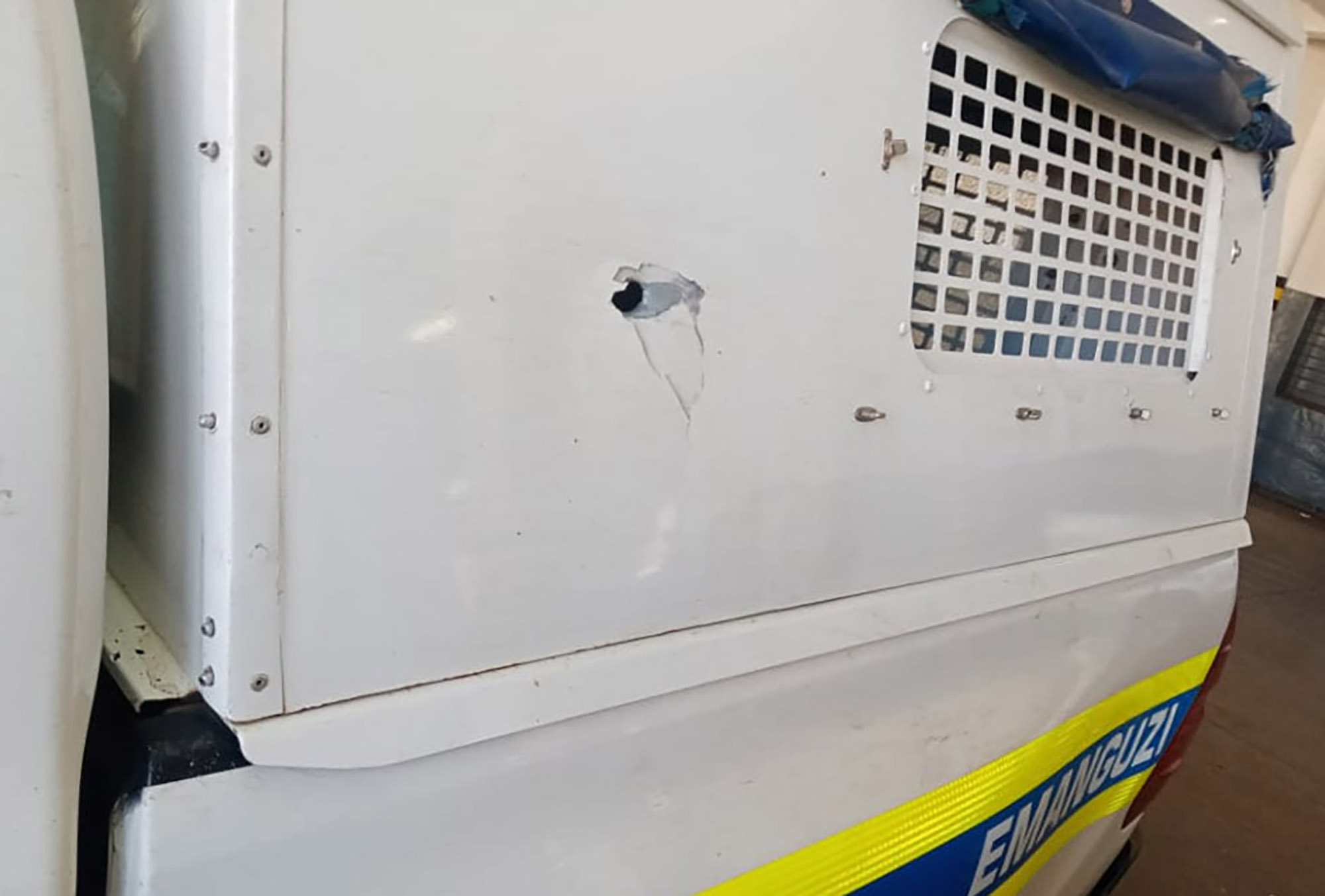
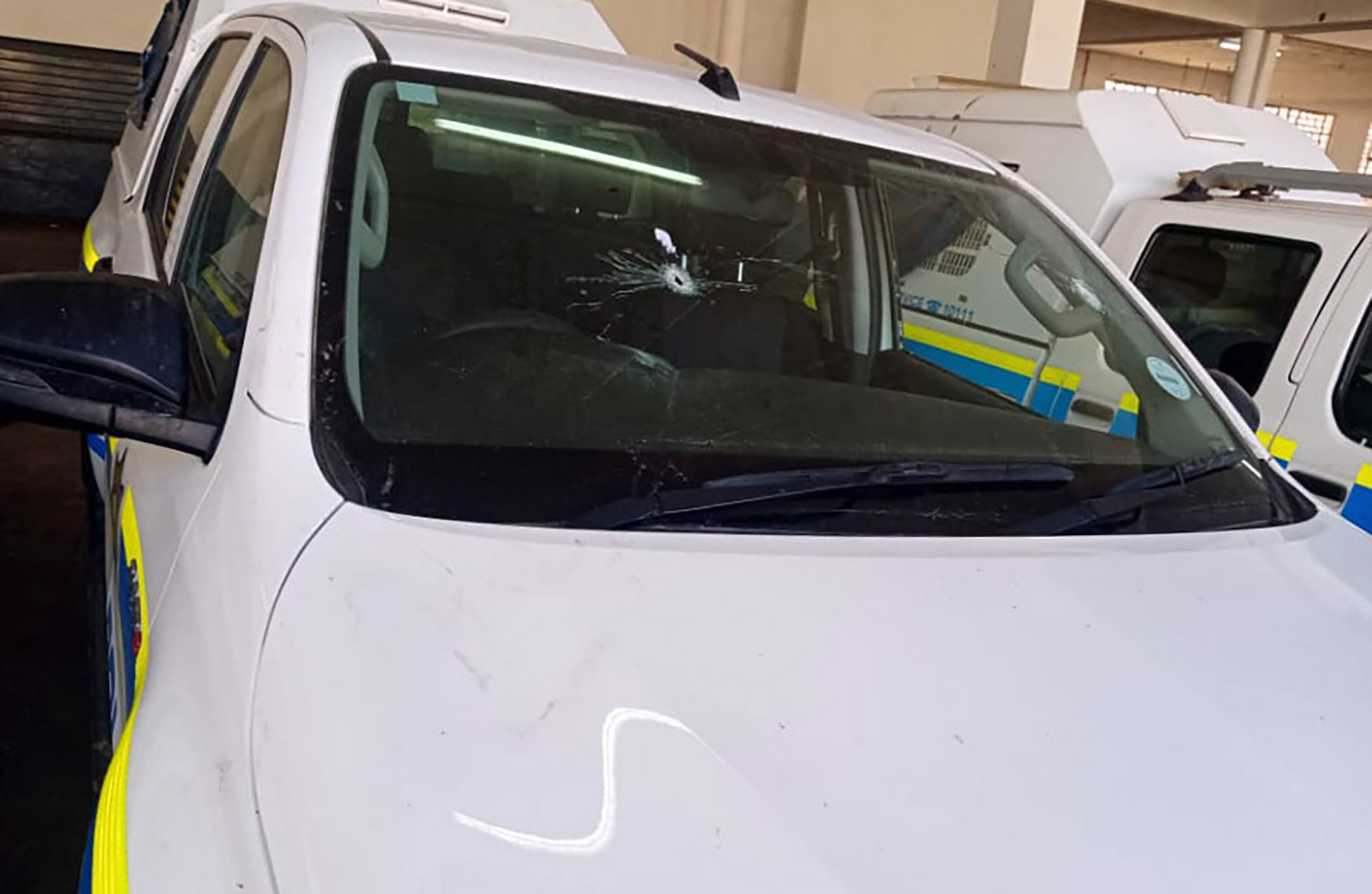
The SAPS vehicles which were damaged by the SANDF shootings while they were pursuing cross-border syndicates and stolen vehicles near the SA/Mozambican border.Photo:Supplied
The South African Police Service (SAPS) and the South African National Defence Force (SANDF) are both probing a 14 September 2021 incident in which SANDF members shot at SAPS members who were pursuing cross-border car thieves near the Mozambican border.
Information about these separate investigations emerged during Daily Maverick’s own investigation – and raises red flags in the war against cross-border vehicle smuggling.
The September 14 skirmish is the latest in an alleged clash between the SAPS and the SANDF, who have kept the other incidents out of the public eye.
The tensions arose from the accusation made by both parties that the other is aiding and abetting cross-border crime syndicates.
On the night of Tuesday, 14 September 2021, Detective Constable MH Mthembu and Sergeant VJ Maphanga were driving a clearly marked police vehicle, following the tracks of a stolen vehicle near the border in Gazini. They came under fire from SANDF members guarding the border.
A bullet grazed Maphanga’s skull, from which fragments were removed in hospital.
The police van was damaged and had to be taken by tow truck to the police garage in Jozini. It has not been repaired.
The police van that was fired at along the Mozambican border. (Photo: Supplied)
A case of attempted murder was opened at the Manguzi police station the following day, 15 September.
According to sources, the SANDF has not cooperated and has yet to submit a statement from all the members who were involved, describing why they had to fire at the police van with occupants.
Both the SAPS and the SANDF have admitted that the incident took place, and both say it is being investigated.
Cross-border crime levels are so high that there are mounting accusations that this is because some members of both the SANDF and SAPS are on the payroll of syndicates to enable the latter to smuggle vehicles into Mozambique.
Neither the SANDF nor the SAPS top brass has admitted to bribery claims against their members.
Sboniso Gumede, chairperson of the local community policing forum, said the bribery accusations and the tiff between SANDF and SAPS members is a concern for those who wish to see an end to cross-border crime. He said this is because it is emboldening the syndicates and escalating crime.
The SAPS and the SANDF are supposed to be cooperating under a joint agreement to fight organised crime, including hijacking and smuggling of vehicles to Mozambique. “The non-cooperation and one-upmanship between the police and the army has given the syndicates a free reign, they are operating with impunity,” Gumede claimed.
“If all the law enforcement agencies were to do their work diligently and forcefully, the smuggling and crime syndicates would be a thing of the past. But, clearly, there is no will to fight cross-border crime.”
A board of inquiry has been convened to investigate the circumstances that led to an attack on an SAPS vehicle. (Photo: Supplied)
Approached for comment, SANDF spokesperson Brigadier-General Andries Mahapa confirmed there was an incident in which SANDF members “accidentally” shot at SAPS members. “The SANDF confirms that we are aware of a particular incident that happened in/around Manguzi area on 14 September 2021.
“Our understanding is that the SAPS are conducting their own case of attempted murder. A board of inquiry has been convened to investigate circumstances that led to the incident.”
However, he downplayed the alleged conflict: “The SANDF enjoys good working relations with all law enforcement agencies employed within the role of safeguarding our borders, especially the SA Police Service. In this regard, the SANDF has been working jointly with the SAPS and other law enforcement agencies to intercept vehicles from illegally crossing the border on a daily basis. The confiscated vehicles are handed over to the SAPS or SARS.
“The SANDF as the co-chairperson of the Provincial Joint Intelligence Structure in the province of KwaZulu-Natal, works jointly with the SAPS and there is cooperation between the two organisations. The agreements are implemented without any challenges.”
Mahapa added: “Specific to RSA/Mozambique border, cross-border crimes such as illegal smuggling of dagga, stolen vehicles and undocumented persons are common in the area.”
Police Minister Bheki Cele told Daily Maverick they are aware of the incident and that SAPS and SANDF leadership are dealing with it.
“There is an investigation by both the SAPS and the SANDF regarding this matter. It would be premature for me to comment until these investigations have been concluded and reports have been produced,” he said.
SAPS spokesperson Brigadier Vish Naidoo declined to answer questions, saying Cele had spoken for the ministry and the SAPS.
“He is the higher authority and once he has spoken I cannot say anything further,” said Naidoo.
The bigger picture
Richard Chelin, a senior researcher at the Institute for Security Studies (ISS), said cooperation and information-sharing between national and cross-border law enforcement agencies is critical if efforts to curb cross-border crime are to succeed.
“The information available is quite limited actually. While there have been media reports around cross-border crimes, there has been little on cross-border crime syndicates which are terrorising communities in the KZN border region with Mozambique.
An SAPS vehicle after it was allegedly fired on by SANDF members while the police were pursuing cross-border car thieves near the Mozambican border. (Photo: Supplied)
“I think it is important to contextualise this within the broader organised crime of vehicle theft. While the modus operandi of the various criminal groups may vary, the crime remains that of vehicle theft. Vehicle theft is one of the most prominent forms of organised crime in the southern African region.
“As such, it has been listed as one of the priority areas for the Southern Africa Regional Police Chiefs Cooperation Organisation. As a crime type, it is systematic and transnational and organised criminal groups exploit routes and systems used by the legitimate economy. Yet, there is little research done on this issue.”
Other experts say the tensions between the SAPS and the SANDF along the border arose because there are many agencies operating there, including the Department of Home Affairs, all with their own heads and priorities.
After nine years of deliberation, the National Assembly passed the Border Management Authority Bill in June 2020. A month later, President Cyril Ramaphosa signed the bill into law and the Border Management Authority (BMA) was instituted as a single authority to manage the country’s borders.
In September 2021, Cabinet announced it had appointed Dr Nakampe Michael Masiapato as commissioner of the BMA agency and Major-General David Chilembe as deputy commissioner for operations. DM
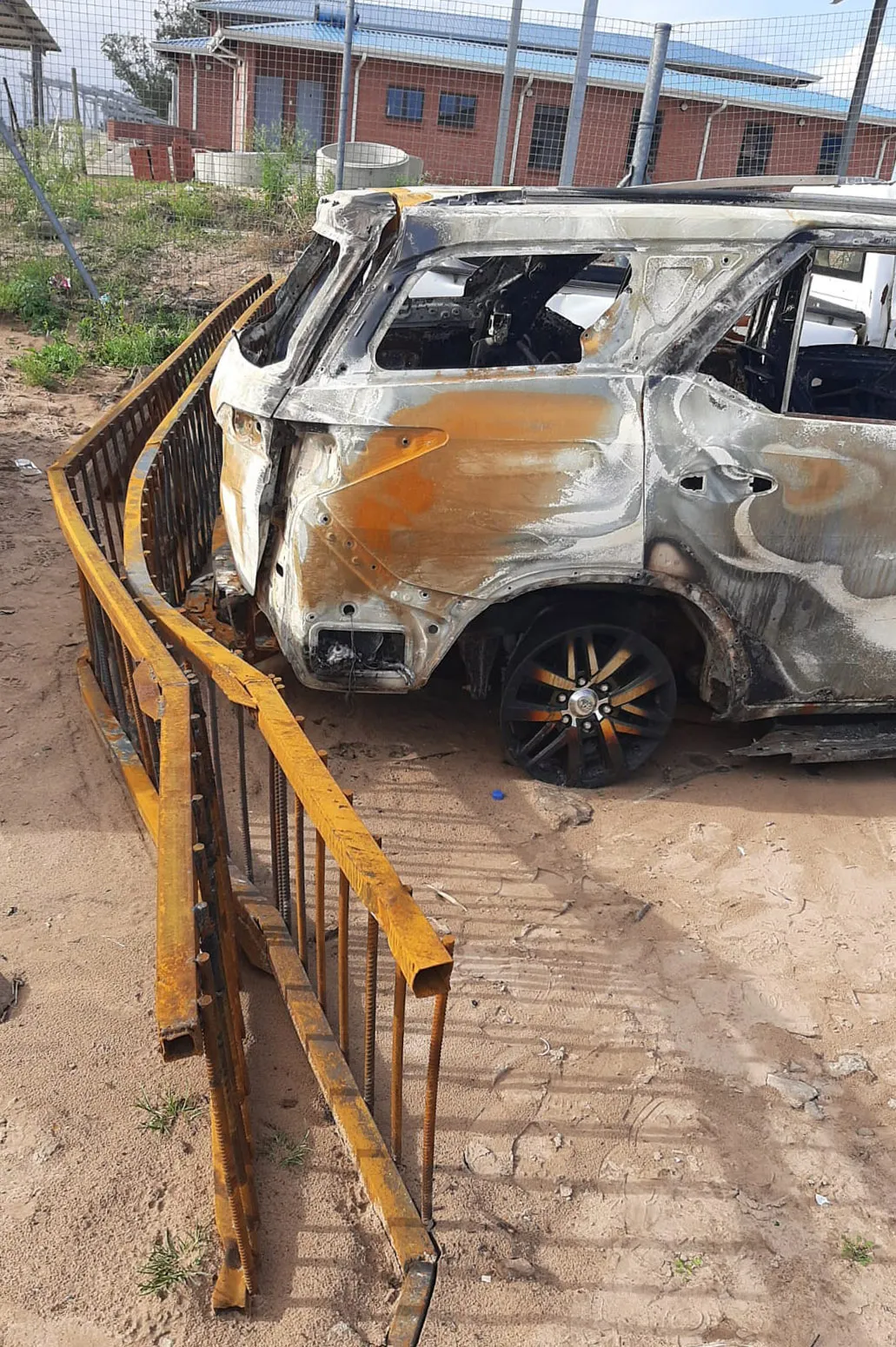
A Toyota Fortuner was being smuggled across the border, but it missed the ramp and plunged into the jersey barrier wall which is being set up to separate SA and Mozambique (the project has stalled and is the subject of an SIU investigation). This incident happened in July. It is not clear whether this vehicle burnt upon plunging into the wall or was burnt deliberately by the syndicate. Photo: Supplied
These are six case studies from the Manguzi area over the past two years – the stories of a few of the many victims of brazen and murderous car smuggling syndicates.
Case Study 1
Animal health technician survives hijacking, then killed in second hit in July
Melisizwe Mnikathi, a 32-year-old animal health technician, had been sent to an animal auction centre near Manguzi in July 2021 to take livestock samples to check for foot-and-mouth disease. He was attacked by three men who forced their way on to the premises and pointed guns at him.
Only three years earlier, in 2018, Mnikathi had been with a female colleague when they were hijacked in a Department of Agriculture bakkie in the area and taken to the forest near the border, gagged and tied to the tree. They managed to free themselves and make the long trek to the local police station.
In July 2021, hijackers forced him to drive his 2019 Ford Ranger 4×4 out of the facility and not to alert anyone that he was being hijacked, but he decided to ram the gate to alert the security guards. The hijackers shot him in the chest and stomach, pulled him out of the vehicle and drove off. Mnikathi was certified dead on arrival at the local Manguzi hospital.
Mnikathi’s fearful colleagues said he was a good man who responded when subsistence livestock farmers needed his skills and expertise. “He was still young but he was one of the best,” said a senior colleague. “He had worked here since he graduated more than 10 years ago. When he died he was in the process of taking a wife, having paid lobola [bride price].”
Another woman colleague said: “We are always fearful because it seems like we are targeted by these syndicates. Now we cannot go to outlying areas, where our services are most needed, because we are fearful for our lives. Government must do something about syndicates who are hijacking and taking our cars to Mozambique. The most distressing thing is that we are scared to speak about these incidents because you don’t know who within our communities is working with these criminals. We are tired of this thing. One man from Manguzi said he had been talking openly about his frustration about cross-border crime. He then got a call from a cellphone from a prisoner who said he was serving time at Qalakabusha Prison [in Empangeni] warning him to stop talking about these things if he still values his life.”
Case Study 2
Durban businessman and three workers abducted for three nights, ransom demanded from his family
*Ismail had advertised his refrigeration and air-conditioning company on social media, including Facebook, Instagram and WhatsApp.
“It was in August [2021] when one male client called me, asking about our air-conditioning services and ordering equipment to be installed in his house near Jozini. He also sent me pictures of the property in which the installation was to be done. He seemed to be in a hurry and he promised to pay as soon as I start the job. He said I must come with all my equipment so that I could finish the job and go home with the money.
“But I said I will have to come and do the measuring and other assessment so that I could come with the exact material.
“Everything seemed legitimate and my ‘client’ seemed to be a gentleman who went out of his way to assure me. So, on Friday, 20 August, myself and my three assistants (all Indian descent) drove in my Isuzu 2017 D-Max to Jozini.
“The ‘client’ told me to meet at Jozini Spar but when I called him he said let’s rather meet at Ntikini Primary School. We were not familiar with the place and were calling him, since there is no address there,” he told Daily Maverick.
The “client” kept calling.
“He said we must pick up his brother on the way to the house, but as soon as we picked up his brother that was where our ordeal started. When we were driving in a bushy area we were ambushed by six men, armed with two handguns each. They put us in the back of the van and covered our heads, took us to the dark forest and (Umgodi Wezimnvubu). Two guys drove in my vehicle and the other four stayed behind, ordering us to walk deeper into the dark forest.”
Ismail said when his wife called his phone, the men ordered him to tell her he was fine. He believes the syndicate wanted to ensure his bakkie was across the border before demanding a ransom.
“Later that night, when my wife called, they ordered me to tell her that we have been hijacked and abducted and she must give them R500,000 or we will be killed. They were also assaulting us, some asking us about the Phoenix killing between Indians and Africans. We told them we are simple businesspeople and we had nothing to do with the killings,” he said.
“On Saturday, my wife said she could only raise R150,000. They asked her to bring it to Jozini town. My wife asked a male relative to accompany her. When she reached the town she got a call from the syndicate members saying she must drive to a forested area. She said she was scared and the abductors must rather come to Jozini with all the hostages and they would get the cash. But they were scared that she might bring along police officers.”
When it got dark his wife and the relative drove back to Durban but kept the communication channels open between them and the abductors.
The abductors gave the hostages water and bread. On Sunday, his wife returned to Jozini, this time with another male relative.
Ismail said he met his “client” who told him that he will “show” because his wife was refusing to give him money. “They also forced me to use my phone to transfer about R16,000 through an e-wallet and they withdrew it at the Spar nearby.
“When my wife arrived in Jozini on Sunday morning there was a stalemate, again, because the abductors wanted her to drive into the bush and she refused, saying she was scared. I think by this time the police had got wind of our abduction and by the afternoon the police officers started scouring the Umgodi Wezimnvubu forest. The abductors started moving us frantically around the forest. They became even more aggressive in assaulting us and when their spotters told them that police are on the way.
“At about midnight on Sunday, the abductors said we must walk away from the forest and never look back. We walked and walked for hours until we reached the main road. Luckily, the abductors had given me an old cellphone and I used it to call my wife and the police from Manguzi police station were alerted and they came to pick us up. On Monday morning we opened cases and my wife and other family arrived to pick us up at the police station. We left the area because all of us needed medical attention and we wanted to get away from the area as soon as possible.”
He said his bakkie was last tracked when it crossed the Mozambican border.
*Name changed for the safety of the survivor.
Case Study 3
Teacher and wife robbed, forced to accompany abductors to the Mozambican border
Themba Mnguni*, a 43-year-old teacher, was sleeping at home in Thengani Location, near Manguzi, on the night of Sunday, 17 October 2021, when four heavily armed men forced their way in. “They demanded money, laptops, a gun and I told them I didn’t have one. They asked for keys to my Mazda CX5 (2019). They ransacked the house. My wife and I were kept in separate rooms.
“They forced my wife and I to dress up warmly because they are going with us to the Mozambique border. They forced us to accompany them to our car and they told us they were not fighting but only working. In fear for our life we followed their orders.”
Once on the road the abductors called other syndicate members to tell them where they were and ask whether the police were on their route. “They were using the forest to avoid the police. You could tell by the way they were communicating that their job was well planned and it consisted of well-organised people who are well connected.”
At the border, three of the abductors leapt out and bent the fence so the car could get through. On the Mozambique side they drove for a few minutes and stopped. “I thought it was the end of us, I thought they were gonna shoot us, but I thank God they spared our lives.” The abductors then ordered the couple out of the car, helped them back over the fence and told them to walk away and never look back. “It was still dark in the forest. We were scared…”
After walking for hours they found a house where the owner called the police. “We were able to open a case but no arrest was made. No trace of my car as well.”
Mnguni added: “Every evening memories come back and worse I never heard anything about my car and the tracker failed to locate it, I don’t think I will be able to buy or drive a car anytime soon. I’m scared and traumatised. I almost died just for my hard-earned vehicle.”
He believes the syndicates “are working closely with people in our communities… we don’t know who to trust any more… Just a week after our ordeal the syndicate went for one of the neighbours, a teacher, took her Toyota RAV4 and forced her and her three granddaughters to drive to the border fence where they were abandoned and the car taken to Mozambique. This shows that someone very close to us is selling us to the criminals.”
*Name changed for the safety of the survivor.
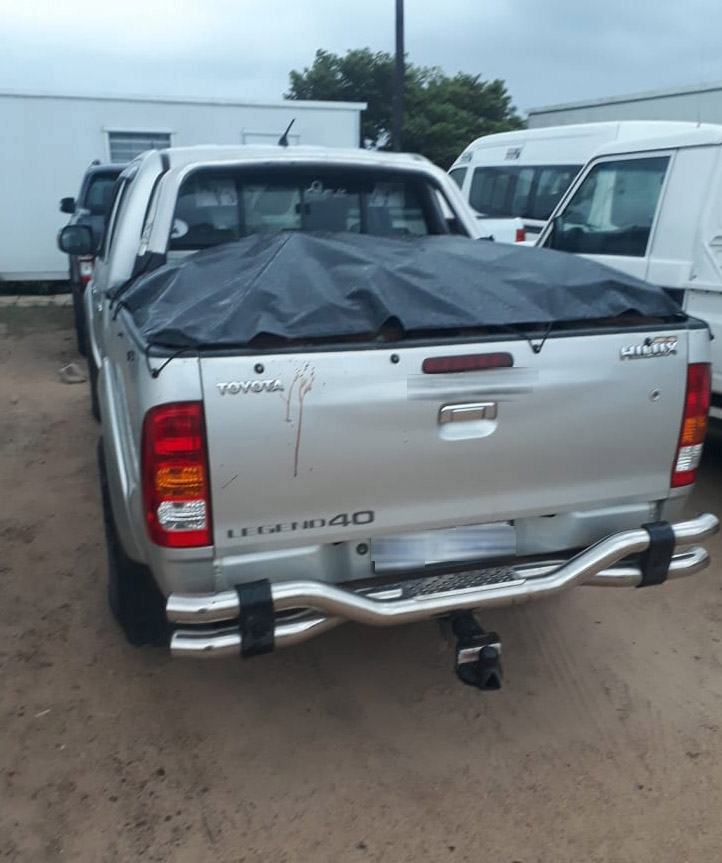
The Toyota Legend is one of the vehicles seized by the police near the Mozambican border fence. (Photo: Supplied)
Case Study 4
Teacher robbed of two cars
Phelandaba location, Manguzi: At about midnight on 17 September 2019, three heavily armed men barged into Sipho Vundla’s* house, tying up him and his wife and demanding the keys to his two cars, a Toyota 4×4 (2011) and a Nissan Hardbody.
“They asked for money and took R1,000 and the spare keys for both vehicles. They were beating me, demanding that I show them where the trackers are. I told them I had uninstalled them because I couldn’t afford them.”
When the attackers couldn’t open the Nissan “they came back to the house and kicked me while I was naked and tied up. I was forced to go outside and unlock my car for them… the locker was jammed, one man picked up a spade and broke the side window. They again locked us inside the house and drove off in our vehicles.”
The Toyota was found near the border fence on the South African side. Police found the Nissan on the Mozambican side and took it to the Nomahasha police station.
Police in Mozambique arrested suspects who outed their accomplices in South Africa. Vundla said three men, including a minor, are on trial in the Manguzi Regional Court where there have been several postponements due Covid-19 regulations.
“All I can say is that I was so shocked to learn that two suspects were my neighbours, people who know me well. They were learners in the school I am teaching at,” he said.
“I am pleading with the government to take this issue of hijacking and taking cars to Mozambique seriously. Communities must form community forums and work together with the police to catch the syndicates and criminals. Our government is failing us because when communities take the law in their hands the government punishes them instead of the criminals. What kind of country is this? We are living in democracy. What is freedom when you work very hard but you cannot even buy yourself a car or cellphone?”
*Name changed for the safety of the survivor.
Case study 5
Lured with the promise of a big contract, hijacked and killed
Vryheid businessman Gert Pretorius’s family didn’t suspect anything when he drove a Toyota Hilux bearing the emblem of his company, Majuba Glass & Aluminium, from home to meet a client in Manguzi on Sunday morning, 22 September 2019.
It was the last time his family saw him. Pretorius’s company specialised in aluminium fittings and covered the whole of Umkhanyakude district.
Weeks earlier he had received a call from a “client” who said he’d seen his advert on social media and was keen to make a big order. But Pretorius had to go to Manguzi to deliver the quotation. The client deposited petrol money into Pretorius’s account to make the whole thing look legitimate.
Manguzi SAPS station commander Colonel Frank Saunders said at the time they believed Pretorius arrived in the Escabazini area and was hijacked and taken to Umgodi Wezimnvubu, to which his last cellphone call was traced.
Police found the Hilux close to the border fence and at 11pm Pretorius’s body was discovered with a gunshot wound next to the P522 road. No arrests have been made yet, added Saunders.
Pretorius’s eldest son told Daily Maverick he was too emotional to talk. “I still cannot talk about this, even now,” he said before hanging up.
Pretorius’s brother, Marius, told the Northern Natal News his brother’s death had affected the family.
“We did not know about the hijacking syndicate at the time. We are very safety conscious and would not have taken a risk, if we were aware. When Gert’s phone was off, we knew something was wrong. His phone was never off… He had been lured into an ambush by a group of guys who knew what he was driving. They were after his Toyota Hilux,” he said.
“Gert was not a violent guy, but he was the type of person who would have fought for his life and for his family.”
Police say they were alerted by Jozini residents to the Hilux being driven recklessly by suspicious-looking men. They gave chase but the men managed to get out of the vehicle and flee.
This was before Pretorius’s body was discovered.
Case Study 6
Hospital worker dumped at border with three grandchildren
Gloria Mnguni* (54) was sleeping with her three granddaughters at home in the Thengani area of Manguzi on Wednesday, 27 October 2021, when three armed men forced their way in through the kitchen door.
This was not her first ordeal – in 2006, armed men barged into her home and shot her husband dead. No one has been arrested.
“When they were inside they asked me where my late husband’s firearm was. I told them it was taken by the police who were investigating his murder. They then forced me and my grandchildren to sit on the bed while they were ransacking the house. They asked for the phones, for money. They took takkies, they took everything they could lay their hands on. They also asked for the keys to the Toyota RAV4.
“They tied us using shoelaces and made us sit as they carefully opened things, saying they don’t want to alert neighbours and my 31-year-old son and his wife, who were sleeping in the outbuilding.
“They drove out of the house with us. When we entered the gravel there was another man who was keeping watch, he entered the car. As we were driving I could see a stationary police vehicle and I was hopeful that they would stop the car. The police ignored us and the car passed. Our tormentors did not seem to worry about the presence of police. We passed another police van. Here, too, I thought the police would stop us as it was long after midnight and the Covid-19 curfew had passed. But the police ignored us.
“The hijackers were making calls, asking the person on the other side of the line if everything is fine. The guy said they must drive slowly as there were cars on the gravel road. We saw a teenager standing on the side of the gravel road in the dark. I thought he is the person they were talking to to spot danger for them. One of the hijackers said, ‘you can now go and sleep, Mshana [nephew or lad]. Your job is done.’ We drove through a dark forest and they were frantically phoning. At some point they stopped the vehicle and they all got out. They were asking if everything is fine and if the person has finished cutting the border fence. After about 30 minutes they returned to the vehicle and the driver was driving faster now. Soon we reached the border fence. They ordered us out of the car and said we must walk on the side of the border fence. They said we will reach the SANDF camp where we can ask for assistance.
“We walked for kilometres until I could see the camp and we asked for assistance. The SANDF members at the camp were sleeping and we had to scream and plead for help. They woke up and two of them got into their vehicle and drove in the opposite direction to where we said the hijackers had left. They came back a while later and told us they cannot even spot car tracks. I thought, why would they go east when I told them the car had gone west. However, I was still too traumatised to ask them these questions.
“We waited in the camp until 9.30 when police arrived. One officer apologised for not assisting us at night, saying they were only on the lookout for vehicles heading to Manguzi and not those going the other way. I wondered where he could have gotten the information as I had not told him that. But perhaps he had been told by SANDF members to whom we had related the story.”
Mnguni said she opened a case at Manguzi police station but has not heard anything about her car or the arrest of the culprits. The insurance company has still not responded to her claim.
“I don’t have a car, I am traumatised and so are my grandchildren. I don’t know why we have to go through all this hardship. We are at the mercy of ruthless criminals who strike at will without any government assistance,” she said.
*Name withheld to protect the survivor.
KwaZulu-Natal police respond
Colonel Thembeka Mbele confirmed these incidents without going into detail, and warned residents to be extra vigilant.
She said some people are hijacked at night in their homes and others are lured into the region from other areas, hijacked, robbed and even abducted.
“Police would like to warn the community of Emanguzi and Umkhanyakude district about the car hijacking trend that is taking place in the area. Many people have been targeted from different areas in the province and outside the province. The criminals target individuals who conduct businesses such as building, carpentry and truck-hire services which transport goods. The criminals identify these individuals and offer them jobs, especially those that own cars. Once the individual agrees to do the job, they are sent to the ‘intended’ destination. On their arrival someone will be waiting for the drivers to hijack them. Their vehicles are allegedly taken to neighbouring countries.” DM
A Toyota Fortuner was being smuggled across the border with Mozambique in July 2021 when it missed the ramp and plunged into a jersey barrier. It is not clear whether it caught fire on impact or was torched by a car theft syndicate. The jersey barrier project has stalled and is the subject of an SIU investigation. (Photo: Supplied)
Residents of Manguzi on the Mozambican border are gatvol of living with the constant menace of cross-border car theft syndicates who they say are becoming more daring and dangerous. While Police Minister Bheki Cele admits there is a ‘huge’ problem, locals say police and the government are failing to protect them from heavily armed thugs who lure them to the Umkhanyakude district where they are robbed, abducted and sometimes killed. To make matters worse, the SANDF and SAPS accuse each other of being on syndicate payrolls.
Residents of Manguzi, Jozini and Pongola and surrounding areas in Umkhanyakude say they are under siege from brazen cross-border crime syndicates who hijack them and spirit their cars across the porous border into Mozambique.
They say they are defenceless against these heavily armed syndicates while leaders in government and law enforcement agencies are failing to protect them.
Two years ago, in August 2019, police in Manguzi announced they had seized 20 vehicles at the border between South Africa and Mozambique. Having been either hijacked or stolen from various parts of the country, they included trucks, bakkies and smaller cars. Some were found hidden in dense bush and forests. Police said others were intercepted just before they crossed the border.
Eight suspects were arrested and have appeared in the Manguzi Magistrates’ Court, charged with possession of suspected stolen vehicles.
Residents say that despite rare police successes, the syndicates are becoming even more daring and dangerous.
Makes in demand in Mozambique include Toyota Fortuner, DG-6 bakkie, Toyota Hilux, RAV4, Ford Ranger, VW Amarok, VW Tuareg and Mazda CX5.
A Toyota Fortuner was being smuggled across the border with Mozambique in July 2021 when it missed the ramp and plunged into a jersey barrier. The vehicle and ramps were taken to the Manguzi police station. (Photo: Supplied)
Businesspeople who advertise services and products online – who come from Durban and other parts of KwaZulu-Natal, and as far as the Eastern Cape and Gauteng – say they are lured by the promise of big contracts to Umkhanyakude where they are robbed, abducted and even killed.
South Africa shares a 491km border with Mozambique. These are divided into two and separated by the Kingdom of Eswatini. The 410km northern segment runs north-south along the Lebombo mountains from Zimbabwe to Swaziland. The southern segment is 81km and runs east-west across Maputaland in KZN to the Indian Ocean.
The large number of robberies and hijackings in Manguzi and surrounding areas are ongoing. During one huge spike, in 2018, angry Manguzi residents shut down the town and the nearby Kosi Bay border post that separates South Africa and Mozambique, for three weeks, demanding that authorities do something about the syndicates.
Then police minister Fikile Mbalula led a delegation of top government officials to try to mollify the residents, with promises including installing jersey barriers along the border fence, especially in syndicate hotspots.
The R85-million barrier project began in 2019, but was abruptly stopped amid allegations of corruption. The Special Investigating Unit (SIU) said recently it was investigating the tender awarded to a joint venture between ISF Construction and Shula Construction in August 2018. It had launched the corruption probe following a tip-off from whistle-blowers.
Community policing forum chairperson Sboniso Gumede said he and other forum members had been threatened several times by syndicate members.
Gumede said Manguzi is the hardest hit, with repeated attacks from the syndicates. They often arrive heavily armed in the middle of the night, hijack and rob residents and drive them to the border fence where they tie them up before vanishing across the border where a lucrative market for 4×4 and other expensive vehicles awaits.
These concrete barriers between Manguzi and Mozambique are used to curb cross-border crime, but they are not yet installed. (Photo: Supplied)
“These syndicates have become brazen and fearless in recent months because they know the authorities are ineffective in combating their activities. That is why they up the ante,” he said.
“What I have observed over the years is that police action would be effective for a few months and the syndicates would find another method of doing their thing. They would also find a new location from where to spirit the vehicles across the border.”
They had hoped the rate of hijackings would drop when the government started installing jersey barriers. “Now that too has stopped and these concrete blocks are lying there uninstalled and the project abandoned.”
What are jersey barriers?
These precast road barriers are the primary protection method for pedestrians and people working along roadways. They have a traffic-control function and cause minimal vehicle damage on impact. The barriers along the South Africa-Mozambique border are higher and are meant to prevent vehicles from being smuggled across.
‘Sensitive’ operations
The syndicates use a number of routes, the most popular of which appears to be a place called Umgodi Wezimvumbu (loosely translated to “Hippos’ Hole”), not far from the Tembe Elephant Park border fence.
Tracking companies say they have their hands full trying to prevent their clients’ vehicles from being smuggled into Mozambique.
Reyana Gangat, communication officer at Tracker, said: “Any vehicle that is stolen or hijacked in close proximity to a border shows an increased risk of being taken across to other countries. We do continue to work with authorities in South Africa and our surrounding countries to mitigate and minimise this from happening.
“Most of our operations are confidential and sensitive and we are not currently at liberty to disclose these operations. [But] we work with a number of authorities in South Africa and our surrounding countries. This includes insurance companies, international vehicle crime units on bilateral operations in cross-border interventions and with a number of foreign law enforcement agencies.”
She warned that people should be alert and aware of their surroundings when driving. “There are various proactive telematic devices available in the market that will alert the tracking company of a potential hijacking, allowing quick response.”
On the rise
Richard Chelin, a senior researcher at the Institute for Security Studies, said there are a number of possible reasons for syndicates establishing the area as their turf.
“One of the reasons could be the lack of capacity and resources to address this type of crime. Since it is a transnational and organised crime, authorities would require a dedicated task team with experts and resources to be able to conduct investigations and dismantle these criminal syndicates.”
He said cross-border car theft is on the rise in the Southern African Development Community region, adding that the Southern African Regional Police Chiefs’ Cooperation Organisation was formed in 1995 but it has not been effective in curbing cross-border crime such as transnational car theft.
“Through [the organisation] there should be some form of collaboration that exists to deal with transnational organised crime – especially vehicle theft – in the region,” he said. This could be achieved through:
Better intelligence sharing among law enforcement in South Africa and Mozambique;
Dedicated resources to enable law enforcement to deal with the problem;
A specialised task team on organised crime consisting of expert investigators and prosecutors experienced in dealing with organised crime and specifically vehicle theft; and
A holistic approach by law enforcement and the private sector (security companies, car tracking companies and other stakeholders) to develop preventative strategies.
A ‘huge problem’
Police Minister Bheki Cele admitted to Daily Maverick that the South Africa-Mozambique border is a “huge crime problem”, followed by the border with Zimbabwe. There was no problem at the Botswana and Namibia borders, he added.
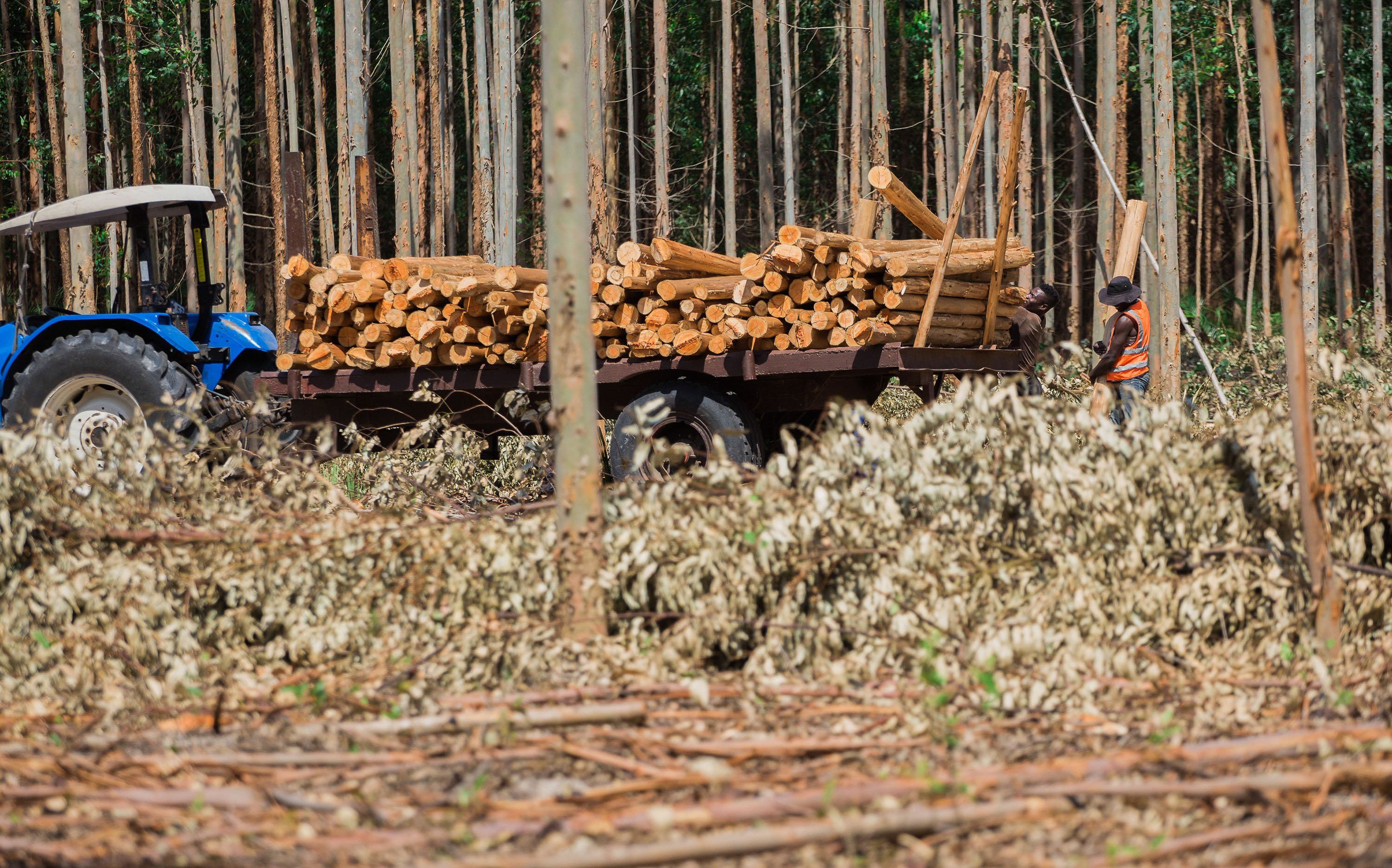
Workers load felled trees not far from the border separating Manguzi and Mozambique. (Photo: Supplied)
“The problem is that these crimes become violent, especially Manguzi, Kosi Bay and other areas in Umkhanyakude district.”
His department was spending an extra R3-million a month to beef up policing in the Manguzi area. “We are pumping more resources and opening a new police station and we will be putting human and other resources there to capacitate that police station to deal with the challenges of cross-border crime.”
Cele said corrupt police officers must be identified and arrested. “We have arrested 22 people there recently, including police officers, Home Affairs and syndicates from Mozambique and South Africa.”
He had been in meetings – attended by President Cyril Ramaphosa, his Mozambican counterpart Filipe Nyusi and Mozambican interior minister Arsenia Felicidade Felix Massingue – to find solutions and stop the flow of hijacked or stolen cars from South Africa to Mozambique.
“There is a bridge in Mozambique which is a gateway to Maputo. At times we have an agreement with Mozambique when we have officers stationed [there]. When that happens the rate of stolen vehicles in South Africa dips to low levels because our officers are able to spot cars stolen from South Africa and they have equipment to detect stolen cars.
“But after three months of these joint operations the Mozambican authorities hound our officers out of that country, using this or that excuse. The Mozambican authorities have a right to say who can and cannot be in their country. But once our units are out of Salamanga, the flow of stolen cars starts rising again.
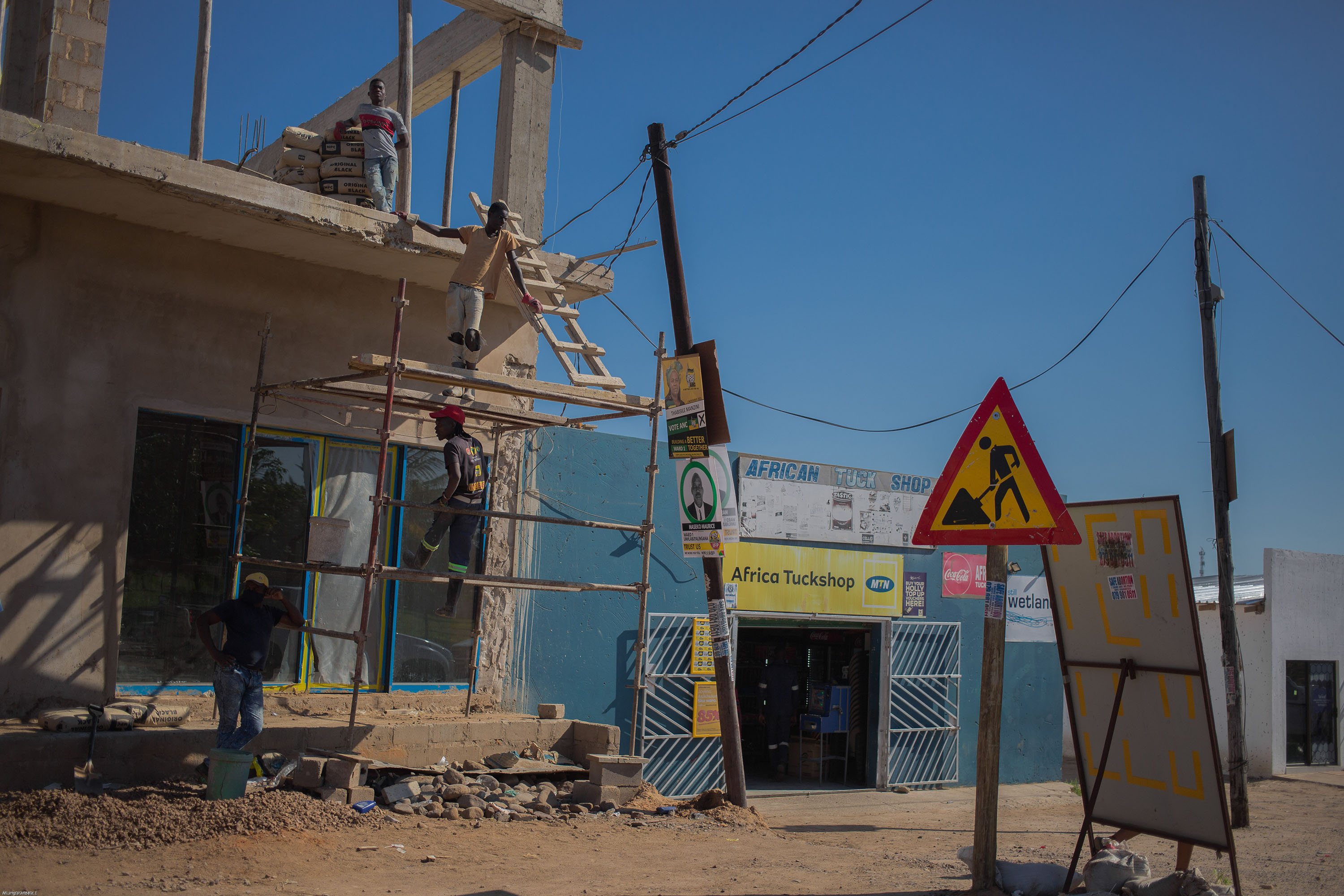
Workers build a block of shops in Manguzi. (Photo: Supplied)
“So, for us, it is the issue of cooperation between us and Mozambican officials to deal with these issues and once that can be sorted out, will stop the flow of stolen cars going to Mozambique.”
Cele said there are no current joint operations between South African and Mozambican agencies to combat vehicle smuggling, but talks are ongoing.
Neither the police, tracking companies nor the Institute for Security Studies could provide statistics for vehicle smuggling into Mozambique. DM
On the western border of the Greater Kruger Conservancy, where the fence has fallen into serious disrepair, a community of 26,000 people faces an eviction order from the national government. Why do the authorities want them off the land? The answer to this question takes us into an apparent scam run by hunting outfitters, provincial officials and a traditional chief. It also takes us into the desperation and poverty that drives the bushmeat trade.
Fence, noun: “A barrier, railing, or other upright structure, typically of wood or wire, enclosing an area of ground to prevent or control access or escape.”
WARNING: Graphic images below may disturb sensitive readers.
I.
The Oxford English Dictionary is pretty clear on this point: in order to qualify as a fence, there are certain qualities that a structure is obliged to demonstrate. They are obvious qualities, transparent and uncomplicated, which any school child would accept as self-evident. And yet on a Thursday morning in early October 2021, on a drive through the protected Limpopo bushveld somewhere north of Phalaborwa, Daily Maverick was confronted with a structure that met none of the OED’s standards.
There was a barrier, sure, but in many places it wasn’t upright. In those places where it was upright, there were holes in the wire mesh of various shapes and sizes. Also, given that this was supposed to be an electrified fence, a structure the sole purpose of which was to “prevent or control” the escape of wild and dangerous animals, the area that it enclosed was doubly exposed to breach. The electric current had long ago been deactivated, the wire conductors stolen by poachers and turned into snares.
“To remind you,” said Daily Maverick‘s source, “this is effectively the border of the Kruger National Park.”
It was an easy fact for the mind to forget, particularly in light of the sign that appeared at the entrance to the gravel track: “Mthimkhulu Private Game Reserve, no entry without prior arrangement.”
As Daily Maverick was just beginning to learn, the Mthimkhulu traditional community, comprising around 26,000 residents of the twin settlements of Mbaula and Phalaubeni on the banks of the Letaba River, had a long and complex relationship with its namesake reserve. According to the latest interpretation, the land did not belong to them, but to the South African government, which had incorporated it in 1985 into the Letaba Ranch Nature Reserve. The original interpretation, which appeared to fit with post-apartheid land rights legislation — specifically, section 25(7) of the South African Constitution and the Interim Protection of Informal Land Rights Act (IPILRA) — contended that the government was holding the land in trust on behalf of the community.
In the weeks ahead, working off the responding affidavits that had resulted from the government’s attempt to evict the community from the land, Daily Maverick would arrive at a more nuanced understanding of Mthimkhulu history. For the moment, however, it was all about the fact that the Kruger National Park appeared to be missing at least 27 kilometres of fence.
The problem, which now had implications that extended from poaching and illegal trophy hunting to human-wildlife conflict and the ever-present likelihood of a foot-and-mouth disease outbreak, had properly begun back in 2002, when the management of Kruger National Park decided to drop its boundary with Letaba Ranch and incorporate the latter into the Greater Kruger conservancy. At the time, it seemed like an inspired idea — not only would it lessen the pressure on the Kruger’s vegetation, it would enable the wildlife to roam according to historical migration patterns.
And yet by the accounts of community members, the villagers of Mbaula and Phalaubeni had been told nothing of the Kruger’s plans. Daily Maverick was informed that the agreement to drop the fence was concluded between SANParks, the Limpopo provincial government’s department of economic development, environment and tourism (LEDET) and a traditional chief by the name of Pheni Cyprian Ngove, who lived more than 50km away and was not recognised by the locals as their rightful leader.
According to Daily Maverick’s sources, there had been no interaction with the Mthimkhulu community as required by the tenets of IPILRA — no engagement, no signed resolutions and therefore no “prior and informed consent”. One day, we were told, the residents of Mbaula and Phalaubeni woke up to find that they lived a stone’s throw away from the Greater Kruger Park.
As long as the fence was properly maintained, this legislative breach didn’t seem to affect the lives of the community members. But in around 2015, when LEDET and the Department of Agriculture, Forestry and Fisheries began to neglect their maintenance duties, the effects of the unlawful shortcuts became increasingly evident on the ground.
There were three examples of the fallout that Daily Maverick encountered during our visit to the region. The first was the buffalo spoor that our source pointed out on the gravel track, which ran along the perimeter of the fence on the human settlement side. The spoor, given that buffalo are the primary carriers of the foot-and-mouth virus in African savanna ecosystems, sat there like a wailing alarm — not only could an outbreak destroy the community’s cattle herds, it could also potentially spread through the province, shutting down South Africa’s cattle exports and causing untold economic loss.
The second was a story that had just been published in the Far North Bulletin, under the header, “Is it a free for all on elephant bulls?” The elephants, it appeared, had all escaped from the Kruger, following the scent of Maroela fruit. Seven bulls had been shot dead by LEDET rangers in the streets and exurbs of Phalaborwa, sparking the outrage of the same locals that the rangers claimed to be protecting. For the nearby residents of Mbaula and Phalaubeni, we were told, such encounters were a regular occurrence, although their unwanted visitors, which included hippos, buffalo and the odd predatory cat, were far less likely to be taken down by a LEDET bullet.
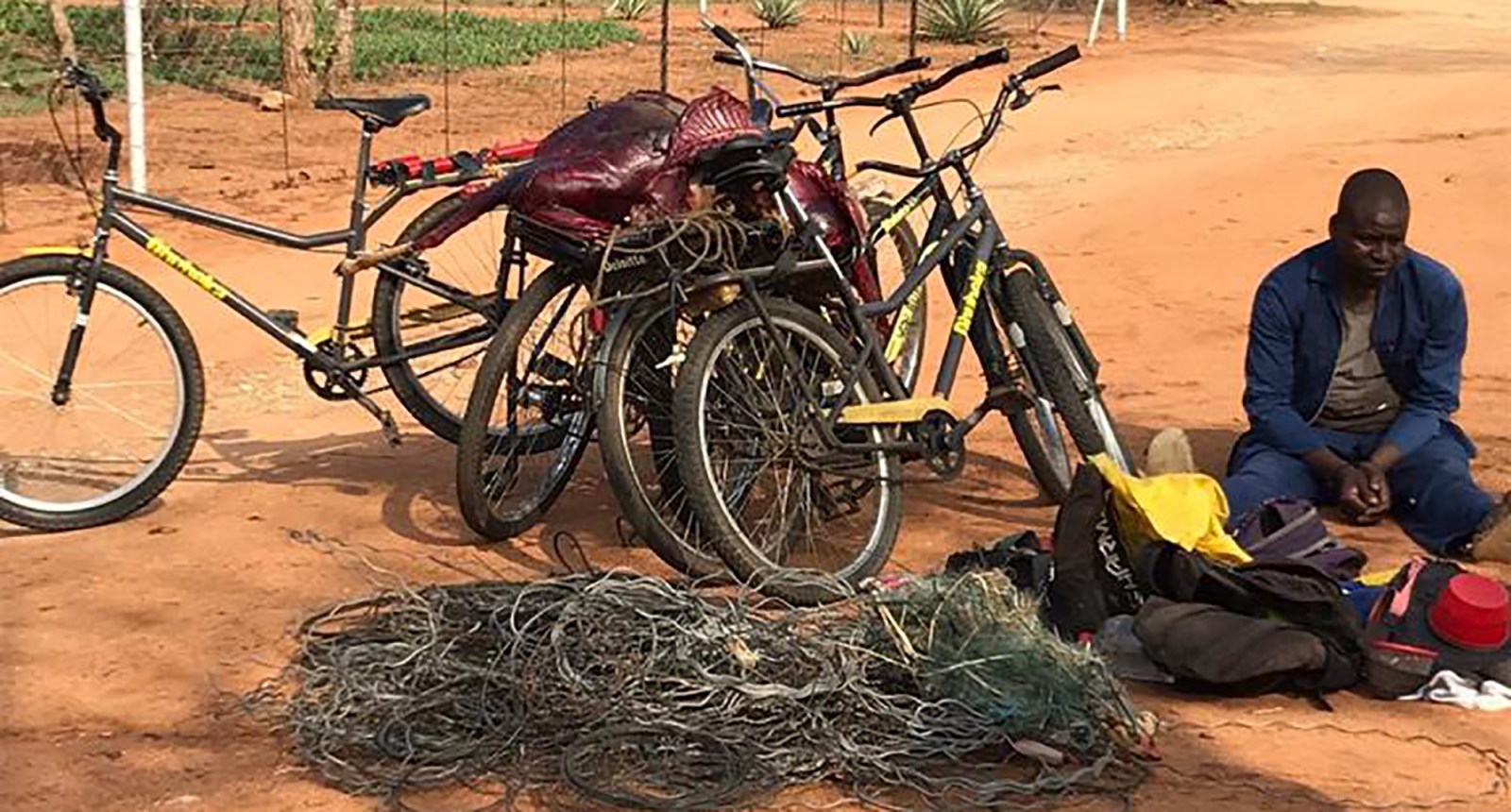
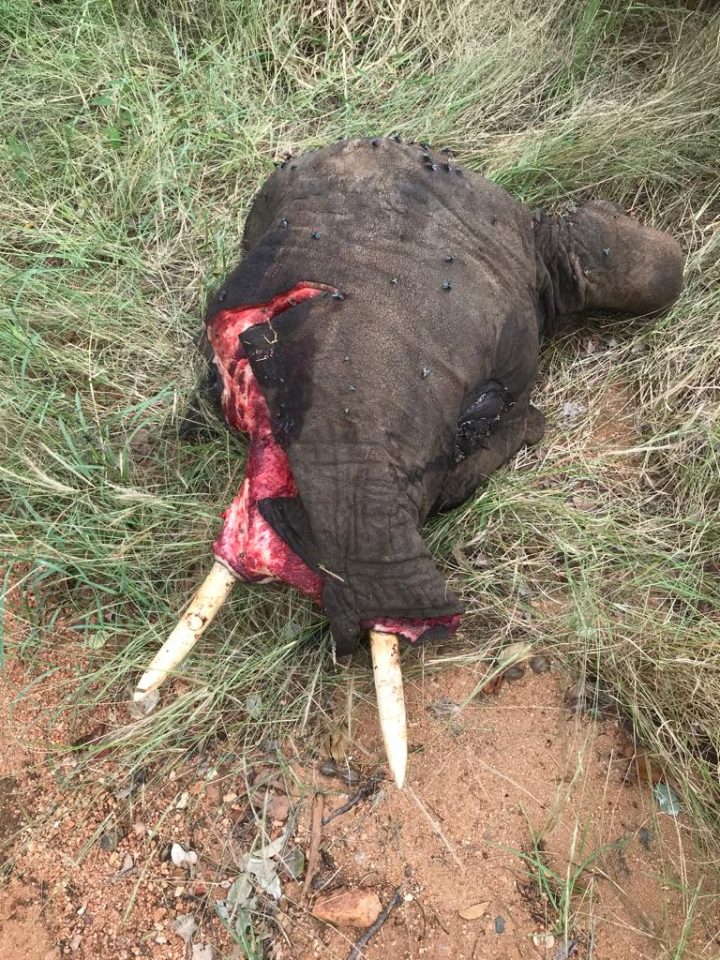
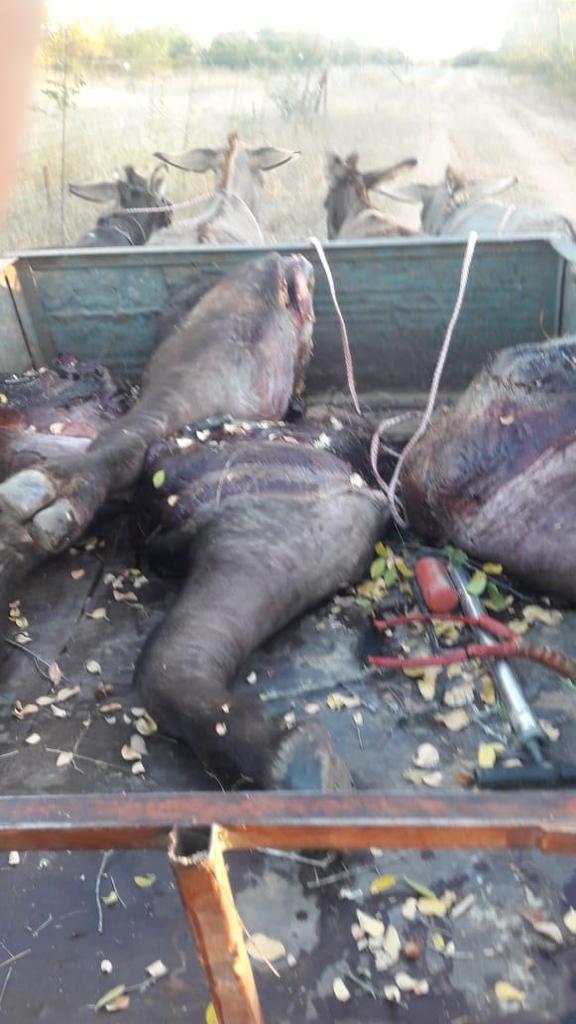
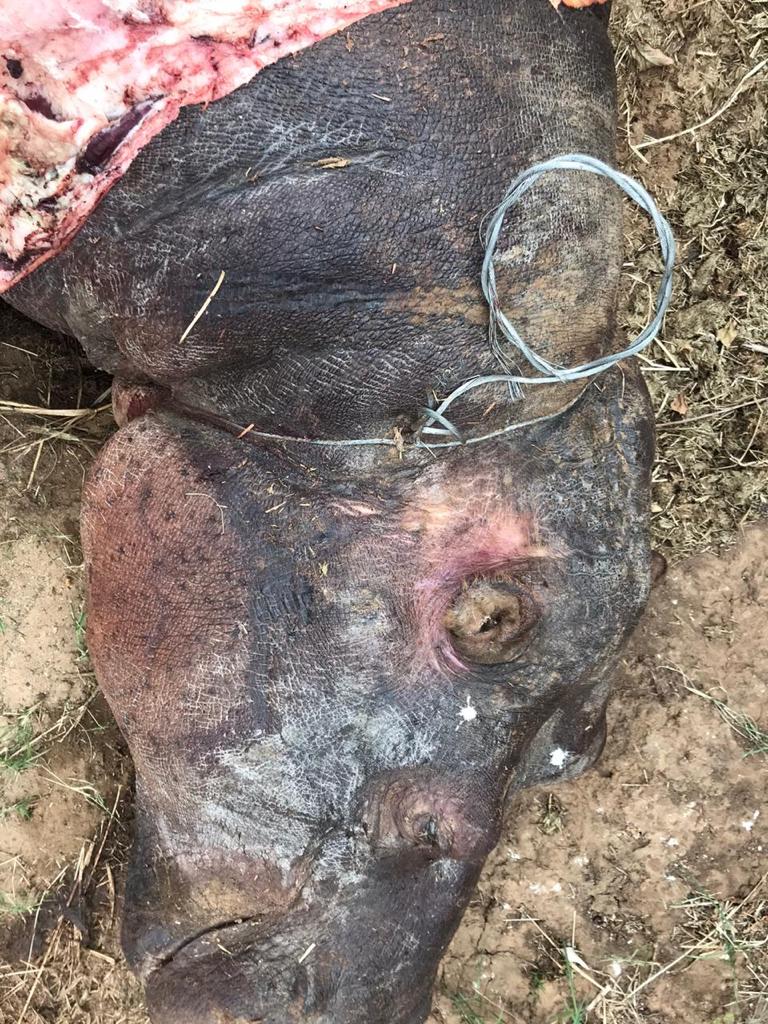
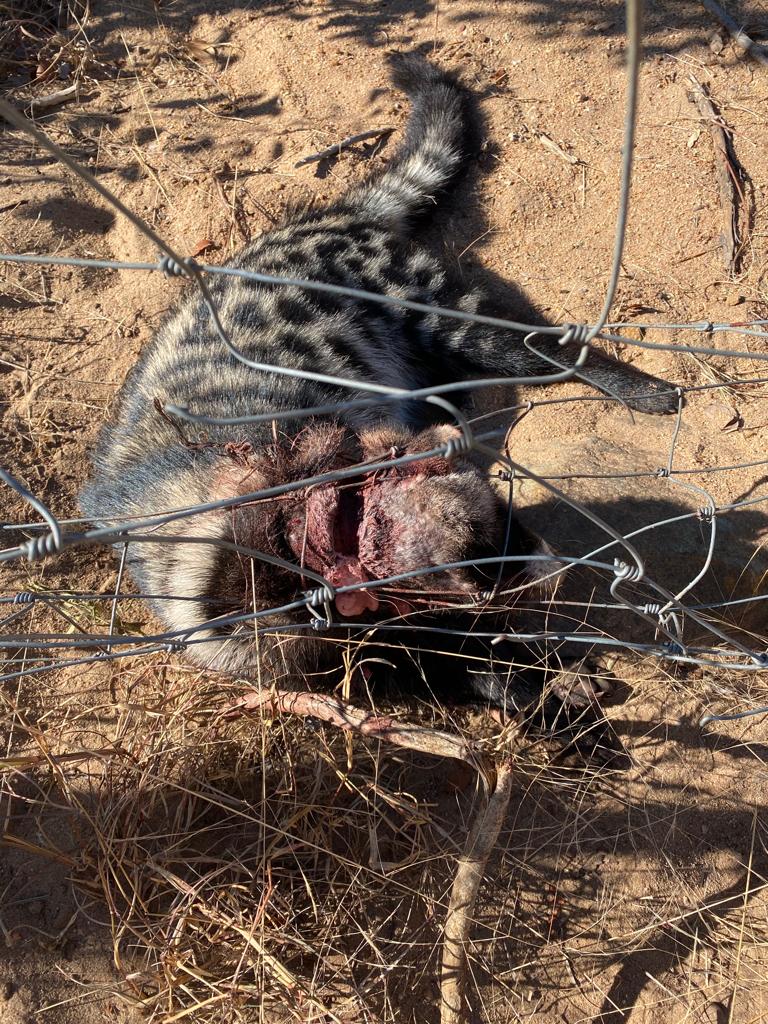
Then there was the third example of the fallout, which was perhaps the most devastating. On his phone, Daily Maverick’s primary source — who could not be named due to the threat to his personal safety — held a collection of photographs that illustrated the local trade in bushmeat: a severed baby elephant’s head; a baby hippo strangled by a snare; a range of small animals trapped in excruciating death-poses in the holes of the Greater Kruger fence.
Evidence of bushmeat trade, Mthimkhulu community, Limpopo. (Photo: Supplied)Evidence of bushmeat trade, Mthimkhulu community, Limpopo. (Photo: Supplied)Evidence of bushmeat trade, Mthimkhulu community, Limpopo. (Photo: Supplied)
Like the buffalo spoor and the escaped wildlife, the tragedy inherent in the bushmeat trade was that it seemed on the surface to be a direct result of the authorities’ refusal to maintain the fence. Below the surface, however, lay a thread of evidence and testimony that suggested a much darker genesis to the photographs on our source’s phone. The thread had everything to do with the land rights of the Mthimkhulu community and the fact that, up until 2015, the residents of Mbaula and Phalaubeni had been nowhere near desperate enough to poach the Kruger’s animals.
Why? Because up until that fateful year, the community was earning a steady income from lawful and sanctioned trophy hunting.
II.
“We started hunting a long time ago,” Kotlani Elvis Mavunda told Daily Maverick. “The outfitters were putting money into our trust account and we were using that money to uplift the community. We built a crèche and drilled a lot of boreholes. We were also donating to the drop-in centres. That was up until 2015, when the benefits were stopped by LEDET and given to the Mabunda Traditional Authority.”
Although Mavunda held the surname that aligned most closely with the traditional authority, he added, the signature on the 2015 agreement with LEDET had been that of Pheni Cyprian Ngove.
“An official from the government wrote a letter to us saying that anything we do we have to consult Ngove, because in writing it says that he is the chief of Mthimkhulu. It just happened like that one day, although all along the hunting rights had been given to us. We don’t know what changed.”
As Daily Maverick would establish, while there had been a bitter and ongoing traditional leadership dispute between Mavunda and Ngove, the former had for years been recognised by the residents of Mbaula and Phalaubeni as their de facto chief. In providing us with a background to the dispute, it turned out that Mavunda was echoing the heavily referenced and footnoted work of Professor CC Boonzaaier of the University of South Africa, who had recently compiled a history of the Mthimkhulu community.
In brief, from their origins in Mozambique, the Mavunda and Mthimkhulu clans had been closely interlinked, although in 1839 they had settled in the territory of Modjadji the Rain Queen as distinct entities. As refugees, they had no official status; their internal succession battles and the various relocations that ensued were of little significance to the court of Modjadji and their primary allegiances would therefore remain to the original clans.
Then in 1967, when the apartheid government enforced a further relocation of the Mthimkhulu clan to the settlement of Mbaula in the homeland of Gazankulu, it just so happened that they were “arbitrarily” placed under the jurisdiction of the Mabunda Tribal Authority and Chief Ngove. As Boonzaaier made clear, while the headman of the Mthimkhulu clan retained his status, he was appointed as a councillor to the tribal authority “without his consent and against his will”.
Boonzaaier also noted that two regents in succession had pledged allegiance to Ngove “without the consent of the Mthimkhulu Royal Family”, which he interpreted as “untenable” in terms of indigenous constitutional law — this one legal fact, he added, “does not justify [Kotlani Elvis Mavunda’s] deprivation of the chieftainship”. He further noted that “the Mthimkhulu community does not want to be governed by the Mavunda of Ngove” and that should Kotlani Mavunda of the Mthimkhulu not be legally elevated to the position of chief, it would be “difficult to imagine how sound administration and peace will be maintained in the area concerned”.
And yet these last few points, as persuasive as they were, did not feature in the responding affidavit that Mavunda’s advocates would submit to the Polokwane High Court in February 2021. As above, this specific case was all about the government’s attempt to evict the Mthimkhulu community from their namesake 9,000-hectare nature reserve, with the applicants listed as the national minister of the Department of Agriculture, Rural Development and Land Reform (DARDLR), the MEC of LEDET and the Mabunda Traditional Authority.
What did feature in the affidavit were the community’s origins and the fact that for the first 18 years following their enforced relocation to Mbaula, as testified by community elders, they had used the 9,000ha plot as grazing land. In terms of IPILRA and the South African Constitution, the affidavit stated, the law was clear — the Mthimkhulu community were the “beneficial occupants” of the nature reserve as defined by the system of redress that had been instituted by the post-apartheid state to accord communal land rights to former residents of the Bantustans. In this context, the subject of Mavunda’s elevation to chief had “nothing to do with” the relief sought by the community at large.
From the beginning of Mavunda’s responding affidavit, the tone was harsh. After referring to documents in the annexures that demonstrated, uncontestably, how previous government officials had acknowledged the community’s land rights — and how Mavunda had been approached to secure community resolutions for hunting rights “as late as 2013” — it was asserted that the current government, instead of fulfilling its constitutional duties, had “adopted an adversarial position akin to a litigant in a commercial matter”.
The post-apartheid state, Mavunda testified, seemed “hell-bent” on protecting the “arbitrary decisions” of the former Bantu Native Affairs Commissioner, who, “when he was devising means of controlling the natives,” decided “by a stroke of a pen” that the Mthimkhulu community would fall under the ambit of the Mabunda Traditional Authority.
By Daily Maverick’s reckoning, based on the legislation and the documentary evidence, the claim of the Mthimkhulu community to the land was watertight. Also, it appeared that the community qualified for security of land tenure in terms of the Upgrading of Land Tenure Rights Act, a legal course that they had been pursuing. The issue, it seemed, was who benefited from the hunting rights. “The purpose of the eviction application,” Mavunda’s affidavit stated, “[is to] ensure that all benefits relating to the property accrue to [the Mabunda Traditional Authority].”
As for LEDET, Mavunda denied that the provincial department was responsible for the conservation and tourism management of the game reserve. In challenging the eviction order, Mavunda noted that the co-management agreement that had been concluded in 2015 between LEDET and the Mabunda Traditional Authority was unlawful — for the simple reason that the Mthimkhulu community had not been consulted. On this point, section 2(1) of IPILRA was about as unambiguous as it’s possible to get: “no person may be deprived of any informal right to land without his or her consent”.
And it was this issue of consent that Mavunda kept returning to in his interview with Daily Maverick.
“If Ngove came here looking for a community resolution for hunting rights,” he told us, “nobody would recognise him. They don’t know what he looks like.”
III.
The hunting fraternity in South Africa, as Daily Maverick discovered during the course of this investigation, is governed by a set of laws and regulations that are designed to ensure two outcomes: first, all proceeds must flow to the rightful beneficiaries; second, animal populations in a given area must remain healthy and sustainable. But in the document entitled “Allocation of Game Quota to a Traditional Authority for 2021/2022 Financial Year,” signed by LEDET’s deputy director-general of environment and tourism on 23 March 2021, it was apparent that both of these outcomes had been compromised.
For starters, unlike the previous year, the hunting quotas for the Letaba Ranch Nature Reserve had been issued jointly to the Mabunda Traditional Authority and the Majeje Traditional Authority, which had been facilitating the process on behalf of the indigenous community to the north. In other words, where LEDET’s assigned hunting quotas for the 2020/2021 financial year had specified how the game was to be divided — for instance, seven buffalo for Mabunda, seven for Majeje and 13 for “the state” — in the latest iteration there was no such breakdown.
Then there was the fact that the numbers themselves had jumped at an alarming rate, particularly as far as the most lucrative animal was concerned: for the 2020/2021 financial year, LEDET had assigned a total of 11 elephant for “reduction”; now, in 2021/2022, there were all of a sudden 23 elephant up for grabs.
On a Thursday afternoon in Pretoria in early November 2021, Daily Maverick met the owners of two commercial hunting operations who, due to the above anomalies, were facing an impossible situation. While neither of the men consented to be named, citing the potential damage to their reputations in the eyes of their international clientele, they were more than willing to guide us through the paper trail.
The first man, who for the sake of clarity we’ll call “Malan,” had secured the exclusive hunting rights for the Majeje Traditional Authority’s quota, made up (based on the split) of 15 buffalo and 12 elephant. The second man, who we’ll call “Swanepoel,” had secured the rights for the Mabunda Traditional Authority’s quota, made up of 15 buffalo and 11 elephant.
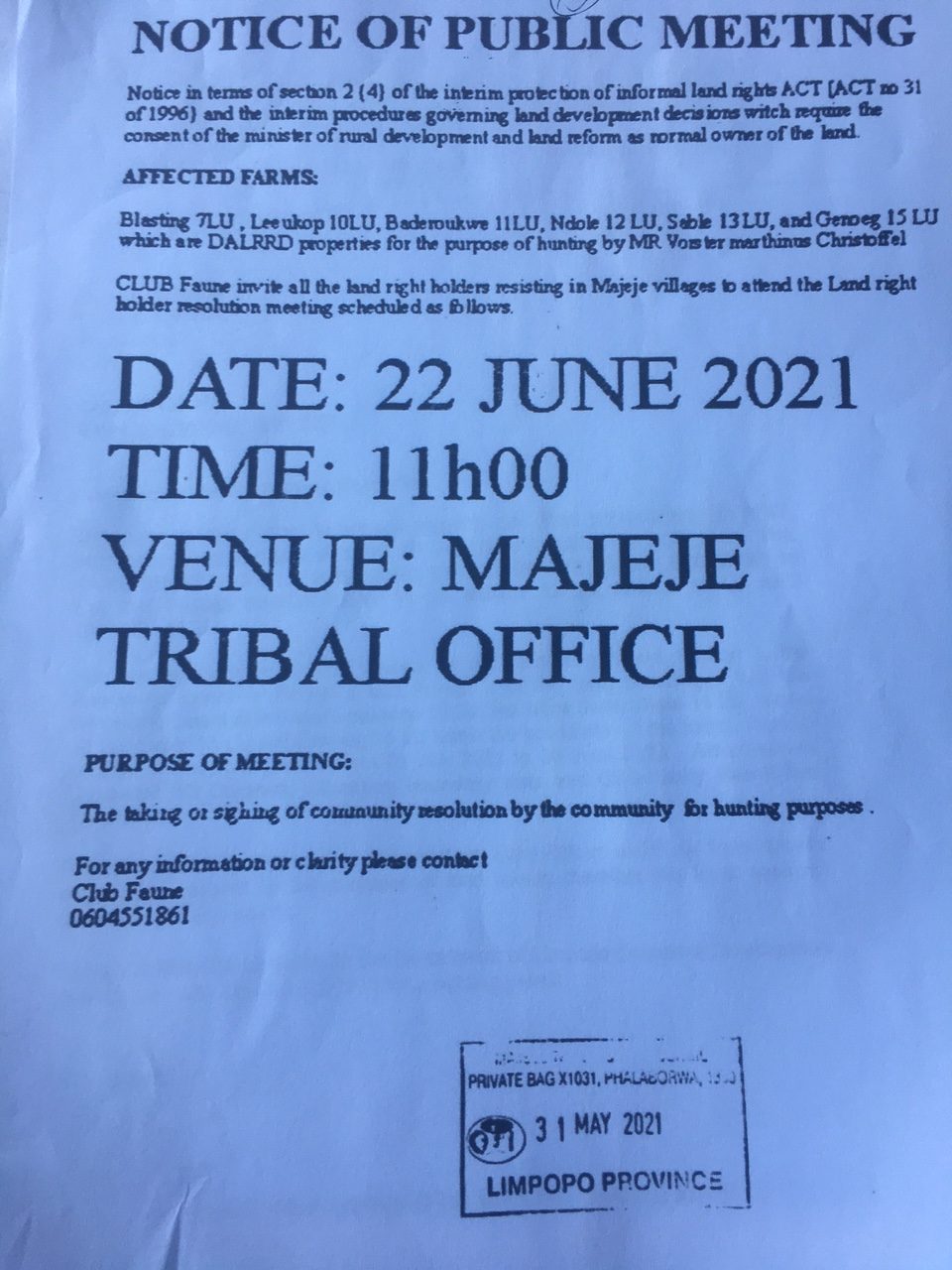
Malan took us through the paperwork to demonstrate that, for him at least, everything was legitimate. After LEDET’s initial quotas, he explained, the next step was allocation of the hunting rights. Here, DARDLR had assigned the rights from 1 July 2021 until 30 June 2022 to one “Christoffel Marthinus Vorster,” a Phalaborwa-based hunting outfitter and middleman from whom Malan — like Swanepoel on the Mabunda portion of the quota — had then bought them. As the third step in the process, Malan handed us a copy of the “Notice of Public Meeting” that had been advertised by Vorster for 22 June 2021 in the “Majeje Tribal Office”. This was the all-important “taking or signing of community resolution… for hunting purposes” as required by section 2(4) of IPILRA.
(Photo: Supplied)
Finally, as the fourth step in the process, LEDET had entered the picture again with the allocation of hunting permits. The farms on which Malan had been authorised to hunt were the same farms that belonged to the Majeje community, a fact he knew from prior experience. But for Swanepoel, who was new to the region, there was a problem. On his own hunting permits, which were shared with Daily Maverick, he had been allocated the same Majeje farms.
“We actually passed each other out in the veld,” Malan told us. “We smiled and waved, but neither of us knew what the other was doing there. Later, when we started talking, we realised that something was very wrong.”
The kicker for Swanepoel, he explained, was when he realised that he could not secure the proper signatures for export of the “hunting trophies” to his international clients. Eventually, this resulted in Swanepoel withholding R677,000 in payments to one “Chris van der Westhuizen” of African Pride Hunting Safaris. As it turned out, there had been three middlemen involved in the on-sale of the quotas to Malan and Swanepoel — Vorster, who had originally been assigned the joint rights by DARDLR, his partner Victor Britz and Van der Westhuizen.
Given the amount of money involved, it wasn’t long before the lawyers’ letters started flying. In a letter dated 19 October 2021, addressed from Van der Westhuizen’s attorneys to Swanepoel, it was noted that the agreement to purchase the hunting quota of the Mabunda Traditional Authority had been concluded at R150,000 per buffalo and R460,000 per elephant.
“We have been informed that during September 2021 you conducted guided hunts for clients for the hunting of 13 buffalo and two elephant,” the letter stated, “through our client acting as agent and intermediary in order to facilitate your hunting activities in respect of the quota allocated to the Mabunda Tribal [sic] Authority at Letaba Ranch (allocated solely and exclusively to our client by agreement between our client and Mr Chris Vorster and Mr Victor Britz).”
Translated, this meant that Swanepoel owed Van der Westhuizen a total of R2.87-million for the September hunt. The attorneys noted that Swanepoel had paid the majority of the amount, but that he “refused to pay the balance of R1.2-million to [Van der Westhuizen] due to undue influence and interference by a third party, [Malan]”.
On 21 September, the letter continued, Swanepoel agreed to pay the outstanding R1.2-million subject to a number of conditions, including that “all transport permits” for the skins, tusks, tails, ears, buffalo skulls, capes and shoulder mounts were arranged.
“You subsequently and during late September 2021 made payment of R543,000 directly to Chris Vorster for the outstanding amount owing to the Mabunda Traditional Authority but have failed and/or refused to make payment of the balance of R677,000 due, owing and payable to our client, despite demand.”
At the venue in Pretoria in early November, Swanepoel handed over evidence of the payments that had been made, including the R543,000 directly to Vorster.
“I want to know where the money has gone,” he told Daily Maverick. “I paid R2.2-million to two people in eight days, and that’s a helluva lot. Where is it?”
IV.
The obfuscations and evasions that we met in our attempts to get answers to this question were spellbinding in their creativity. Max-Wilhelm Rossle, an associate at Peter Le Mottee attorneys, sent a 1,100-word response on behalf of Van der Westhuizen in which he repeated different versions of the following sentence: “All quotas allocated at Letaba Ranch and all hunting rights held by Mr Chris Vorster are, in the absence of material evidence to the contrary or a formal finding to the contrary by a competent Court, accepted by my client to be bona fide and prima facie legitimate and lawful until proven otherwise or overturned by a competent Court of Law.”
At the beginning of the missive, however, despite the fact that Rossle had acknowledged in his letters to Swanepoel the above mentioned R543,000 payment “directly to Vorster” — a payment that had clearly been accepted by Van der Westhuizen too — he’d stated that Daily Maverick “should in no way attempt to… link the commercial affairs of [his client] to those of Club Fauna France and its role-players”.
Accordingly, when it came to distribution of the funds and the pivotal issue of the Mthimkhulu community’s share, Rossle suggested that Vorster and Britz were the only ones with the answers.
As with Van der Westhuizen, we had only two questions for Vorster and Britz of Club Fauna France. First, did the company, acting on behalf of Chief Ngove and the Mabunda Traditional Authority, obtain a resolution from the Mthimkhulu community for the 2021/2022 hunting quotas? Second, what portion of the R2.2-million paid by Swanepoel to Van der Westhuizen and Vorster had been distributed to the community?
In the 24-hour period after the questions were sent, Vorster — whose son Marthinus Vorster had been sentenced to five years in prison for “anti-black terrorist activities” and the desecration of an ANC politician’s grave (upon arrest in 2010, the police had confiscated “pipe bombs, semi-automatic guns and ammunition”) — sent a series of emails to Daily Maverick requesting a face-to-face meeting.
We had our facts “completely wrong,” he stated, and he would make himself available to personally hand us the “documentation” and set the record straight. In the end, despite repeated requests, Vorster did not send us the alleged documentation. Neither did he provide substantive answers to our questions.
As for Chief Ngove, whose name was listed on LEDET’s 2021/2022 quotas, our questions were basically the same: was there a community resolution and to whom had the hunting proceeds been distributed? But the second question, this time, had a much broader scope.
“Daily Maverick has noted,” we began, “that the Mabunda Traditional Authority has not been registered in terms of the Communal Property Associations Act of 1996. Given this apparent fact, to whom have the hunting proceeds been distributed since 2015, when the co-management agreement for the Mthimkhulu Game Reserve was signed between the Mabunda TA and LEDET?”
Chief Ngove’s response was as dismissive as it was brief:
“I have been advised by our attorney that it is not advisable to comment on a live court matter. Regrettable that I cannot be of assistance at this stage.”
Then there was LEDET, which opened by taking the same line as Ngove. We wanted to know, since the communal land rights of the Mthimkhulu community had been recognised by previous government officials (including the former DG of DARDLR), which legal precedents had motivated the eviction order. In other words, why did the tenets of IPILRA no longer apply? We were told, as if this was somehow new information, that the matter was before the Polokwane High Court.
Okay, but did the Mthimkhulu community give their free, prior and informed consent to the 2015 co-management agreement between LEDET and the Mabunda Traditional Authority, as required by the tenets of IPILRA?
The non-answer read as follows: “LEDET has signed a co-management agreement with the Mabunda Traditional Council (Ngove) in which the Mthimkhulu Community form part of the larger community structure under the tribe.”
Can LEDET then prove that the Mthimkhulu community has been receiving benefits from hunting since 2015?
Again, the same nonsensical non-answer, with a brazenly absurd twist at the end for effect: “LEDET has signed a co-management agreement with the Mabunda Traditional Council (Ngove) in which the Mthimkhulu Community form part of the larger community structure under the tribe and all benefits accrued to the tribe are for the benefit of the communities under the tribe.”
This was about as direct an admission as Daily Maverick was likely to get: if LEDET, as the “competent authority” in charge of the hunting quotas and the permits, had proof that the Mthimkhulu community were receiving their rightful benefits, we can only assume that the department would have shared it with us.
As for the absent community resolution for the Mabunda portion of the 2021/2022 hunting quotas, LEDET referred us to DARDLR, with which “the IPILRA mandate lies”.
At the time of this writing, Minister Thoko Didiza’s office had yet to reply to our questions.
V.
If it’s to be placed anywhere, this investigation must be placed within the context of the UN Convention on Biological Diversity’s “New Global Framework for Managing Nature through 2030”. Drafted in Montreal in July 2021, the framework, which ultimately seeks the ratification of 196 member countries, includes 21 “targets” for the end of the decade.
The first of these targets reads as follows:
“At least 30% of land and sea areas global (especially areas of particular importance for biodiversity and its contributions to people) conserved through effective, equitably managed, ecologically representative and well-connected systems of protected areas (and other effective area-based conservation measures).”
The science on which this target is based is inarguable. In May 2019, working off the contributions of 145 “expert authors” from 50 countries — plus the inputs of another 310 “contributing authors” — the Intergovernmental Science-Policy Platform on Biodiversity and Ecosystem Services (IPBES) released a report that environmentalist George Monbiot called “the biggest and worst news humanity has ever received.”
At the time of the report’s release, IPBES chair Sir Robert Watson had these words for the world’s press: “The overwhelming evidence of the IPBES Global Assessment, from a wide range of different fields of knowledge, presents an ominous picture. The health of ecosystems on which we and all other species depend is deteriorating more rapidly than ever. We are eroding the very foundations of our economies, livelihoods, food security, health and quality of life worldwide.”
And so, given that the first measure for the amelioration of these effects is protection of 30% of the planet’s surface — with “conservation corridors” listed as a primary method — it’s hardly a stretch to argue that South Africa’s Greater Kruger conservancy is a major player in humanity’s fate.
Which begs the question: do the 21,200 square kilometres that make up the KNP and Greater Kruger — an area of protected land as large as Belgium — serve as an example of an “effective, equitably managed, ecologically representative and well-connected” conservation corridor?
To the first pair of criteria, if the story of the Mthimkhulu community is any indication, the answer is obviously “no”. By definition, an effective and equitably managed corridor cannot sustain a system of entrenched corruption that robs 26,000 human beings of their collective income.
Neither can it sustain the trade in bushmeat — the snares in the village square; carts transporting elephant limbs — that is a direct result of the hunger and desperation caused by such corruption.
Evidence of bushmeat trade, Mthimkhulu community, Limpopo. (Photo: Supplied)
Also, if a corridor is to be “well-connected,” the boundary fence that separates it from the outside world cannot, by implication, be porous. Human-wildlife conflict must be kept to a minimum and the threat of a viral outbreak, like foot-and-mouth disease, must be strictly and properly managed.
We are therefore left with only the third criterion, “ecological representation,” on which KNP and the Greater Kruger can score some positive marks. But here, although the reserve’s biodiversity is healthy and intact, the illegal hunting of keystone species is another problem over which SANParks has no apparent control.
“The management of community land adjoining Kruger National Park remains a complex issue,” stated Luthando Dziba, the acting CEO of SANParks, when Daily Maverick put these issues to him. “SANParks developed the Greater Limpopo Transfrontier Conservation Area (GLTFCA) Cooperative Agreement framework in 2018 in order to ensure there are shared principles about cooperation for conservation and development in the Greater Kruger and the Greater Limpopo TFCA. There are however conservation areas that fall outside the mandate of SANParks and these include the Mthimkhulu Private Game Reserve and the Letaba Ranch, which are under the management authority of LEDET.”
Dziba hoped, he told Daily Maverick, that SANParks did not “appear evasive”. But on this story, as he must have known, evasion was the central theme. DM/OBP