In 1969 a young idealist, on her first trip to Hawaii, checked into the Royal Hawaiian Hotel, a sublime pink confection of a place in Waikiki Beach, on the island of Oahu. She threw open the balcony curtains, only to have the view of the surrounding mountains spoiled when she looked down onto the parking lot of the neighboring Sheraton Waikiki, then under construction. In April of the following year, the woman in question released “Big Yellow Taxi,” a protest song inspired by her stay at the legendary resort. A couple of the lyrics—“You don’t know what you got ’til it’s gone” and “They paved paradise and put up a parking lot”—became bywords of the ’60s counterculture.
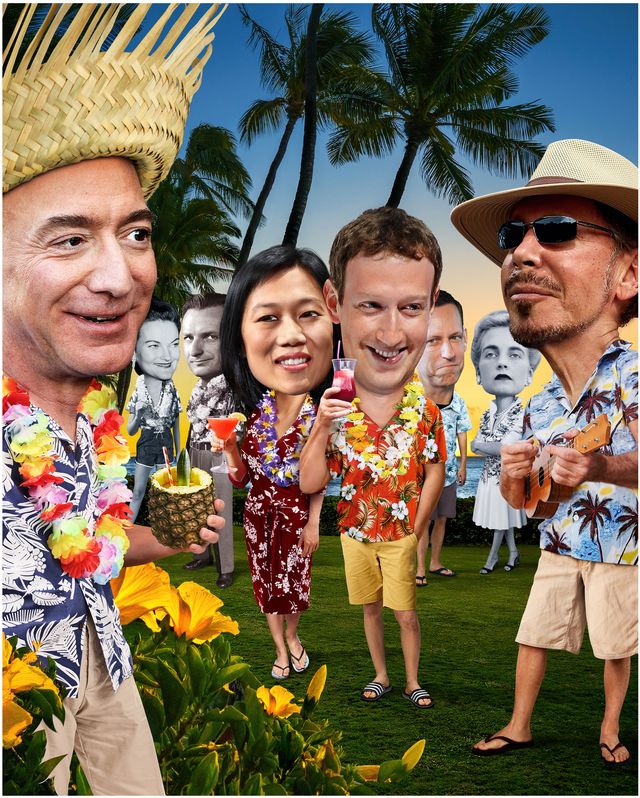
In a turn of events that in another era might have galvanized a generation of tambourine-wielding folklorists, the rest of this remote Pacific archipelago has become Eden for the one percent.
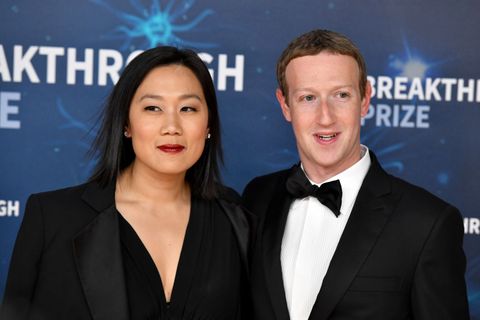
EBay founder Pierre Omidyar, who spent part of his childhood in Hawaii, is now back as a full-time Honolulu resident. Salesforce boss Marc Benioff holds court on the Big Island, along with Starbucks capo Howard Schultz. Oprah is over in Maui, as is Jeff Bezos. If they squint they can make out Peter Thiel’s lair in Makena, on the south shore. In December, Mark Zuckerberg and Priscilla Chan bought an additional chunk of land on Kauai, bringing their total to more than 1,500 acres. And the film producer Allison Sarofim is in Kahala on Oahu, where her family owns the old Clare Boothe Luce estate.
“Going there has taught me the concept of pono, which means living in harmony with each other and the environment,” Sarofim says. “It’s a fundamental value that is deeply ingrained in Hawaiian culture, and it’s my hope that people see and understand that part of Hawaii, as opposed to simply a beautiful vacation destination.”
Promoted for 120 years as a tourist escape for its sun, surf, and great year-round weather, Hawaii is a victim of its own success; sales of properties costing $10 million or more have increased sixfold in the last year.
“We always thought people wanted authentic experiences, and we encouraged them to come and live like a local,” says Chris Kam, president and COO of Omnitrak, a Honolulu-based research company. “Somewhere along the line that messaging got interpreted as ‘Move to Hawaii and become a local.’ ”
“There are a lot of really interesting things going on below the surface, if you’re willing to make the effort,” he says. “I’m not surprised that a lot of these people who come decide to stay.”
The first gentrifiers of the islands were mostly robber barons, but today’s status-conscious transplants are more likely to come from Palo Alto or Wall Street. The Big Five (the sugarcane conglomerates that wielded considerable power in the early 20th century) may have gone the way of traditional instruments like the pahu, but a scan of the map and headlines reveals that serious money from the mainland is as prevalent as ever.
Though there are no formal programs or tax incentives to attract residents from out of state, the draw of Hawaii, beyond the Gilligan’s Island escapist fantasy, remains its isolation and the perception that it’s a safe place to visit and, by extension, to live. Then there is the allure of the not insignificant anonymity of a largely TMZ-free zone.
The charge of the billionaire brigade, at least as portrayed in the media, is being led by the notoriously press-shy Zuckerberg, who purchased several hundred acres on Kauai in 2014 for $53 million and shelled out $120 million on subsequent expansions. Last year he became the poster boy for “There goes the neighborhood!” anxieties when he infamously shared a video of himself, slathered in zinc cream, surfing on a hydrofoil—an image that is not likely to be featured on official tourism channels.
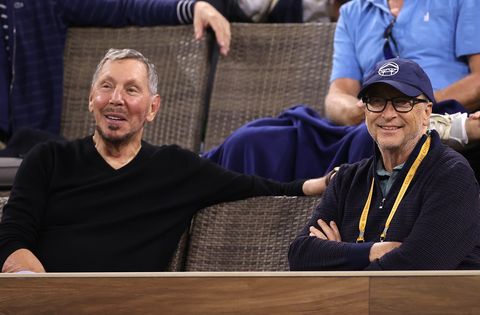
But it is the 35-mile Kona-Kohala coast, on the northwest part of Hawaii Island, as the Big Island is also called, that continues to attract the likes of Walmart heir S. Robson Walton, Emerson Collective billionaire Laurene Powell Jobs, Intel co-founder Gordon Moore, and Benioff, who wears Hawaiian shirts to work and named his dog Koa, or warrior.
They join Michael Dell, founder and CEO of Dell Technologies, who bought the Four Seasons hotel and the surrounding Hualalai Resort in 2006, going on to build an oceanfront home valued around $75 million in Hualalai’s tony Kukio Golf and Beach Club. For his part, Bill Gates reportedly stays up the coast at the Hilton Waikoloa Village, even though, since 2007, he has co-owned the Four Seasons hotel management company with Saudi prince Alwaleed bin Talal. (Last year Gates became the majority shareholder.) It is increasingly hard to see the forest for the megayachts.
Not surprisingly, a lot of these tech arrivistes are buying their way in with the help of organizations, such as the Hawaii Community Foundation, that connect donors with charities. Benioff recently made the news as a good neighbor by coordinating the donation of 1 million face masks to Hawaii County Civil Defense through the University of California San Francisco, where he funded the Benioff Center for Microbiome Medicine. In 2016 Zuckerberg incensed locals by building a six-foot-tall wall along the perimeter of his enormous estate, so he then poured more than $22 million into various nonprofit organizations on Kauai, including $4 million to save the Alakoko Fishpond. In January he gave $50 million to the University of Hawaii, its largest cash gift ever.
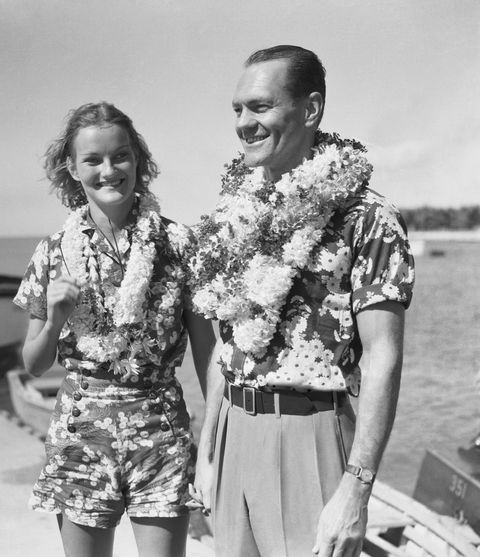
De Fries is referring to the decades-old migration of high society, led principally by transplants from San Francisco, which has been beating a path to Hawaii ever since Laurance Rockefeller, the son of John D. Rockefeller, built the landmark Mauna Kea Beach Hotel on the Kohala Coast in 1965. Rockefeller tapped his friend Lurline Matson Roth, who was possessed of not only immaculate taste but also a substantial shipping fortune, to design a template for the beau monde to luxuriate in style, like Luce and Doris Duke, whose estate, Shangri La, became part of the modern mythology of Hawaii. (Her feud with Barbara Hutton escalated there, when the Woolworth heiress decided to help out her friend by redecorating Duke’s Xanadu.)
Luce commissioned the Russian-born Hawaii modernist master Vladimir Ossipoff to build her a post-retirement sanctuary that exalted the lush tropical splendor. Halenai‘a, or House of the Dolphins, was finished in 1967, and 32 years later the beachfront manse was acquired by Allison Sarofim’s father Fayez. Today Sarofim too preaches the gospel of environmental conservation: “Like many, I go to Hawaii to recharge, and a crucial part of that experience for me is to connect with nature.”
The land remains Hawaii’s most precious inheritance, one that requires caretaking by everyone, visitors and locals alike, from generation to generation. De Fries, who was born in Waikiki, learned that early on from his grandmother. When asked to explain the concept of a glass half full versus half empty, her reply was that it is always 100 percent full—with the water we drink and the air with breathe. And all of it filled with light.
“She taught me that until you learn to value what’s intangible the same way you value what is tangible,” De Fries says, “you will just keep repeating the same lessons in life. Each is a life-giving force: Our ancestors referred to them as ha, that breath of life; wai, the water we drink; and i was in reference to the light or spirit in the glass. In this story is the essence of who we are as a place and as a people. And it speaks to our fullest potential, because we come from the land of life-giving water with lessons to learn and lessons to teach.”
This story appears in the April 2022 issue of Town & Country.


No comments:
Post a Comment