Sunday, 8 January 2023

The Lifelong Isolation of Two Elderly Sisters in India

Swati Goswami stands with her hand across her chest.
Photographs by Debsuddha

In Kolkata’s Hatibagan area is a two-story house that is a hundred and sixty-three years old. It sits far back from the road, on a piece of land so well insulated that none of the sounds of the city—not the honking of cars nor the cries of the peanut vendors, not even the barking of stray dogs—may enter. It is the ancestral home of Gayatri and Swati Goswami, two elderly sisters who rarely step outside.

The Goswami sisters are albino, with white skin and blond hair, and face a daunting level of scrutiny whenever they venture out in public. Some people point; others taunt, in Bengali, “look, look, a foreigner.” Such behavior has made the sisters reluctant to leave home, save for rare, special visits to another sister’s house, or to the institute where Gayatri studied when she was younger.

The sisters were among the millions of people in India who learned that the country would go into lockdown on March 24, 2020. They were shocked and devastated by the announcement, recalled their nephew, the photographer Debsuddha, who documented the sisters’ experience living under covid restrictions in a series called “Belonging.” The sisters’ small outings had been their only way of breaking the monotony of their life; now their world became smaller still.

Gayatri and Swati’s parents, an army officer and a housewife, fled from East Pakistan to India before Partition, in 1947. The Goswamis were middle class, and channelled the hardship of their new life and lesser status into tending to their seven children, giving them every opportunity they could afford. Three of the children, Gayatri, Swati, and another sister, Snigdha, who died, were born with albinism.

All of the children were educated—even the girls—but, despite their parents’ best efforts, life was painful for the albino sisters. During Durga Puja, the most important festival of the Bengali Hindu calendar, when families dress up in new clothes, visit temples, and socialize, some relatives avoided the Goswami house, believing that the sisters’ appearance would negatively impact their social status. When she was in the eighth grade, a group of students pinned Gayatri to the ground and chopped off her curly blond hair. When Swati wanted to train as an actor, she was rejected because the school staff were afraid of how an audience would react upon seeing her. Though fair skin is often revered in Indian culture—particularly in comparison with dark skin—the sisters’ coloring has made them targets for cruelty.

Their mother counselled them not to pay their bullies any heed. Both sisters went on to be highly accomplished—Gayatri has three degrees and speaks five languages, including Sanskrit and Japanese, and Swati has a degree in history and plays violin and guitar—but they continued to be ostracized as adults. Both sisters have struggled to find work, and today they survive on their inheritance. (Their isolated life style accrues few expenses.) Their house, Debsuddha told me, is the safest place for them.

VIDEO FROM THE NEW YORKER


The photographer, who is thirty-one, has become closer with his aunts in recent years. His curiosity about their story is shaped by his own experiences of alienation—he speaks with a stutter, and was bullied by his peers for it. Debsuddha’s first language is Bengali, but even in English he talks forcefully about the indignities his aunts have suffered. “When they fell in love, they had to keep it to themselves,” he said. “They have lived a life of restraint in every way.”

Gayatri and Swati Goswami embrace.
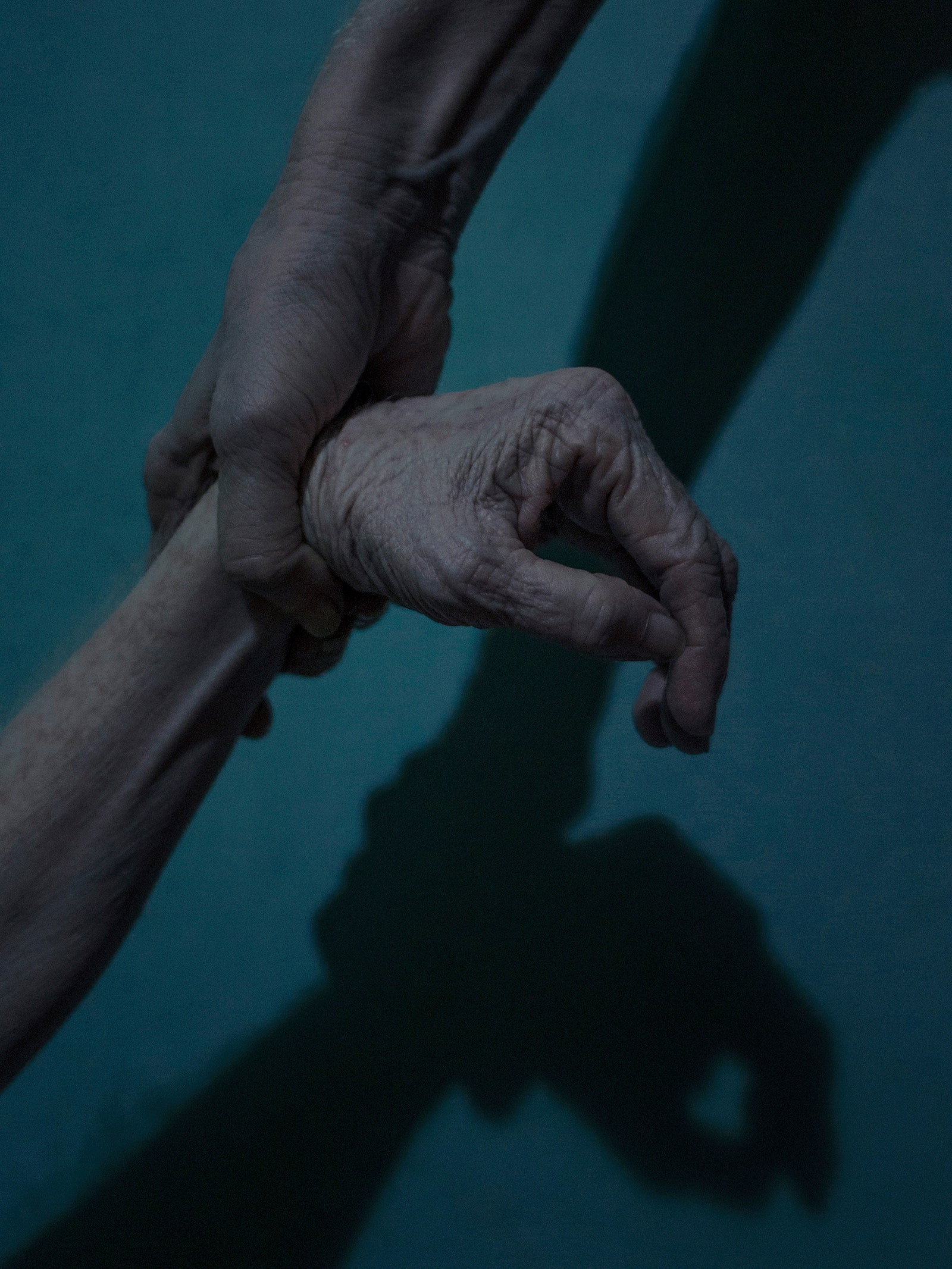
One sister grabs another by the wrist.

The sisters continue to struggle through the pandemic. In 2018, Gayatri, the older of the two, slipped and injured herself in the bathroom, leaving her almost entirely dependent on Swati. They had always been bound by their condition, but this experience was different. Debsuddha captured this new stage of the sisters’ relationship with a closeup image, in which Swati firmly holds her older sister’s limp white arm at the wrist. Like the other images in “Belonging,” the picture has a mesmeric quality, the cool tones deliberately chosen to resemble snapshots from a dream.

A woman's hand partially submerged in water.

The palette, Debsuddha said, is meant to capture the surreal seclusion of his aunts’ home. In addition to being unusually quiet, the house is damp and dark, and the sisters use electric tube lights to navigate their way around the heavy furniture. To the photographer, it appears as though the darkness isn’t just in their surroundings—“it is also in their minds.” Artifacts of their early life, such as a high wooden cradle that both aunts and Debsuddha slept in as babies, have been retired to the attic. The gramophone is gone, but there’s still an old TV, an old telephone, and piles of old papers. The paint on the walls is peeling, like skin. Throughout lockdown, other members of the family have kept in touch with one another, but the sisters don’t use the Internet. A rickshaw puller who has known them for decades would come by with groceries. The sisters would pay him and then retreat inside.

A hanger holding a textile in dark blue light.
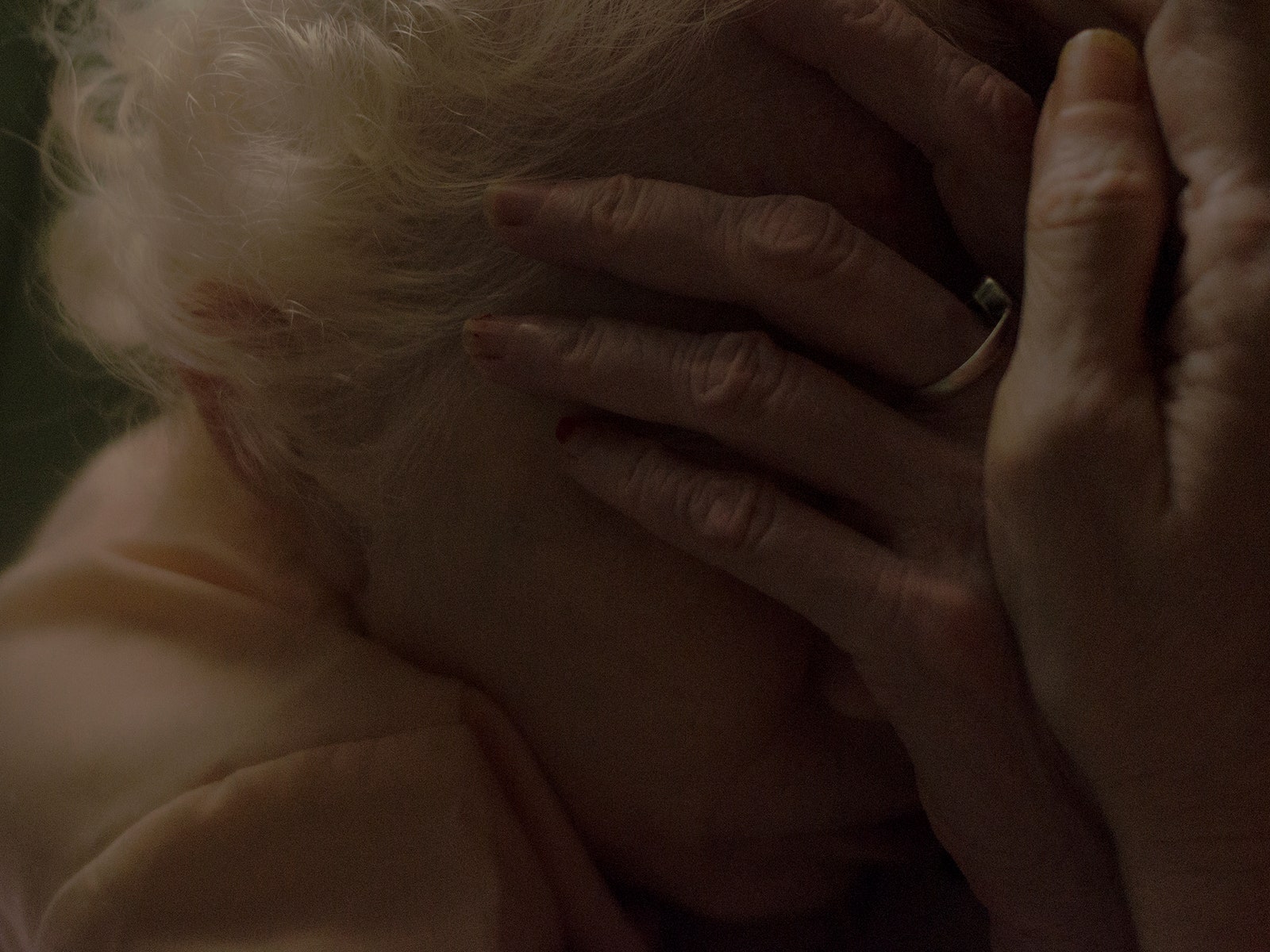
Swati holds her own face in fear.

When Debsuddha visits Gayatri and Swati, they are joyful, eager to make him tea and to hear the latest gossip. He worries about them when he leaves—at times, he wonders if his aunts feel like they only exist to each other. Yet, through his work, he makes their lives visible. One image shows Swati seated on the terrace. In earlier times, the sisters would walk up together in the late afternoon, when the sun was low in the sky, and gaze out over the city while combing their hair, but Gayatri can no longer climb the stairs. Swati is alone but surrounded by plants, her expression determined, her feet red with alta, a sensual colored dye usually worn by young or newly married women. Gently, she tilts a watering can.

Albanese accuses Dutton of engaging in ‘culture war stunts’ over Indigenous voice

Opposition leader has demanded more detail, saying lack of clear information will condemn referendum to failure and damage reconciliation efforts * Follow our Australia news live blog for the latest updates * Get our morning and afternoon news emails, free app or daily news podcast The prime minister, Anthony Albanese, has accused the opposition leader, Peter Dutton, of engaging in “cheap culture war stunts” over the Indigenous voice to parliament. Dutton on Sunday demanded – in a letter to Albanese also released to the media – more detail on the proposed body which will be voted on at a referendum by the end of 2023. Continue reading...
http://dlvr.it/SgY6ys

Saturday, 7 January 2023

The Profound Defiance of Daily Life in Kyiv

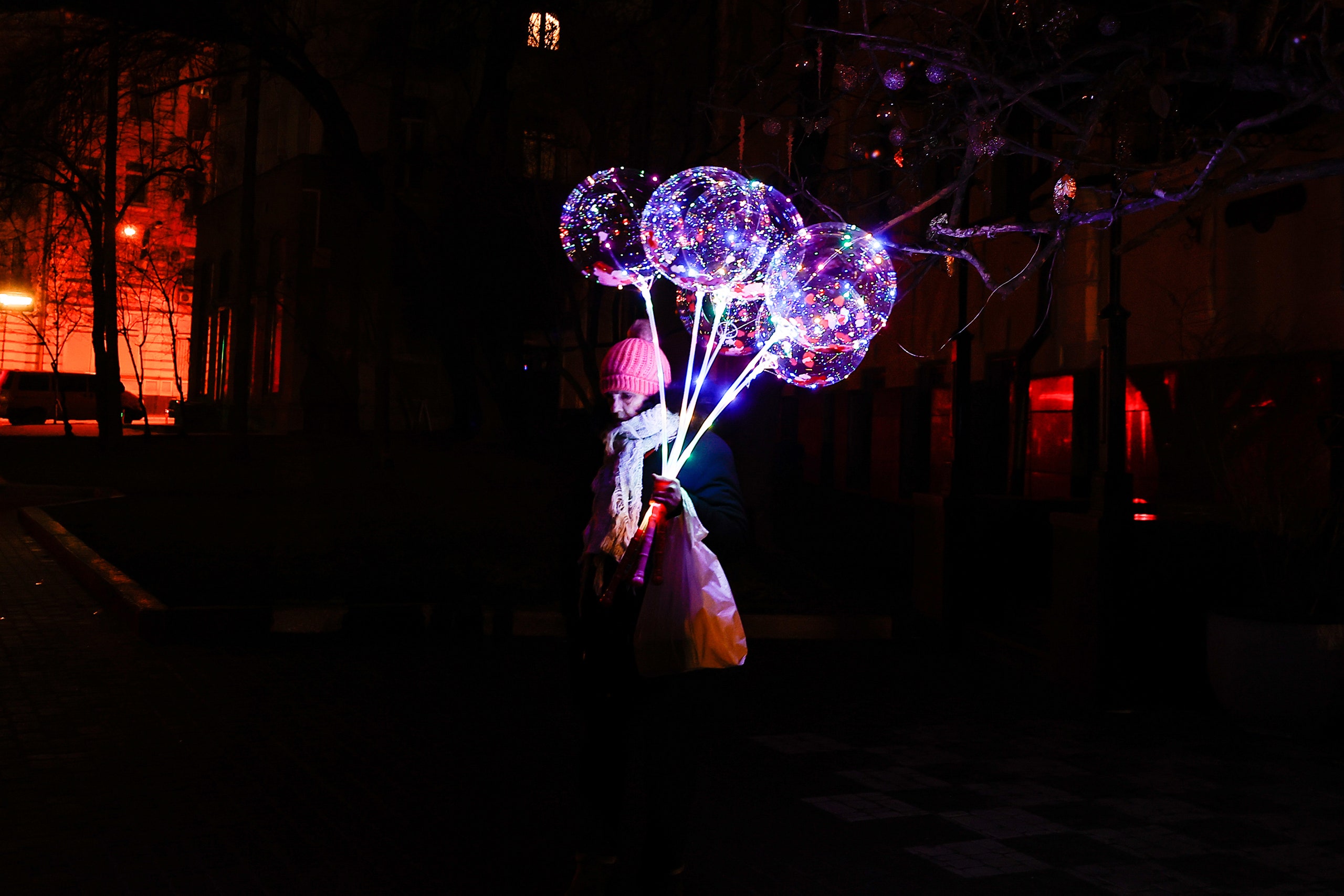
Ukrainians gather at Sophia Square for the new year celebrations in Kyiv.
Ukrainians celebrate New Year’s Eve in Kyiv, where life in wartime is going on with shocking regularity.Photograph by Mustafa Ciftci / Anadolu Agency / Getty 

It was just after 1 p.m. The weather in Kyiv was about fifteen degrees Fahrenheit but felt far colder. The writer Peter Godwin and I were walking through the university district. To get warm, we entered the National Museum of the History of Ukraine, its lower windows covered with sandbags and plywood. Inside, the lobby had been transformed into an exhibit of recent artifacts of the Russian invasion—street signs riddled with bullet holes, a child’s pillow pierced by a bullet. In the light-filled stairway just off the main floor, pieces of shrapnel and Russian bombs had been hung from the ceiling, making a grim installation of rusted steel.

A guide approached. Her name was Svitlana. She wore skinny jeans and an orange faux-fur vest. We asked her if we could see the rest of the museum. She told us that much of the museum was empty, that the most precious of its eight hundred thousand artifacts were hidden, to avoid being looted by Russian forces. We asked if we could see the museum anyway. She called the museum’s press secretary and, after a few minutes of intense conversation, she got permission to give us a tour.

“But the cashier isn’t here yet,” Svitlana said. She asked us to wait a few minutes, so we sat down on a bench in the lobby, next to a couple of Ukrainian women who looked to be in their seventies. They were bundled up in heavy down coats and rubber boots.

A few minutes later, Svitlana approached again.

“I’m sorry,” she said. “There is an air raid. We must go downstairs.”

These days in Kyiv, news of air raids is more commonly communicated by smartphones than by sirens. We followed her to the basement.

Downstairs, a group of older docents were huddled together in a carpeted room used for children’s education. We sat with Svitlana in the adjoining hallway, brightly lit and covered in gray tile. The hallway was unheated, so we kept our coats on. We asked how long the air raids usually lasted.

“Sometimes an hour, sometimes two,” she said.

Her full name was Svitlana Slastennikova. She was in her thirties, with blond hair, a heart-shaped face, and an earnest disposition. Her fingernails were painted red and matched her phone case. Hunched forward on a bench, she opened an app that allowed her to track Russian missiles in the air.

She clicked her tongue. “Oh, it’s bad,” she said.

The technology is now so advanced that Ukrainian citizens can know, more or less in real time, where the Russian missiles are coming from and generally where they’re going. In this case, Russia had just launched some seventy missiles, headed to sites all over Ukraine. The assumption was that they were directed at power substations, meant to cripple the country’s electrical grid. Vladimir Putin’s recent strategy has been to knock out the power in the depth of winter in hopes of breaking the spirits of everyday Ukrainians.

So far this strategy has not worked.

“My friends and I, we have jokes about it,” she said. “At home I organize all my housework during the hours I have power.” She and her husband, a doctor who runs a private medical clinic, recently bought an inverter, which stores power when the grid is functioning. “I’m ready to be without electricity, but not a part of the Russian world, you know?”

Svitlana was born in 1986, “the year of Chernobyl,” she said. She’s worked at the museum for thirteen years, but her work has grown more urgent since 2014. When the Russians invaded the Donbas and annexed Crimea, Ukrainians wanted to learn more about their history as a people, independent of Russia. Because she finds so many Ukrainians, and foreign visitors, confused about the distinct histories of Ukraine and Russia, Svitlana wrote, and is now translating into English, a lecture titled “Ukrainians vs. Russians. Why Are We Not ‘Fraternal’ Nations?” It details the distinct history of Ukraine, going back centuries. “We’re not the same people,” she says. “Ethnically, we’re totally different from Russians.”

For years, Svitlana had been giving tours inside the museum, but immediately after the February, 2022, invasion, the staff closed the building. Before the war, the museum employed about three hundred, but around twenty per cent of the staff left when the war started and have not returned. Now, on any given day, between fifty and seventy curators, guides, archivists and other staff members are on site, she says, and they have to fulfill their educational mission without many of the museum’s holdings.

“At the moment,” Svitlana says, “We have lectures, lectures, lectures.”

Meanwhile, Putin has made every effort to erase Ukrainian identity. His troops have ransacked museums and churches, bombed schools and cultural centers, and have fed Russian-speaking Ukrainians in occupied regions a constant diet of propaganda asserting that Ukrainians are Russians, and always have been. Before the 2022 invasion, even Svitlana’s own mother had believed some of the messaging coming from Moscow.

“When the Russians first invaded in February,” Svitlana said, “my mother told me, ‘In one month we will be part of Russia.’ I said to her, ‘You are insane.’ ”

This is part of the generational divide in Ukraine. Those who grew up in Soviet times are often more sanguine about Russian control, while those who grew up after Ukraine’s independence, in 1991, often look to Europe, not Moscow, as their past and future. The fierce resistance put up by Ukrainian troops, and the atrocities committed by Russian soldiers, have shocked many older Ukrainians.

“My mother, when she saw how wild these Russians are,” Svitlana said, “she changed her mind. These crimes being committed in the twenty-first century? Now she doesn’t want to be part of Russia.” Her mother, like millions of Ukrainians, is fluent in both Russian and Ukrainian. But many people now choose to speak Ukrainian, even if they grew up speaking Russian. A few days earlier, Peter and I had joined a delegation from pen America (where Peter served a term as president) that was highlighting cultural erasure in Ukraine, and toured a library in Chernihiv that had been hit by a missile.The second floor was largely ruined, but on the first floor, a group of women gathered for tea, biscuits, and lessons in the Ukrainian language.

Svitlana’s phone pinged again.

“Oh, no. This is real,” she said. Her app had more detail now. The missiles appeared to be heading toward targets all over the country: west toward Lviv, Ternopil, and Khmelnytskyi, south toward Kryvyi Rih, and north toward Kyiv.

Peter and I were getting texts now from friends in Ukraine, telling us to get somewhere safe. In recent weeks, the danger was most acute near any of the power substations. Residents could either be hit by the missile itself or, more likely, by a fragment of that missile after the Ukrainian military had shot it from the sky.

But in our time in Kyiv, nine months into the war, we saw that life away from the front was going on with shocking regularity. The grocery stores were well-stocked and immaculate. Restaurants were full. The streets were crowded with people shopping, working, living. The nail salons were open. The tattoo parlors were open. Stores were bright with holiday decorations. Make no mistake, there were countless signs that the country was at war—checkpoints outside the city, rolling blackouts—but, also, throughout Kyiv, a profound defiance was evident in every packed café and gallery. Even the members of the museum staff, as we’d been talking to Svitlana in the basement, were moving up and down the stairs, seeming unworried about the missiles in the air. A cleaning woman had been busy with the basement’s two bathrooms; she hadn’t paused once since the raid began.

We heard the scuffling of footsteps on the stairs. A group of people trundled down, two adults and a teen-ager in a sweatshirt bearing the face of Johnny Depp. They’d been outside and had come into the museum for shelter. They went into the carpeted classroom and sat next to a whiteboard featuring a handwritten time line of Ukraine’s history.

Online, we could see images of families massing in the subways of Kyiv. Built during Soviet times in anticipation of nuclear war, the subway stations are among the deepest in the world—some as far as three hundred feet below street level. I asked if Svitlana needed to check in with her own husband and kids. No, she said. She already had got word on her phone that they were sheltering in place. Her kids’ school had a basement they used during raids.

“They started practicing before the invasion began,” she said, “I didn’t approve of this. I thought it was scary to the kids, to have them doing these drills.” Like so many Ukrainians, Svitlana didn’t think the invasion would actually happen—even when a hundred thousand Russian troops were amassing at the border.

Her son is twelve and her daughter is five, and by now they’re used to the drills. Her children play games while they shelter in place. At the beginning of the invasion, Svitlana had taken her kids west for a couple of months, but now that the fighting has moved to the eastern front, she is content to stay in Kyiv. With every Ukrainian victory, more residents of the city have returned from elsewhere in Europe and the western part of the country. “I can’t imagine living in Poland. Living in some gymnasium,” she said. Her husband, like all men between eighteen and sixty, is barred from leaving the country anyway.

Svitlana checked her phone again.

“Explosions reported in Vinnytsia,” she said. This was southwest of Kyiv. She put her phone down. She scoffed at the Russian strategy. Using Telegram, she’d been able to watch Russian political talk shows—those surreal programs where pundits expound on the war on a TV set resembling “The Weakest Link.”

“They were saying they have to continue to hit these electrical targets, because they want people to rise up and overthrow the government. To get rid of Zelensky. They want it to be like Maidan,” she said, referring to the 2013-2014 Ukrainian movement that pushed for closer relations with the E.U., and resulted in the fall of the country’s government. “It is insane. They do not understand us.”

The teen-ager in the Johnny Depp sweatshirt and her parents emerged, putting their coats back on. They made their way up the stairs and left the building. The air raid was still on, but, these days, Ukrainians are only willing to sit still for so long. Peter and I thanked Svitlana and left at about two o’clock, an hour into the raid. The day was clear and cold, and eventually the sidewalks filled up with pedestrians. Stores and bars were open, and there was virtually no sign that Kyiv was under attack. Which it was.

Later we found out that over sixty of the more than seventy rockets had been shot down by Ukrainian forces. The ten or so missiles that found their targets shut off electricity in at least six regions: Zhytomyr, Sumy, Mykolaiv, Dnipropetrovsk, Cherkasy and Odesa. This was the sixth large-scale attack on infrastructure since October 10th, and would not be the last. Four civilians were reportedly killed, bringing the total dead to well over sixty-five hundred, including more than four hundred children.

As evening came on, we entered the closest subway station and stepped onto the escalator. We moved at an alarming speed, through a concrete tunnel, descending into the bowels of the earth while triumphant signs greeted us left and right—children’s drawings of Ukrainian soldiers. When we finally reached the train platform, we expected it to be empty, or full of families sheltering in place, but instead we saw a few dozen commuters waiting for trains, in office clothing, heading home from work.

Then, when the first train arrived, a thousand Ukrainians poured from it like water from a broken dam. They flowed around us so quickly we had to throw our backs against the station’s wide concrete columns. The people of Kyiv were going about their business, entirely uncowed.

We returned to the street level to find the city’s lights on and bright. A café next to the train station was blasting music from a tinny speaker. A gift shop was selling toilet paper bearing the face of Vladimir Putin. A nearby storefront featured, in foot-high letters, the slogan “Bravery is Ukrainian Brand.” We checked the time; we had twenty minutes to get across town. Ukrainian friends had invited us to dinner at a celebrated Crimean Tatar restaurant, opened by refugees after the 2014 annexation. When the air raid began, we had wondered if our dinner would be cancelled. But no. When we arrived, the place was full. The hostess seated us at the last empty table. ♦

The Devastating New History of the January 6th Insurrection

People gather in front of a building in Washington D.C. on January 6 2021
Photograph by Balazs Gardi for The New Yorker 

The New Yorker is publishing the full report of the House Select Committee to Investigate the January 6th Attack, in partnership with Celadon Books. The edition contains a foreword by the magazine’s editor, David Remnick, which you’ll find below, and an epilogue by Representative Jamie Raskin, a member of the committee. Order the full report.

In the weeks while the House select committee to investigate the insurrection at the Capitol was finishing its report, Donald Trump, the focus of its inquiry, betrayed no sense of alarm or self-awareness. At his country-club exile in Palm Beach, Trump ignored the failures of his favored candidates in the midterm elections and announced that he was running again for President. He dined cheerfully and unapologetically with a spiralling Kanye West and a young neo-fascist named Nick Fuentes. He mocked the government’s insistence that he turn over all the classified documents that he’d hoarded as personal property. Finally, he declared that he had a “major announcement,” only to unveil the latest in a lifetime of grifts. In the old days, it was Trump University, Trump Steaks, Trump Ice. This time, he was hawking “limited edition” digital trading cards at ninety-nine dollars apiece, illustrated portraits of himself as an astronaut, a sheriff, a superhero. The pitch began with the usual hokum: “Hello everyone, this is Donald Trump, hopefully your favorite President of all time, better than Lincoln, better than Washington.”

In his career as a New York real-estate shyster and tabloid denizen, then as the forty-fifth President of the United States, Trump has been the most transparent of public figures. He does little to conceal his most distinctive characteristics: his racism, misogyny, dishonesty, narcissism, incompetence, cruelty, instability, and corruption. And yet what has kept Trump afloat for so long, what has helped him evade ruin and prosecution, is perhaps his most salient quality: he is shameless. That is the never-apologize-never-explain core of him. Trump is hardly the first dishonest President, the first incurious President, the first liar. But he is the most shameless. His contrition is impossible to conceive. He is insensible to disgrace.

On December 19, 2022, the committee spelled out a devastating set of accusations against Trump: obstruction of an official proceeding; conspiracy to defraud the nation; conspiracy to make false statements; and, most grave of all, inciting, assisting, aiding, or comforting an insurrection. For the first time in the history of the United States, Congress referred a former President to the Department of Justice for criminal prosecution. The criminal referrals have no formal authority, though they could play some role in pushing Jack Smith, the special counsel appointed by Attorney General Merrick Garland, to issue indictments. The report certainly adds immeasurably to the wealth of evidence describing Trump’s actions and intentions. One telling example: The committee learned that Hope Hicks, the epitome of a loyal adviser, told Trump more than once in the days leading up to the protest to urge the demonstrators to keep things peaceful. “I suggested it several times Monday and Tuesday and he refused,” she wrote in a text to another adviser. When Hicks questioned Trump’s behavior concerning the insurrection and the consequences for his legacy, he made his priorities clear: “Nobody will care about my legacy if I lose. So, that won’t matter. The only thing that matters is winning.”

Trump has been similarly dismissive of the committee’s work, going on the radio to tell Dan Bongino, the host of “The Dan Bongino Show,” that he had been the victim of a “kangaroo court.” On Truth Social, his social-media platform, he appealed to the loyalty of his supporters: “Republicans and Patriots all over the land must stand strong and united against the Thugs and Scoundrels of the Unselect Committee…. These folks don’t get it that when they come after me, the people who love freedom rally around me. It strengthens me. What doesn’t kill me makes me stronger.”

Experience makes it plain that Trump will just keep going on like this, deflecting, denying, lashing out at his accusers, even if it means that he will end his days howling in a bare and echoing room. It matters little that the report shows that even members of his innermost circle, from his Attorney General to his daughter, know the depths of his vainglorious delusions. He will not repent. He will not change. But the importance of the committee’s report has far less to do with the spectacle of Trump’s unravelling. Its importance resides in the establishment of a historical record, the depth of its evidence, the story it tells of a deliberate, coördinated assault on American democracy that could easily have ended with the kidnapping or assassination of senior elected officials, the emboldenment of extremist groups and militias, and, above all, a stolen election, a coup.

The committee was not alone in its investigation. Many journalists contributed to the steady accretion of facts. But, with the power of subpoena, the committee was able to uncover countless new illuminating details. One example: In mid-December, 2020, the Supreme Court threw out a lawsuit filed by the State of Texas that would have challenged the counting of millions of ballots. Trump, of course, supported the suit. He was furious when it, like dozens of similar suits, was dismissed. According to Cassidy Hutchinson, who worked directly for Mark Meadows, the White House chief of staff, Trump was “raging” about the decision: “He had said something to the effect of, ‘I don’t want people to know we lost, Mark. This is embarrassing. Figure it out. We need to figure it out. I don’t want people to know that we lost.’”

In large measure, this report is the story of how Trump, humiliated by his loss to Joe Biden, conspired to obstruct Congress, defraud the country he was pledged to serve, and incite an insurrection to keep himself in power.

The origins of the committee and its work are plain: On January 6, 2021, thousands marched on the Capitol in support of Trump and his conspiratorial and wholly fabricated charge that the Presidential election the previous November had been stolen from him. Demonstrators breached police barricades, broke through windows and doors, and ran through the halls of Congress threatening to exact vengeance on the Vice-President, the Speaker of the House, and other officeholders. Seven people died as a result of the insurrection. About a hundred and fourteen law-enforcement officers were injured.

Half a year later, the House of Representatives voted to establish a panel charged with investigating every aspect of the insurrection—including the role of the former President. An earlier attempt in the Senate to convene an investigative panel had met with firm resistance from the Minority Leader, Mitch McConnell, who called it an “extraneous” project; despite support from six Republican senators, it failed to get the sixty votes required. It was left to the Democratic leadership in the House to form a committee. The vote, held on June 30, 2021, was largely along party lines, but the U.S. House Select Committee to Investigate the January 6th Attack on the United States Capitol officially came into existence.

Speaker Nancy Pelosi then asked the Republicans to name G.O.P. members to join the panel. The House Minority Leader, Kevin McCarthy, responded by proposing some of the most prominent election deniers in his caucus, including Jim Jordan, of Ohio, who had attended “Stop the Steal” demonstrations and was sure to behave as an ardent obstructionist. Pelosi, who had named Liz Cheney, of Wyoming, to the panel, rejected two of McCarthy’s five recommendations, saying, “The unprecedented nature of January 6th demands this unprecedented decision.” After conferring with Trump, McCarthy refused to provide alternatives, and abruptly withdrew all of his proposals, gambling that doing so would derail or discredit the initiative. Pelosi, in turn, asked a second Republican who had, with Cheney, voted to impeach the President on a vote held on January 13th—Adam Kinzinger, of Illinois—to serve on the committee. Both Cheney and Kinzinger accepted.

Cheney, a firm conservative and the daughter of former Vice-President Dick Cheney, had made her judgment of Trump well known. “The President of the United States summoned this mob, assembled the mob, and lit the flame of this attack,” she said not long after the insurrection. “Everything that followed was his doing.” She knew that by opposing Trump and joining Kinzinger and the Democrats on the committee she was almost sure to lose her seat in Congress. She didn’t care, she said later, declaring her work on the panel, on which she served as vice-chair, the “most important” of her career. The G.O.P. leadership was unimpressed with this declaration of principle. In February, 2022, the Republican National Committee censured both Cheney and Kinzinger.

In deciding how to proceed with its investigation, the committee’s chairman, Bennie G. Thompson, of Mississippi, along with Liz Cheney and the seven other members, looked to a range of similarly high-profile investigative panels of the past, including the so-called Kefauver Committee, which investigated organized crime, in 1950-51; the President’s Commission on the Assassination of President John F. Kennedy, known as the Warren Commission, in 1963-64; the Senate Watergate hearings, in 1973; the Iran-Contra hearings, in 1987; and, particularly, the 9/11 Commission, in 2002-04. The committee hired staff investigators who had worked in the Department of Justice and in law enforcement, and they conducted more than a thousand interviews. Teams were color-coded and tasked with making “deep dives” into various aspects of January 6th. The division of labor included a “blue team,” which examined the preparation for and the reaction to events by law enforcement; a “green team,” which examined the financial backing for the plot; a “purple team,” which conducted an analysis of the extremist groups involved in the storming of the Capitol; a “red team,” which studied the rally on the Ellipse and the Stop the Steal movement; and a “gold team,” which looked specifically at Trump’s role in the insurrection.

Committee members also insisted on inquiring into whether Trump planned to use emergency powers to overturn the vote, call out the National Guard, and invoke the Insurrection Act. Was Trump’s inaction during the rioting on Capitol Hill merely a matter of miserable leadership, or was it a deliberate strategy of fomenting chaos in order to stay in the White House? “That dereliction of duty causes us real concern,” Thompson said. In this way, an inquiry into a specific episode broadened to encompass a topic of still greater significance: Had the President sought to undermine and circumvent the American system of electoral democracy?

The political urgency of the committee’s work was geared to the calendar. Members had initially hoped to complete and publish a report before the 2022 midterm elections. But that proved impossible, such was the volume of evidence. Still, the committee members knew they could not go on indefinitely. The Republicans were likely to win back a majority in the House, in November, and McCarthy, who was the most likely to succeed Nancy Pelosi as Speaker, would almost certainly choose not to reauthorize the committee, effectively shutting it down; it was also quite possible, they knew, that McCarthy and the Republicans might generate “counter” hearings as an act of retribution.

As the committee began its work, it was soon clear that the Republican leadership in the House had made a tactical error in refusing to appoint any members to the panel. Even Republicans less vociferous than Jordan would have had the power to slow down the investigations, debate points with Democratic members, and appoint less aggressive staff members. Instead, the committee, with its seven Democrats and two anti-Trump Republicans, worked in relative harmony, taking full advantage of a sense of common purpose and the capacities of a congressional committee.

Still, they faced predictable obstacles. Not only did many Trump loyalists refuse to testify; much of the American public was, after so many previous investigations, impeachments, scandals, and news alerts, weary of hearing about the unending saga of Donald Trump. Who would pay attention? What more was there to learn? In a polarized America, who was left to be persuaded? Committee members such as Jamie Raskin, of Maryland, insisted that the real purpose of the investigation was to establish the truth. What prosecutors and the electorate make of those facts is beyond the committee’s authority.

The committee members determined that they could not go about the hearings in the old way, with day after day of interminable questioning of witnesses. Instead, they needed to produce discrete, well-produced, briskly paced multimedia “episodes” designed to highlight various aspects of the insurrection: its origins, its funding, the behavior of the President, the level of involvement by white nationalists, militias, and other menacing groups. The members agreed that, in an age of peak TV, they needed to present a kind of series, one that was dramatic, accessible, accurate, evidence-rich, and convincing. Ideally, they would provide a narrative that did not merely preach to the converted but reached the millions of Americans who were indifferent to or confused by the unending stream of noise, indirection, hysteria, lying, and chaos that had characterized the hyperpolarized era. The committee also recognized that only a minority would watch the full hearings, much less read every word of a long narrative report months later. They needed to produce the hearings in a way that could also be transmitted effectively in bits on social media and go viral. They needed memorable moments and characters. In the words of one staffer, “We needed to bring things to life.”

To help with that effort, the committee hired an adviser, the British-born television producer James Goldston, who had been a foreign correspondent for the BBC in Northern Ireland and Kosovo. Goldston had also covered the impeachment of Bill Clinton. In 2004, he moved to New York and went to work at ABC, where he ran “Good Morning America” and “Nightline”; between 2014 and 2021, he served as president of ABC News. The committee decided to videotape its depositions, and Goldston was among those who helped to select brief and particularly vivid moments from those long interviews, the way a journalist uses quotations or scenes to enliven a piece of narrative prose. The committee’s presentations also employed everything from surveillance video to police radio traffic to the e-mails and tweets of government officials, right-wing media personalities, militia leaders, and the insurrectionists on Capitol Hill.

“We live in an era where, no matter how important the subject, it’s competing for attention,” Goldston told a reporter for TheWrap. “People are distracted, people have got a lot going on. And so, the hope was, by bringing these new techniques to this format, that we could engage people in a way that perhaps they wouldn’t otherwise have been.” The second prime-time hearing brought in nearly eighteen million viewers, an audience comparable to NBC’s “Sunday Night Football.” The Republican House leadership was predictably unimpressed with the committee’s commitment to narrative, prompting Kevin McCarthy to say that the Democrats had hired Goldston to “choreograph their Jan. 6 political theater.”

The committee’s published report does not have a single authorial voice. Rather, it is a collaborative effort written mainly by a team of investigators and staffers, with input from members of the committee. And, while it lacks a mediating, consistent voice, it is a startlingly rich narrative, thick with details of malevolent intent, political conspiracy, sickening violence, and human folly. There is no question that historians will feast on these pages; what the Department of Justice does with this evidence remains to be seen.

At times, there’s comedy embedded in this tragic narrative. A figure such as Eric Herschmann, a Trump adviser, holds the stage long enough to recount telling the Trump lawyer John Eastman that his plan to overturn the election is “completely crazy”: “Are you out of your effing mind?” And: “Get a great effing criminal defense lawyer. You’re gonna need it.” Viewers of Herschmann’s deliciously profane taped testimony were transfixed by at least two artifacts on the wall behind him: a baseball bat with the word “Justice” written on it and a print of “Wild Thing,” Rob Pruitt’s image of a panda, which also makes an appearance in the erotic thriller “Fifty Shades of Grey.”

Anyone who watched the hearings and who now reads this report will dwell at times on the outsized figures who emerge, either in their own testimony or as described by others: the neo-fascistic campaign strategist and onetime White House aide Steve Bannon; the blandly ambitious Mark Meadows, the chief of staff in the final year of the Trump Administration; and, of course, the oft-inebriated Rudy Giuliani, the onetime New York City mayor and Trump’s personal lawyer.

Time and again, senior figures in the drama refused to testify, hiding behind claims of executive privilege. The report includes many comical instances of would-be witnesses claiming their Fifth Amendment rights and refusing to answer questions as benign as where they went to college. And so it was often the junior staffers in the Administration, with far less to spend on legal fees and with their futures at risk, who stepped forward to describe what they had seen and heard. The most memorable such episode came on June 28th, when Cassidy Hutchinson, the earnest young aide to Meadows, testified live before the committee. Hutchinson had already been deposed four times, for a total of more than twenty hours. Liz Cheney, as the vice-chair, began the session by announcing that Hutchinson had received an ominous phone call from someone in Trump’s circle saying, “He wants me to let you know he’s thinking about you. He knows you’re loyal. And you’re going to do the right thing when you go in for your deposition.” Cheney bluntly referred to this as tantamount to witness tampering. When the report and its accompanying materials were finally released, we learned that Hutchinson told the committee that a former Trump White House lawyer named Stefan Passantino, who represented her early in the process, had instructed her to feign a faulty memory and “focus on protecting the President.” She said Passantino made it plain that he would help find her “a really good job in Trump world” so long as she protected “the family.” Hutchinson also testified that an aide to Meadows, Ben Williamson, had passed along a message from Meadows that he “knows that you’ll do the right thing tomorrow and that you’re going to protect him and the boss.”

But Hutchinson, who had been a loyal staffer in the Trump White House, privy to countless conversations in and around the offices of the President and the chief of staff, would not be intimidated. She found new counsel and thwarted the thuggish attempts to gain her silence, delivering some of the most damning testimony of the investigation. She described conversations, some secondhand, that made it plain that Trump knew full well that he had lost the election but would stop at nothing to keep power. Because of her preternatural calm before the microphone, the uninflected, more-in-sadness-than-in-anger tone of her delivery, Hutchinson was often compared to John Dean, the White House counsel under Richard Nixon, who emerged from the Watergate hearings as the most memorable and decisive witness.

But the nature of Hutchinson’s testimony, in keeping with the era, was distinctly more lurid than Dean’s. She recalled how Trump hurled his lunch against the wall, splattering ketchup everywhere, when he learned that Attorney General William Barr had publicly declared that there was, in fact, no evidence of election fraud. On other occasions, she said, the President pulled out “the tablecloth to let all the contents of the table go onto the floor and likely break or go everywhere.” She recounted the names of the many Trumpists—including Meadows, Giuliani, Matt Gaetz, and Louie Gohmert—who had requested that Trump grant them pardons in connection with the Capitol attack. She said that, three days before the insurrection, the White House counsel, Pat Cipollone, told Trump that, if he carried out his plan to march to the Capitol with the crowds, “we’re going to get charged with every crime imaginable.” Hutchinson testified that on January 6th Cipollone told Meadows, “They’re literally calling for the Vice President to be effing hung.” As she recalled, “Mark had responded something to the effect of ‘You heard him, Pat. He thinks Mike deserves it. He doesn’t think they’re doing anything wrong.’ ”

Finally, Hutchinson made it clear just how much Trump had wanted to join the insurrectionists on Capitol Hill. Trump was so incensed with his Secret Service detail for refusing to take him there, she testified, that he lunged at the agent driving his car and struggled for the wheel. The report corroborates Hutchinson’s testimony, saying that the “vast majority” of its law-enforcement sources described a “furious interaction” between the President and his security contingent in his S.U.V. The sources said that Trump was “furious,” “insistent,” “profane,” and “heated.” The committee concluded that Trump had hoped to lead the effort to overturn the election either from inside the House chamber or from a stage outside the building.

Hutchinson was equally forthright about Trump’s disregard for public safety. Despite being told that many of the supporters who came out to see him speak on January 6th were armed, she said, Trump insisted that the Secret Service remove the “mags”—the metal detectors. He was not terribly concerned that someone might be killed or injured, so long as it wasn’t him. “I don’t fucking care that they have weapons,” he said, according to Hutchinson. “They’re not here to hurt me.”

The insurrection at the Capitol was of such grave consequence for liberal democracy and the rule of law that commentators have struggled ever since to find some historical precedent to provide context and understanding to a nation in a state of continuing crisis. Some thought immediately of the sack of the Capitol, in 1814, though the perpetrators then were foreign, soldiers of the British crown. Others have pointed to contested Presidential elections of the past—1824, 1876, 1960, 2000—but those ballots were certified, peacefully and lawfully, by Congress. None of the losers sought to foment an uprising or create a national insurgency. Compare Trump’s self-absorption and rage with Al Gore’s graceful acceptance of the Supreme Court’s decision handing the election to George W. Bush: “Tonight, for the sake of our unity as a people and the strength of our democracy, I offer my concession.”

Still, there have been efforts to overturn the constitutional order, notably in the “secession winter” of 1860-61, when seven slaveholding states, having warned that they would never accept the election of Abraham Lincoln, declared themselves in opposition to the United States itself. As Lincoln prepared for his inauguration, to be held in March, he received a series of warnings that an army raised in Virginia might invade Washington, D.C. So prevalent were the rumors of a Confederate conspiracy that Congress assembled a committee to “inquire whether a secret organization hostile to the government of the United States exists in the District of Columbia.” Lincoln was particularly concerned about a potential plot to undermine the counting of electors, an event scheduled for February. In the end, John Breckinridge, James Buchanan’s Vice-President and a loser in the 1860 Presidential race, obeyed the law. Although Breckinridge was sympathetic to the secessionist cause, he presided with “Roman fidelity” at the certification vote, according to Representative Henry Dawes, of Massachusetts, “and the nation was saved.” But only temporarily. On April 12, 1861, the South Carolina militia opened fire on the Union garrison at Fort Sumter and the Civil War began.

A civil war, in the nineteenth-century understanding of the term, is not at hand. But what makes the events of January 6, 2021, so alarming is that they were inspired and incited by the President of the United States, Donald Trump, who remains popular among so many Republicans and a contender to return to the White House.

The events of January 6th were the culmination of a long campaign that Trump and members of his circle have led against the legitimacy of American elections. The campaign’s most powerful weapon was the undermining of truth itself, the insidious deployment of conspiracy theories and “alternative facts.”

Trump first announced his emergence from the worlds of New York real estate and reality-show television by declaring that Barack Obama, the first Black President, had been born in Kenya, not Hawaii, and was, therefore, ineligible to hold office. After joining the 2016 Presidential race, Trump continued to traffic in casual accusations and unfounded conspiracy theories: Ted Cruz’s father was an associate of Lee Harvey Oswald. Antonin Scalia might have been murdered. Obama and Joe Biden might have staged the killing of Osama bin Laden with a body double. Trump welcomed the endorsement of the professional conspiracy theorist Alex Jones, who had earlier claimed that Hillary Clinton had “personally murdered and chopped up and raped” children, and that the mass murder at Sandy Hook had been “staged.” The most consequential conspiracy theory of Trump’s political career, however, charged that American elections were rigged.

In 2016, Trump, once he had a hold on the Republican Party nomination, began the process of undermining confidence in the entire electoral system. The reporter Jonathan Lemire, in his book, “The Big Lie,” recalls attending a rally, in Columbus, Ohio, at which Trump told his followers, weeks before the nominating Convention, “I’m afraid the election is going to be rigged, I have to be honest.” On Fox News, talking with Sean Hannity, Trump again expressed his doubts: “I hope the Republicans are watching closely, or it’s going to be taken away from us.” Trump began to warn that he was not necessarily prepared to accede to the election results. At one of the Presidential debates, the moderator, Chris Wallace, asked Trump if he would make a commitment to accept the outcome, no matter what. Trump refused: “I will look at it at the time. What I’ve seen is so bad.”

Clinton won the popular vote by a margin of more than two per cent, but, because she fell well short in the Electoral College, there was no compulsion on Trump’s part to consider extralegal action. But four years later, as Trump lagged behind Joe Biden in the polls, he revived the theme. “MILLIONS OF MAIL-IN BALLOTS WILL BE PRINTED BY FOREIGN COUNTRIES, AND OTHERS,” he tweeted. “IT WILL BE THE SCANDAL OF OUR TIMES!” Once more, Trump refused to promise a peaceful transfer of power. A month and a half before the election, he said, “Get rid of the ballots and you’ll have a very peaceful—there won’t be a transfer, frankly. There will be a continuation.”

This kind of rhetoric was of grave concern to Democrats, including Speaker Pelosi, who privately told confidants, “He’s going to try to steal it.” And, not long after the voting ended, the tweets from Trump began:

Last night I was leading, often solidly, in many key States, in almost all instances Democrat run & controlled. Then, one by one, they started to magically disappear as surprise ballot dumps were counted. VERY STRANGE, and the pollsters got it completely & historically wrong!

They are finding Biden votes all over the place—in Pennsylvania, Wisconsin, and Michigan. So bad for our Country!

On November 7th, the Associated Press, Fox News, and, soon, all the other major news outlets called Pennsylvania, and the election, for Biden. The battleground states—Pennsylvania, Michigan, Georgia, Arizona, and Wisconsin—all went Biden’s way, and, in the end, he won 306 electoral votes to Trump’s 232. In his victory speech, the President-elect said, “It’s time to put away the harsh rhetoric. To lower the temperature.”

This was a vain hope. As the Trump White House emptied, a motley assemblage of satraps and third-raters—Giuliani; a former federal prosecutor, Sidney Powell; the MyPillow C.E.O., Mike Lindell; the former law professor and Federalist Society leader John Eastman—stayed behind to encourage Trump in his most conspiratorial fantasies and schemes. In their effort to challenge election results in various states, Trump’s lawyers filed sixty-two federal and state lawsuits. They lost sixty-one of those suits, winning only on an inconsequential technical matter in Pennsylvania. By mid-December, even Mitch McConnell began referring to “President-elect Joe Biden.” When Trump called to berate him for conceding the ballot, McConnell, for once, stood up to him. “The Electoral College has spoken,” he said. “You lost the election.”

The only option Trump had left was to challenge the certification of the vote. With Eastman in the lead, his team concocted a plan that called on Vice-President Pence to declare that voting in seven states was still in dispute and to eliminate those electors. If the remaining forty-three states put forward their electors, Trump would win the election, 232–222. As part of that plan—what Chairman Thompson called, from the first day of the hearings, “an attempted coup”—Trump pressured government and election officials to coöperate. Former Deputy Attorney General Richard Donoghue testified that Trump did not conceal his intent, telling Donoghue, “What I’m asking you to do is just say it was corrupt and leave the rest to me and the Republican congressmen.” Once Trump unleashed his campaign of intimidation against local election officials, the death threats against those officials came from all directions. Ruby Freeman, an election worker in Georgia, testified, “There is nowhere I feel safe. Nowhere. Do you know how it feels to have the President of the United States target you?”

Another version of the plan had Pence calling for a ten-day-long recess and sending the slates back to the so-called “disputed” states. Eastman himself conceded that this plan would be rejected unanimously by the Supreme Court. Even so, the White House could surely be retained if Trump could convince Pence to “do the right thing.”

On the night of January 5th, the President met with Pence at the White House and tried to pressure him into adopting the scheme that Eastman had devised. For years, Pence had been the most loyal of deputies, never daring to challenge the falsehoods or the cruelties of his master. Trump, after all, had rescued him from political oblivion. But Pence would not go along with the plot. His job on January 6th, he told the President, was ceremonial. He was only there “to open envelopes.”

Trump was outraged. “You’ve betrayed us,” he told Pence. “I made you. You were nothing.”

The committee’s report is not a work of scholarship removed from its era. It was compiled by politicians and staff members and published at a moment of continuing peril and uncertainty. And the committee was formed in the contrails of the terrifying episode it was charged with investigating.

Although an abundance of new details has surfaced, the contours of what happened have never been in doubt. The events on January 6, 2021, began with a well-planned rally on the Ellipse, the fifty-two-acre park south of the White House. Trump had tweeted in advance, “Be there, will be wild!” Katrina Pierson, a spokeswoman for Trump’s 2016 campaign and one of the organizers of the rally, had texted another organizer saying that Trump “likes the crazies,” and wanted Alex Jones to be among the speakers. Jones did not speak, but Trump himself supplied the inflammatory rhetoric. In the seventy-minute-long speech he gave on the Ellipse, he told his followers they would “save our democracy” by rejecting “a fake election,” and warned them that “if you don’t fight like hell, you’re not going to have a country anymore.” He taunted his Vice-President: “Mike Pence, I hope you're going to stand up for the good of our Constitution and for the good of our country. And if you’re not, I’m going to be very disappointed in you.” He set a tone of combativeness, defiance, and eternal resistance. And he put the life of his own Vice-President in jeopardy. As Chairman Thompson put it at one hearing, “Donald Trump turned the mob on him.”

Even though senior officials around Trump had told him that it was long past time to step aside—William Barr informed congressional investigators that he told Trump that reports of voting fraud were “bullshit”—Trump refused to listen. (“I thought, boy, if he really believes this stuff, he has, you know, lost contact with, he’s become detached from reality,” Barr recalled.) Trump was unrelenting. “We will never give up,” he told the crowd on the Ellipse. “We will never concede. It doesn’t happen. You don’t concede when there’s theft involved. Our country has had enough. We will not take it anymore.” After listening to the President’s repeated calls to fight, and to march to the Capitol building—“you’ll never take back our country with weakness”—thousands of his followers, some of them armed, some of them carrying Confederate symbols, some deploying flagpoles as spears, headed toward Capitol Hill.

As the march began, at around 1 p.m., Representative Paul Gosar, of Arizona, and Senator Ted Cruz, of Texas, both conservative Republicans, rose in Congress to object to the counting of the electoral ballots from Arizona. But Pence had already told Trump he would not go along with his plot, and there was no sign that Gosar, Cruz, and Trump’s loyalists in Congress had the numbers to succeed. McConnell, at that time the Senate Majority Leader, said, “Voters, the courts, and the states have all spoken—they’ve all spoken. If we overrule them all, it would damage our republic forever.”

By 2 p.m., demonstrators began to overrun the Capitol Police, sometimes using improvised weapons. Caroline Edwards, of the Capitol Police, testified to the committee that there was “carnage” in the halls: “I was slipping in people’s blood.” The insurrectionists kept coming, breaking through windows and doors, assaulting police officers, and, once inside, they went hunting for the Vice-President, the Speaker of the House, and other officials who refused to participate in the President’s scheme to overturn the election. At around 2:20 p.m., the Senate, and then the House, went into emergency recess, as Capitol Police officers rushed members of both chambers to safety. The two Democratic congressional leaders, Nancy Pelosi and Charles Schumer, fearing for their lives and the lives of their colleagues, were reduced to sequestering in a safe location. In the final session of the committee’s investigation, we saw footage of Pelosi, enraged yet composed, deploying her cell phone to get someone to come to the aid of the legislative branch.

Trump watched these events on television at the White House with scant sense of alarm. He refused to send additional police or troops to quell the violence. At 2:24 p.m., he tweeted, “Mike Pence didn’t have the courage to do what should have been done to protect our Country and our Constitution.” By 3 p.m., insurrectionists, some of them in cosplay battle gear, had swarmed into the Senate chamber. Trump’s passivity was not passivity at all. As Adam Kinzinger put it, “President Trump did not fail to act. He chose not to act.” Liz Cheney was no less blunt. “He refused to defend our nation and our Constitution,” she said during the hearings. “I say this to my Republican colleagues who are defending the indefensible, there will come a day when Donald Trump is gone. But your dishonor will remain.”

For Trump, the choice was simple. The insurrectionists were his people, his shock troops, there to do his bidding. Nothing about the spectacle seemed to disturb him: not the gallows erected outside the building, not the savage beatings, not threats to Pence and Pelosi, not graffiti like “Murder the Media,” not the chants of “1776! 1776!” And so he ignored calls to action even from his own party. At 3:11 p.m., Mike Gallagher, a Republican from Wisconsin, tweeted, “We are witnessing absolute banana republic crap in the United States Capitol right now. @realdonaldtrump you need to call this off.” Trump would not tell his supporters to go home until the early evening, when the damage had been done.

And though Trump and the insurrectionists failed to halt the certification of the ballot, they did get substantial support: a hundred and forty-seven Republicans in Congress voted to overturn the election results. At 3:42 a.m. on January 7th, Vice-President Pence, speaking to a joint session of Congress, certified the election of Joe Biden as the forty-sixth President of the United States. When, however, the midterms were held, two years later, dozens of Republican candidates continued to claim that his election was fraudulent. Those few Republicans, like Liz Cheney, who took a stand against Trump were swept out of office.

January 6th was a phenomenon rooted both in the degraded era of Trump and in the radicalization of a major political party during the past generation. The very power of these developments explains why many people may approach this congressional report with a sense of fatigue, even denial. Part of Trump’s dark achievement has been to bludgeon the political attention of the country into submission.

When a nation has been subjected to that degree of cynicism—what is politely called “divisiveness”—it can lose its ability to experience outrage. As a result, the prospect of engaging with this congressional inquiry into Trump’s attempt to delegitimatize the machinery of electoral democracy is sometimes a challenge to the spirit. That is both understandable and a public danger. And yet a citizenry that can no longer bring itself to pay attention to such an investigation or to absorb its astonishing findings risks moving even farther toward a disturbing “new normal”: a post-truth, post-democratic America.

A republic is predicated on faith—not religious faith but a faith in the fundamental legitimacy of its political institutions and the decisions they issue. To concede the legitimacy of statutes, rulings, and election returns is not necessarily to favor them. It’s simply to participate in the basic system that gives them form and force; citizens can, through democratic machinery, seek to defeat or contest candidates they deplore, initiatives that offend them, court opinions they consider misguided. By contrast, the campaign that culminated in the Capitol attack of January 6th was, fatefully, against democracy itself. It sought to instill profound mistrust in the process of voting—the mechanism through which, even in highly imperfect democracies, accountability is ultimately secured.

The committee and its work were far from apolitical, and yet to dismiss the report as merely political would be a perilous act of resignation and defeatism. The questions that hovered over the inquiry from the start—what more is there to learn? who is really listening?—persisted and loomed over the midterm elections. When the hearings began, the polling outfit FiveThirtyEight reported that Trump’s approval rating was 41.9 per cent; when the hearings ended, it was 40.4 per cent, a minuscule dip. As Susan B. Glasser, of The New Yorker, wrote, “All that damning evidence, and the polls were basically unchanged. The straight line in the former President’s approval rating is the literal representation of the crisis in American democracy. There is an essentially immovable forty per cent of the country whose loyalty to Donald Trump cannot be shaken by anything.” And yet the Republicans failed in their promise to produce a “red wave” in the midterms. The Democrats maintained their slender hold on the Senate and lost far fewer seats in the House than was expected. And while the reasons behind the Republican failure were many, ranging from the imperilment of abortion rights to the dismal quality of so many of the Party’s candidates, it was clear that one of the principal reasons was a deep concern about the future of democracy.

The most urgent thing to learn is whether a two-and-a-half-century-old republic will resist future efforts to undercut its foundations—to steal, through concerted deception, the essential legitimacy of its constitutional order. The contents of the report insist that complacency is not an option. The report also insists on accountability, though that will ultimately be the responsibility of the Department of Justice and the American public. The report has provided the evidence, the truth. Now it remains to be seen if it will be acted upon.

The violation of January 6th was ultimately so brazen that many of Trump’s own loyalists could not, in the end, bring themselves to defend him. Even some on the radical right have come to recognize the insurrection’s implications for the future. Jason van Tatenhove was once the media spokesman for the militia group known as the Oath Keepers, which played a crucial role in the uprising. He left the group well before January 6th, but he remained well connected enough to know that the Oath Keepers were eager to take part in an “armed revolution.” Testifying before the committee, he expressed his sense of betrayal by Donald Trump, and a growing sense of alarm: “If a President that’s willing to try to instill and encourage, to whip up, a civil war among his followers uses lies and deceit and snake oil, regardless of the human impact, what else is he going to do?”

Trump is running again for President. Perhaps his decline is irreversible. But it would be foolish to count on that. Should he win back the White House, he will come to office with no sense of restraint. He will inevitably be an even more radical, more resentful, more chaotic, more authoritarian version of his earlier self. And he would hardly be an isolated figure in the capital. Following the results of the midterm elections, Congress is now populated with dozens of election deniers and many more who still dare not defy Trump. The stakes could not be higher. If you are reaching for optimism—and despair is not an option—the existence and the depth of the committee’s project represents a kind of hope. It represents an insistence on truth and democratic principle. In the words of the man who tried and failed to overturn a Presidential election, you don’t concede when there’s theft involved. ♦

WHAT IS BREAKOUT → RE-TEST?

Breakout: When the price breaks a support or resistance level that it has tested before and moves above or below that level. Re-...