Teen models, powerful men and private dinners: when Trump hosted Look of the Year
In the early 90s, Donald Trump judged the world’s biggest modelling competition - since hit by allegations of abuse. This is how the people who were there remember it.
Special investigation by Lucy Osborne, Harry Davies and Stephanie Kirchgaessner at The Guardian.
On 1 September 1991, a large private yacht cruised towards the Statue of Liberty. It was a clear, breezy evening, and from the upper deck of the Spirit of New York, a golden sunset could be seen glinting off the Manhattan skyline. Downstairs, a party was in flow. Scores of teenage girls in evening dresses and miniskirts, some as young as 14, danced under disco lights. It could have been a high school prom, were it not for the crowd of older men surrounding them.
As the evening wore on, some of the men – many old enough to be the girls’ fathers, or even grandfathers – joined them on the dancefloor, pressing themselves against the girls. One balding man in a suit wrapped his arms around two young models, leering into a film camera that was documenting the evening: “Can you get some beautiful women around me, please?”
The party aboard the Spirit of New York was one of several events that Donald Trump, then 45, attended with a group of 58 aspiring young models that September. They had travelled from around the world to compete in Elite’s Look of the Year competition, an annual event that had been running since 1983 and was already credited with launching the careers of Cindy Crawford, Helena Christensen and Stephanie Seymour. At stake was a life-changing prize: a $150,000 contract with the world’s then leading modelling agency, Elite Model Management, run by John Casablancas.
Trump was closely involved in Casablancas’s competition. In 1991, he was a headline sponsor, throwing open the Plaza, his lavish, chateau-style hotel overlooking Central Park, transforming it into the main venue and accommodating the young models. He was also one of its 10 judges.
In 1992, Trump hosted the competition again. On a similarly golden evening in early September that year, another group of contestants boarded the Spirit of New York, chartered for another Elite cruise. One of the girls on the boat was Shawna Lee, then a 14-year-old from a small town outside Toronto. She recalls how the contestants were encouraged to parade downstairs, one by one, and dance for Trump, Casablancas and others. Lee, an introverted teenager who loved to draw but hated school, was in New York for the first time. “A woman at the agency was pushing me,” she recalls. “I said to her, ‘I don’t see why me going down the stairs and dancing in front of those two has anything to do with me becoming a model. And she said, ‘No, you look great, take off your blazer and go and do it.’ So I walked down the stairs. I didn’t dance – I blew a kiss at them, spun around and walked away.”
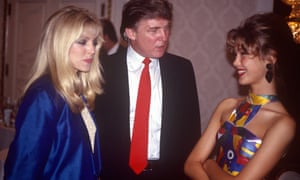
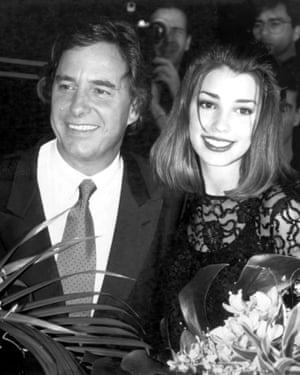
Top: Trump with his then fiancee Marla Maples (left) and a contestant in the 1991 Look of the Year competition
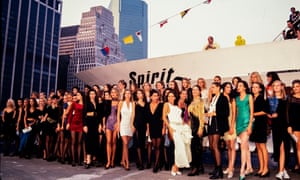
Bottom: contestants wait to board the Spirit of New York yacht, September 1992. Photograph: Nina Berman/NOOR
Another contestant, who was 15 at the time, also remembers being asked to walk for Trump, Casablancas and other men on the boat in September 1992. She says an organiser told her that if she refused, she would be excluded from the competition. “I knew in my gut it wasn’t right,” she recalls. “This wasn’t being judged or part of the competition – it was for their entertainment.”
While Elite’s official brochure stated that contestants were aged between 14 and 24, all of those the Guardian has spoken to, competing in both years, were aged between 14 and 19. Some had come to New York with parents or chaperones in tow; others were alone. Many were away from their families for the first time. For them, the stakes were high, and the pressure to impress the judges great. As Casablancas had warned them at the outset of the competition, in a scene recorded by TV cameras: “You are going to be judged, constantly judged.” (In 1991 and 1992, the Elite contest was filmed for a 60-minute glossy television special, featuring interviews and behind-the-scenes footage, and later screened on Fox – an early foray into reality TV.) Casablancas was a powerful figure in the industry, and to many of the new crop of would-be supermodels, this seemed an opportunity too good to miss.
Three decades on, a very different picture of the competition is beginning to emerge. Over the last six months, the Guardian has spoken to several dozen former Look of the Year contestants, as well as industry insiders, and obtained 12 hours of previously unseen, behind-the-scenes footage. The stories we have heard suggest that Casablancas, and some of the men in his orbit, used the contest to engage in sexual relationships with vulnerable young models. Some of these allegations amount to sexual harassment, abuse or exploitation of teenage girls; others are more accurately described as rape.
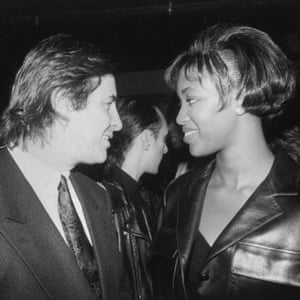
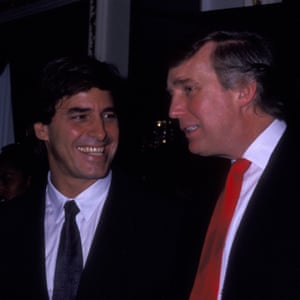
Top left: John Casablancas with Naomi Campbell, who co-presented the 1991 Look of the Year finale. Photograph: Bettina Cirone/The LIFE Images Collection via Getty Images
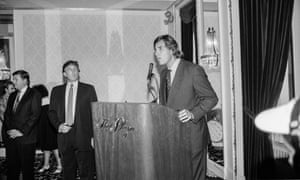
Top right and bottom: Trump with Casablancas, at Trump’s Plaza hotel in New York, venue for the 1991 Look of the Year awards. Photograph: Ron Galella Collection via Getty Images
No such allegations have been levelled against Trump, who at the time was dating Marla Maples, the woman who in 1993 became his second wife. But his close involvement in the contest raises questions for the president. Did he know that Casablancas and others were sleeping with contestants? Why would a man in his 40s, whose main business was real-estate development, want to host a beauty contest for teenage girls?
Journalists have scoured almost every corner of the 45th president’s life, but his friendship with Casablancas, and his involvement in Look of the Year in 1991 and 1992, have been largely overlooked. Yet the competition is more than a footnote in the Donald Trump story. In time, it would prove to be the foundation of his pivot into reality TV. He even married a former Look of the Year contestant: the current first lady, Melania Trump, narrowly missed out on a trip to New York in 1992, after coming second in the Slovenian heat.
When John Casablancas arrived in New York in 1977, aged 35, he quickly caused a stir. Branded “the snatcher” for poaching models from rivals for his Elite Model Management agency, he gained a reputation as a ruthless operator. Handsome and charismatic, the son of a former Balenciaga model and a wealthy Spanish banker, he formed the agency that became Elite in Paris in his late 20s. Within years of setting up shop in New York, Casablancas was generating millions of dollars in revenue each year, and ushering in the era of the supermodel. Glamorous friends flocked to Elite parties in fashionable clubs like Studio 54.
It’s not clear how Casablancas first met Trump but, according to several former models who encountered him during the 1980s, the businessman became a regular at his parties. With the opening of Trump Tower on New York’s Fifth Avenue in 1983, and the acquisition of the Mar-a-Lago resort in Florida in 1985, Trump had gained the reputation of a high-flying playboy in his own right. In 1987 he published The Art Of The Deal, and a flurry of publicity followed. “He sits atop a $3 billion empire,” proclaimed the Washington Post, “and seems to have a Midas touch.”
It was perhaps unsurprising that Trump, a New York celebrity who liked to date beautiful women, should come to know the city’s best-known model agent. “Trump was good with PR and that was something John liked,” says Jeremie Roux, who now runs System, a modelling agency he cofounded with Casablancas in 2009. “Good or negative press was all good to Trump.”
Patty Owen, an Elle and Cosmopolitan cover star, recalls seeing Trump at Elite parties as far back as 1982. “He would always be at the bar. That’s where he would stay and that’s where all the new models would hang out,” she says. “Whenever I saw him, I was always like: why does John have to invite him?” Barbara Pilling, also then an Elite model, told us Trump asked her out for dinner in the summer of 1989 at an industry soiree. She recalls Trump asking how old she was. “I said 17 and he said, ‘That’s just great – you’re not too old, not too young.’”
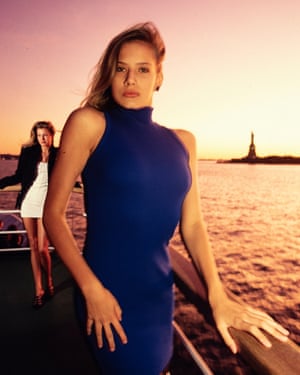

Top: Stacy Wilkes on the Spirit of New York in 1991, with that year’s winner, Ingrid Seynhaeve. Photograph: Nina Berman/NOOR
Bottom: Shawna Lee (second from right) with other contestants at the 1992 Look of the Year competition
Speaking to the Guardian, four former Elite models say that in the late 80s or early 90s, when they were teenagers, the agency required them to attend private dinners with Trump, Casablancas and sometimes other men. One was Shayna Love, an Australian model who was 16 when she came to New York for the first time in the summer of 1991. Recalling a dinner she attended, she says now: “It was presented as our duty as models at the agency. It wasn’t an invitation. It was like, you have to go and do this.” She says the dinner she attended, at which 10 or 15 models were present, was served at a long table in a private area of an upmarket restaurant. “I was at one end with John, and Trump was up the other end… surrounded by the other girls.”
In the spring of 1991, Trump and Casablancas struck a business deal. Trump would sponsor Look of the Year’s final and host contestants at the Plaza, which would double as the headquarters. At the time, Trump faced significant financial pressures and was close to filing for Chapter 11 bankruptcy, but it didn’t seem to deter him. In the newly unearthed, behind-the-scenes footage of Look of the Year 1991, Trump makes a series of appearances alongside Casablancas, whom he describes as “my friend John”. At one point, Casablancas reveals how he and Trump struck their business partnership. “I had prepared for a long meeting with Donald Trump to explain to him why this was going to be a great success,” Casablancas tells the crowd. “In fact, I hadn’t finished my third sentence and he said: ‘I love the idea. Let’s do it.’”
Trump now disputes being friends with Casablancas. The president’s representatives told the Guardian that he denies it “in the strongest possible terms”. Trump, they said, “hardly knew him, spent very little time with him, and knew very little about him”.
Stacy Wilkes had never been anywhere like the New York Plaza when she arrived at Trump’s hotel with another contestant in September 1991. Then 16, she was living in Louisville, Kentucky, with her mother, who was struggling to make ends meet. The teenager would hold yard sales and mow lawns to make extra cash. “I was just so excited to be in a hotel,” she says. “To go from a poor part of Kentucky to a place like this – I felt like the little kid in Home Alone.” She recalls feeling out of place in a hotel where “everything was gold”.
The teenager had been selected as part of a sprawling international search, overseen by Casablancas, for “new faces”. Many contestants had come through feeder competitions after winning regional heats, or being spotted in malls and hotel lobbies or, in one case, on the beach. Casablancas had visited Wilkes’ local mall to host an Elite scouting event a year earlier, when she was 15. Her local agent had sent her to meet him, telling her what to wear and how to act. She says: “I was told to put my hair down in front of my face and then, like, whoop it around and look up at him.”
One year later, Wilkes was among those met at the airport by a scrum of photographers, and whisked into limousines – a supermodel welcome. “That was kind of neat,” she recalls. The contestants assembled beneath crystal chandeliers at the Plaza to meet Casablancas. He told them they would be judged over several days ahead of a gala evening, when the winner would be crowned. The girls would undergo makeovers and attend photocalls, donning spandex for an exercise routine in front of the Plaza. The behind-the-scenes footage shows Casablancas informing the would-be models that attention would be paid not just to appearance, but to “the way you are, your attitude, your personality, your sense of cooperation”.
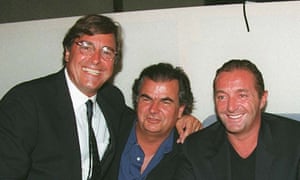
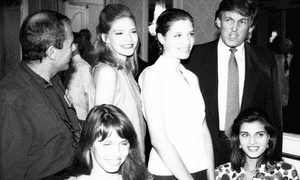
Top, from left: John Casablancas, photographer Patrick Demarchelier and Gérald Marie, head of Elite’s Paris office and a 1991 Look of the Year judge. Photograph: FameFlynet.uk.com
Bottom: Donald Trump with contestants in the 1991 Look of the Year competition, the year he was a judge
At 16, Wilkes was one of the older contestants in Look of the Year. The 1992 Fox documentary reported that the average age was 15, and the film’s interviews make the youth of many contestants plain. Standing before the judges for the key swimwear round, the aspiring models are asked to tell the panel about themselves. “I sing and love animals,” says one girl, nervously. Another tells the judges: “I like big dogs and chocolate.” Later, during a photoshoot, a photographer instructs a 15-year-old to show more of her cleavage by pulling her bra lower. “More,” he tells her. “More. More.”
In 1991, there were 10 judges in total, eight of them men, including Trump, Casablancas, the celebrity magician David Copperfield, and the president of Elite’s European division, Gérald Marie. For the swimwear round, judges including Trump and Casablancas sat at a table in one of the Plaza’s palatial rooms, rating the teenage models. “I felt so uncomfortable, standing there in my bathing suit,” recalls Wilkes. She says that at one stage of the contest the judges said she should lose weight: “It felt like they were ganging up on me.”
The contestant who came third in 1991 was Kate Dillon, then 17. Dillon, who went on to become a successful plus-sized model, says that many of her fellow competitors were “from places that were very poor. I came from a family that had means, so it was something fun to do for a week to get out of school – but a lot of these girls were desperate.” She recalls various “after-hours” events over the course of the five-day competition. “It was very clear that there were opportunities to go out and party with Donald,” she says. The contestants were led to believe “that if you were nice to certain people, good things will happen to you, and I think that’s why girls were going out”.
The behind-the-scenes footage seen by the Guardian shows brief snippets of the future president mingling with the Look of the Year models. At an evening reception, he seems to play the role of host, moving regally around the Plaza’s ornate rooms in a suit and tie, talking to VIP guests and contestants. “How’s the Canadian contestants?” he asks, before moving over to a handful of Canadian would-be models and introducing himself. At another point, he circulates on the top deck of the Spirit of New York as the boat prepares to depart. Wearing a billowing cream blazer, pink open-neck shirt and oversized baseball cap, Trump grins while posing for photographs and chatting to several girls. One tells him she is just finishing school.
Some former contestants recall him being there as they got dressed for events. “Every time we changed, it was like Trump would find a reason to come backstage,” Wilkes says. A Canadian contestant from 1992 recalls similar incidents. “He’d come by and say, ‘Hey girls, are we ready?’” she says. “I remember thinking, what have I got myself into?” Trump denies, “in the strongest possible terms”, behaving inappropriately with any Look of the Year contestants. His representatives say he was not aware of any predatory environment at the time.
Others, however, observed a disturbing side to the contest. Ohad Oman, a young reporter for a magazine in Tel Aviv, was sent to cover it in 1991 and 1992. He attended a number of the after-parties, and remembers seeing girls drinking alcohol. He recalls one particularly debauched party, telling the Guardian: “I saw girls sitting on guys’ laps, and I remember one guy putting his hand down a girl’s top. I remember thinking they were younger than me, and I was 17 going on 18.” (The legal drinking age is 21 in the US.)
Others who were present recall underage models being served alcohol at the contest. Trump’s representatives say he did not provide alcohol to contestants, or encourage any models, whether below the drinking age or not, to drink alcohol, stressing he “does not drink alcohol and does not encourage others to do so”.

A still from previously unseen footage of the 1991 Look of the Year finale
The finale of the 1991 competition was a glittering black-tie gala in the Plaza’s ballroom. Casablancas and supermodel Naomi Campbell presented, as 10 finalists went through a series of costume changes, walking across a stage decorated with columns of sunflowers. Trump sat on the front row alongside a roster of celebrities, his nine-year-old daughter Ivanka perched on his knee.
Ingrid Seynhaeve, an 18-year-old from Belgium, was crowned the winner. As the evening drew to a close, Seynhaeve was surrounded by photographers. Guests filtered out of the ballroom as a party got going in another of the Plaza’s grand rooms. In the newly uncovered footage, a man can be heard off-camera, saying: “Come on, babes. Let’s get some liquor in you.”
In the months before and after the contests, Elite sent several of its teenage models to Milan, New York or Paris on assignments, usually by themselves. Shawna Lee, the 14-year-old from Canada who felt pressured to perform on the Spirit of New York in 1992, had spent the previous summer in Paris, working for Elite. She recalls days at castings, and nights out partying, including at the legendary Les Bains Douches nightclub.
After one drunken night at the club, one of the first times she had drunk alcohol, she says a senior executive at Elite offered her a ride home on his motorbike. Gérald Marie, then in his early 40s, was head of Elite’s Paris office, a powerful figure in the fashion industry and a 1991 Look of the Year judge. Lee accepted the offer. “I was like, OK, sure, because I was always relying on whoever to get me home,” she says. But she alleges that, rather than taking her home, Marie brought her to his apartment and told her to come to his bedroom. Lee says she initially refused, asking about his wife. She says Marie responded: “Oh no, just come and sleep in the bed with me, don’t worry,” and she relented. “So I don’t know, I just went.”
Lee says the #MeToo movement has emboldened her to talk about what happened next. It was her first sexual experience. “I just froze,” she says. “I really didn’t know what to do.” Looking back 30 years later, she feels she was taken advantage of. “I just felt really pressured,” she says. “I was really young and I was manipulated.” She told a friend what had happened, and this soon got back to Elite’s agents. “They all knew something went down, but they downplayed it,” says Lee, who is now 42 and works as a makeup artist in Toronto. “It was just understood that it was in my best interest to walk away from it and brush it under the rug.”
Questions about Marie’s alleged mistreatment of teenage models are not new. In 2000, New York magazine reported that two of Elite’s senior women executives had pleaded with both Casablancas and Marie to stop sleeping with underage models, but had been ignored. (“We are men,” Marie reportedly said. “We have our needs.”) In 2011, the Elite supermodel and actor Carré Otis alleged that Marie had repeatedly raped her when she was a 17-year-old model in Paris in the 1980s. Two years ago, another Elite model, Ebba Karlsson, accused Marie of raping her when she was 21.
Marie did not respond to a formal letter from the Guardian, but in a brief phone call insisted he had never sexually assaulted any models, and denied the specific allegations levelled against him by Lee. “It’s absurd, I don’t know this person,” he said. “Allegations like this are becoming too easy to make. Frankly, it hurts.”
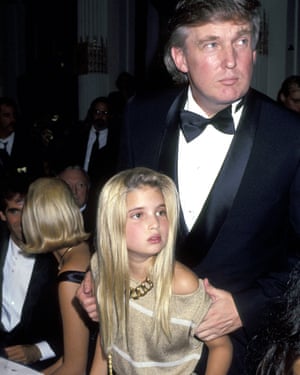
Trump with his nine-year-old daughter Ivanka at the 1991 Look of the Year final. Photograph: Ron Galella Collection via Getty Images
Other men closely involved in Look of the Year during this period have been accused of sexual misconduct by former contestants. Some allegations are contained in legal proceedings filed decades ago; others have been shared for the first time with the Guardian. The newspaper has decided not to publish some of these allegations, at the request of the women involved.
One allegation already made public concerns David Copperfield, an associate of both Casablancas and Trump, who judged Look of the Year in 1988 and 1991, and once dated another Elite supermodel, Claudia Schiffer. Two years ago, as the #MeToo movement reverberated through the entertainment industry, he was the subject of allegations by Brittney Lewis, a 17-year-old contestant in the 1988 Look of the Year, held in Japan. According to her account, published on the entertainment news website The Wrap, Copperfield invited her to a show in California after she had returned home to Utah. Lewis alleged that she saw Copperfield pour something into her glass and then blanked out, but says she retained hazy recollections of him sexually assaulting her in his hotel room. Copperfield stated on Twitter at the time that he had been “falsely accused” in the past, and was now having to “weather another storm”. He added: “Please for everyone’s sake, don’t rush to judgment.” In response to the Guardian’s questions about the alleged assault, his representatives said that the claims were false and seriously defamatory.
Several of the 1991 contestants recall Copperfield behaving in a way that now strikes them as inappropriate. Stacy Wilkes says Copperfield called the hotel room she was sharing with another 15-year-old contestant, inviting the other girl to his room. Another remembers translating a phone call from Copperfield into Spanish so he could invite a teenage contestant to his hotel room. Aimee Bendio, who was a 14-year-old Look of the Year contestant in 1991, says Copperfield and his assistant contacted her at her family home several times after she took part in the contest, “checking in to see how my career was going”. She says the magician invited her to his shows, offering to send a limousine, but she declined.

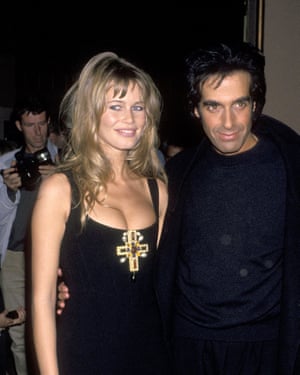
Top: magician David Copperfield on the Spirit of New York in 1991, the year he was a judge
Bottom: Copperfield with former girlfriend Claudia Schiffer. Photograph: Ron Galella Collection via Getty Images
Maya Rubin, a 16-year-old contestant in 1991, says Copperfield approached her on the Spirit of New York. “I told him I’m from Israel,” she recalls. “He said to me that his mum always wanted him to marry a Jewish girl.” Months later, she says, the magician sent her a Christmas card. Copperfield categorically denies behaving inappropriately with any contestants at any time.
In the early 90s, Look of the Year contestants who secured modelling contracts with Elite were introduced to a fledgling financial advisory firm, Star Capital Management. It was run by an associate of Casablancas, David Weil. Housed at Elite’s Manhattan offices, and an official sponsor of Look of the Year, Weil’s company advertised its services in the 1991 competition programme with a photograph of a small girl dressed in adult clothing and jewellery, alongside the marketing line: “Just like you, we’re not just another pretty face.”
By the following year, Star Capital Management was handling millions of dollars earned by Elite’s models. The business soon caught the attention of federal authorities, who later accused Weil and his business partner of stealing at least $1.2m from their clients. In 1998, Weil pleaded guilty to federal fraud charges. He also pleaded guilty to the statutory rape of a 15-year-old model he had met at Look of the Year in 1992.
Weil was sentenced to serve weekends in prison for three months, and required to register as a sex offender for 10 years. Mark Lawless, a New York lawyer who brought a civil fraud case against Star Capital Management on behalf of the 1991 Look of the Year winner Ingrid Seynhaeve and others, says that when he inspected its office, he found an adjoining bedroom. One of the desk’s drawers, he recalls, contained “bullets and condoms”. Weil declined to comment when contacted by the Guardian.
Four years after Weil’s conviction, in 2002, Casablancas faced his own set of accusations in the civil courts. A former Look of the Year contestant, known only as Jane Doe 44, filed a lawsuit accusing him of repeatedly sexually abusing her, beginning when she was 15. The abuse began, according to the lawsuit, at Look of the Year 1988 in Japan, where Casablancas told Doe he was “falling in love” with her. At the end of the competition, the lawsuit states, “contestants drank and partied late into the evening” and Casablancas told the teenager to come to his hotel room. There, Casablancas sexually abused the girl “several times over the evening”. The abuse allegedly continued the following year; when the girl became pregnant, Casablancas told her “she would be having an abortion”. The abortion was allegedly “arranged and paid for” by Elite. Casablancas was 46 at the time.
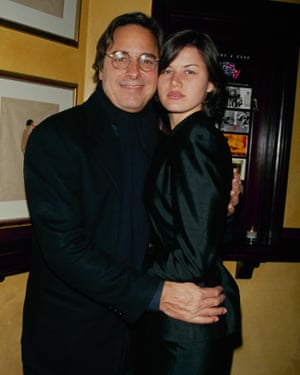
John Casablancas with his third wife, Aline Wermelinger, in 1995; they met when she was a 1992 Look of the Year contestant. Photograph: The LIFE Picture Collection via Getty Images
The lawsuit also alleged that Casablancas “engaged in a pattern of seducing, sexually exploiting and/or abusing minor girls, including girls as young as 14 or 15 years old”. But in 2003, the Los Angeles superior court dismissed the claims against him because he did not live in California, where it had been filed. At the time, a lawyer for Casablancas said the allegations were without merit.
Trump’s representatives have told the Guardian he denies in the strongest possible terms having any knowledge at the time that Casablancas allegedly engaged in sexual relationships with Look of the Year contestants, including those who were under the age of consent, or that Casablancas allegedly enabled others to exploit or abuse teenage models.
But Casablancas’ sexual interest in teenage girls predated this period. His marriage to his second wife, Danish model Jeanette Christiansen, ended in 1983 when it emerged that he was having an affair with a 15-year-old model, Stephanie Seymour. Casablancas, who was in his early 40s at the time, later described Seymour as a “woman-child”. He met his third wife, Brazilian model Aline Wermelinger, in 1992, when she was a Look of the Year contestant staying at Trump’s Plaza. They married the following year; Casablancas was 51 and she was 17.
By his own account, Donald Trump got to know financier Jeffrey Epstein in the late 1980s. “He’s a lot of fun to be with,” Trump famously told New York magazine in 2002. “It is even said that he likes beautiful women as much as I do, and many of them are on the younger side.” After Epstein was charged with the sex trafficking of underage girls last year, the president distanced himself, telling reporters he knew the financier “like everybody in Palm Beach knew him”, but hadn’t spoken to him in 15 years. “I was not a fan of his, that I can tell you,” he said. Trump’s representatives told the Guardian that he had “kicked Mr Epstein out” of Mar-a-Lago for acting inappropriately towards staff.
Photographs of Trump with Epstein, who owned a house near Mar-a-Lago, were widely circulated in the wake of the financier’s arrest last year. Renewed attention was also given to a deposition by Virginia Roberts Giuffre, who said she was first approached by Epstein’s friend, the British socialite Ghislaine Maxwell, while working as a spa attendant at Mar-a-Lago in 1999.
It also appears that Epstein had a Casablancas connection during the 1990s. According to a lawsuit filed in the US three months ago, in 1990 Casablancas sent a teenage model for her first “casting call” at a residential address on New York’s Upper East Side, to meet a “photographer” who, it turned out, was Epstein. The lawsuit states that Epstein ordered the 15-year-old girl to undress before taking photographs of her, pushing her against a wall and sexually assaulting her.
George Houraney, a businessman whose American Dream Calendar Girls beauty contest had been running in Las Vegas casinos since 1978, recalls encountering Epstein at Mar-a-Lago in January 1993. Houraney says that Trump asked him to organise a party that month with some of his pageant’s finalists, promising to invite heads of modelling agencies and prospective sponsors for his competition. “He had me fly in all these girls, and gave me a $30,000 budget for airfares and limos to pick them up at the airport,” he says. “The girls were all decked out, expecting to meet all these VIPs.” But after an hour at the party, Houraney says, there seemed to be only one other guest: Epstein. “I was like, ‘Donald, where are the guys? What’s going on here?’ And he said, ‘Well, this is it.’” Houraney says he realised “this is a Jeff Epstein party, basically”.
While suspicious of Epstein, Houraney was keen to have Trump as a business partner. A month earlier, in December 1992, Trump had met with Houraney and Jill Harth, who ran the pageant together. They were looking for a new sponsor for their contest, which each year saw models aged 16 to 22 compete to appear in wall calendars wearing bikinis and swimsuits while posing with classic cars. At dinner in the Plaza’s Oak Room, Harth, Houraney and Trump discussed moving the American Dream competition from Las Vegas to one of Trump’s casinos. “He wanted to build this into the biggest, the best thing that he could do. He was talking about television and pulling out all the contacts,” Harth later said. Eventually, the pageant was held at Trump Castle in Atlantic City in November 1993, but for one year only.
The partnership soured and ended in two lawsuits, but for Trump it was a prelude to a series of more lucrative ventures in the beauty business. In 1996, he secured what the New York Daily News described as “his most beautiful deal yet”. After months of negotiations, Trump acquired the Miss Universe Organization in a reported $10m deal that handed him control of three large, well-established pageants: Miss Universe, Miss USA, and Miss Teen USA. Three years later, he founded Trump Model Management, poaching many staff from Elite.
For Wolfgang Schwarz, a veteran model agent in Austria who worked closely with Casablancas, and met Trump at the Plaza in the early 90s, Trump’s decision to establish his own agency was about him wanting his own private source for models. “If you have your own agency and you’re the owner, you can tell your bookers to make a party,” Schwarz says. “It’s easier than calling 15 agencies in New York.” Trump’s representatives say he entered the modelling industry because it was a “very profitable” business opportunity.

Top: Kate Dillon, in behind-the-scenes footage from the 1991 contest
Bottom: Casablancas with 1992 Look of the Year winner Mariann Molski, then 14. Photograph: Everett Collection/Alamy
The Miss Universe deal allowed Trump to realise his ambition of turning a pageant into an international televised event. In 1997, he sold a 50% stake in the business to CBS. Five years later, amid a slump in the Miss Universe ratings, Trump brokered a deal with NBC that led to the launch of The Apprentice in 2004.
The move into reality TV positioned Trump as a heavyweight tycoon with a significant media profile. In many ways, it was a natural progression from his involvement in beauty contests and pageants. Where once he had judged young models, whose hopes, rivalries and insecurities became TV storylines in Fox’s Look of the Year documentary, now he was ruthlessly separating aspiring business people into winners and losers.
Three decades on from the contests at Trump’s Plaza, it is striking to reflect on the diverging fortunes of those who attended. Many of the powerful men Casablancas brought on board to help judge the girls thrived in the years that followed. Gérald Marie is now the chairman of a prestigious model agency in Paris, Oui Management. Although Marie told the Guardian he had retired, his LinkedIn page lists his responsibilities at the “thriving newcomer” agency as scouting for and managing talent. Oui Management did not respond to our request for comment. David Copperfield remains a prominent entertainer, with a current residency at the MGM Grand resort in Las Vegas.
The fortunes of the teenagers who took part have been mixed. Some became successful models, Hollywood actors and TV hosts, while many more lived quieter lives. Ingrid Seynhaeve, the 1991 winner, became a face of Ralph Lauren and Dior, hosted Belgium’s Topmodel TV show, and continues to front high-profile campaigns. Other contestants we spoke to include a beautician, a stay–at–home mother, a makeup artist, a yoga teacher and a bus driver.
In 1992, the crown went to one of Look of the Year’s youngest contenders: 14-year-old Mariann Molski. Months after her victory, a profile in the Chicago Tribune reported that the sporty high school student was “on the brink of a career of a kind that most young women only dream about”. While she had some success as a model, it is not clear what happened to her in the years that followed; US public records indicate multiple arrests for probation violations, alcohol offences and prostitution, though there is nothing to say she was ever charged. Molski’s current whereabouts are unknown, but she is believed to have been homeless in Arizona.
After years of financial mismanagement, Elite was forced into bankruptcy in 2004. The Elite brand continues to be used by two separate agencies, owned by different corporate entities. One is Creative World Management, which bought the New York division in 2004. It strongly distances itself from the Casablancas-owned firm and era, saying it “utterly” condemns the kinds of “deplorable behaviour” alleged to have taken place in the past.
The other inheritor of the brand is Elite World Group, which operates the successor to Look of the Year, a similar global contest for the next top young model, called Elite Model Look. It, too, distances itself from the Casablancas era. “We would have no tolerance for the conduct you’ve described,” the company told the Guardian. “Empowering our models and protecting their safety is our foremost priority.”
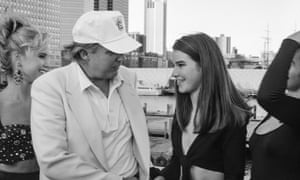
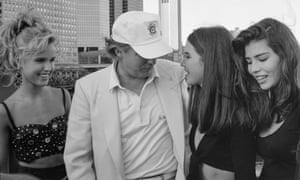
Donald Trump with contestants in 1991’s Elite Look of the Year
John Casablancas retired in Brazil in the early 2000s. He died in Rio de Janeiro in 2013, aged 70, long before the #MeToo movement heralded a new standard of accountability for powerful men accused of exploiting women and girls. He never got to see his old associate Donald Trump ascend to the White House, despite a cascade of allegations about Trump’s own treatment of women. There are now at least 25 sexual misconduct allegations against the president, ranging from unwanted advances and harassment to serious sexual assaults. More than half relate to models or pageant contestants. Trump denies that he has ever behaved in a predatory or inappropriate fashion with any women or girls.
Speaking to the Guardian 30 years on, several former Look of the Year contestants feel that a #MeToo moment for the modelling world is long overdue. “The girls are young and they look at these agents like parental figures, and they’re not,” says Shawna Lee. “Anything they say goes, whether it’s ‘Go cut your hair’, ‘Go wear this dress’. It’s too bad that there were not more consequences for these men.”
After Look of the Year 1991, Stacy Wilkes returned to Louisville and quit school, despite having told the judges she would finish. “I thought that was the reason I lost,” she says, “so I might as well leave if I want to make it as a model. We were really broke, so I thought I’d try and make money for my mom, but it didn’t work out.” She is content with the path her life took, living in Louisville with her partner and three cats, but adds that women were raising concerns at the time and were ignored: “I think models from the 90s tried so hard, over and over, and nobody believed what we had to say.”
Kate Dillon, now a businesswoman living in Seattle, remembers the contest as one that “exploited women’s assets, women’s bodies. A lot of these girls were desperate. They thought modelling was about attracting men, which it isn’t.” There was a climate of opportunism, she says. “There’s no doubt that the men were like, ‘Yes, Look of the Year week, let’s make sure my schedule is clear to have chicks over to my apartment.’
“What’s great is that we now have a language, and a precedent of young people saying: ‘No, I’m not going to let this continue’,” Dillon adds. “They would never accept being treated the way I was.”
• If you would like your comment on this piece to be considered for Weekend magazine’s letters page, please email weekend@theguardian.com, including your name and address (not for publication).
The Guardian will continue to investigate the issues raised in this story. If you have new information, email investigations@theguardian.com, or use Signal or WhatsApp to message reporters in the (UK) +44 7584 640566 or (US) +1 646 886 8761. For the most secure communications, use SecureDrop or see our guide.