Tim Lang, Britain’s leading expert on food policy, says we already faced a challenge unmatched since the war. And things just got worse…


Tim Lang likes to take the long view. A conversation with the internationally renowned professor of food policy at London’s City University will roam in detail from the repeal of the Corn Laws, through Brexit and back again, the narrative seasoned with detailed facts and figures. It’s why he has been a consultant to the World Health Organization, special adviser to four House of Commons select committee inquiries and a food policy adviser to the Department for Environment, Food and Rural Affairs. So when he says in his new book, Feeding Britain, that, “although not officially at war, the UK is, de facto, facing a wartime scale of food challenge”, it’s worth paying attention. We are, he says, in serious trouble.
And yet, he says, all of that masks a bitter reality: we have a massively fragile just-in-time supply chain which could easily collapse; a depleted agriculture sector which produces only around 50% of the food we actually eat, leaving us at the mercies of the international markets; and production methods which are damaging to the environment and human health. “When I looked at the numbers on inequality,” he says, “I was shocked. There’s a staggering gap between rich and poor in terms of wealth and income and therefore access to food.” As he says: “Food is the biggest driver of NHS spending as a result of obesity, diabetes and heart disease.” Food may look cheap, he adds, but too much of it creates vast, unsustainable costs elsewhere.
His doorstep of a book attempts both diagnosis and cure. Consciously, it pushes the impact of Brexit to one side to get at the underlying dysfunction. Likewise, we agree to discuss the implications of coronavirus later. Nevertheless, he says, it all amounts to the same thing. “There is a mismatch between human need, the food system and its outcomes.”
At the heart of this crisis is a British willingness to let a small number of corporations dominate food retailing: just eight companies control 90% of our food supply. “It’s the ‘leave it to Tesco’ approach,” he says. The prioritisation of price has hollowed out UK agriculture, so that primary producers get the smallest slice of the cake. “They get about 5% or 6% of the value of the food we buy. They need double that. And that 50% self-sufficiency should be nearer 80%. Not out of nationalism, but so we are in a position to contribute globally. We have a default position of assuming someone else will feed us.”
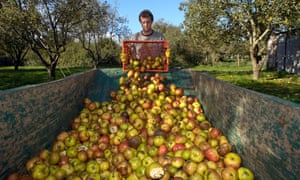
The book comes freighted with eye-popping data. For example, of the six million hectares of cultivatable land in Britain, only 168,000 hectares are used for fruit and vegetables. As a result, we have to import vast amounts of crops we could otherwise be growing. Much of the remaining land is used for crops to feed livestock or for processed foods.
He’s at pains to acknowledge that he is not the first person to raise these issues. He first became interested in the subject in the 1970s when, having just completed his social psychology PhD, he started farming in Wales. He came across a book called Our Food Problem and Its Relation to Our National Defences, published in 1939. One of its authors was Frederick Le Gros Clark, a sometime children’s writer who went on to become an expert in malnutrition. Like Lang, he argued that the British food supply chain was exceedingly delicate and was not serving the health of the nation. The outbreak of war would prove him right. There was also a review of the British food system in 1936 by William Beveridge, later architect of the welfare state, who made similar arguments. “Beveridge was totally ignored,” Lang says.
In the summer of 2019, then Defra secretary Michael Gove announced he was establishing a national food strategy, which was broadly welcomed by the food industry. He put his friend Henry Dimbleby, the co-founder of the Leon healthy fast-food chain, in charge of the review, even though he has no academic credentials in the field. Lang is polite about the classic British choice of a non-expert generalist to lead the review, but he does say that he’s concerned that, like Beveridge, Dimbleby’s review will be ignored when it’s eventually published. “When the new agriculture bill was introduced in January, it had almost nothing about food,” he says.
I suggest this is an old-fashioned 1970s corporatist approach; that he’s proposing a massive expansion of the state to deal with the problem. “I think I’ve been pretty modest,” Lang says. “The British state is failing us by not decentralising.” He also calls for Tesco, which has around 30% of the food retail market, to be broken up, so that no one firm has more than 15%. Likewise, he calls for pension funds to disinvest from manufacturers of ultra-processed foods, as some have started doing with fossil fuels. The list goes on. He insists, however, that this is not some kneejerk leftist manifesto. “We just need to re-engineer how capitalism works for us.”
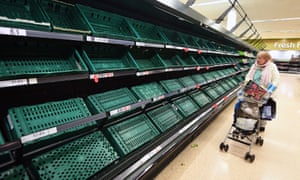
We agree we can no longer ignore the viral elephant both inside the room and outside it. Might the coronavirus crisis help with the re-engineering of our food supply chain? He agrees, sadly, that it might. “It could prove a good reminder of the value of state institutions,” he says. And the emptying of shelves as a result of panic buying may help people to “think about where their food comes from”. He adds: “We need to move from a ‘me’ food culture to a ‘we’ food culture.” It’s a very simple message, but in the white heat of a crisis, defined by queues outside supermarkets, a useful one.
Feeding Britain: Our Food Problems and How to Fix Them by Tim Lang is published on 26 March (Pelican, £25). To order a copy for £21, go to guardianbookshop.com


No comments:
Post a Comment